Software Sales Lead Nurturing Success – A Customer Conversation

Software Sales Lead Nurturing Success – A Customer Conversation

Learn about the 300% Sales Impact Gabriel Sales’ Turnkey Demand Generation Engine drove for a Mobile App and Software Company

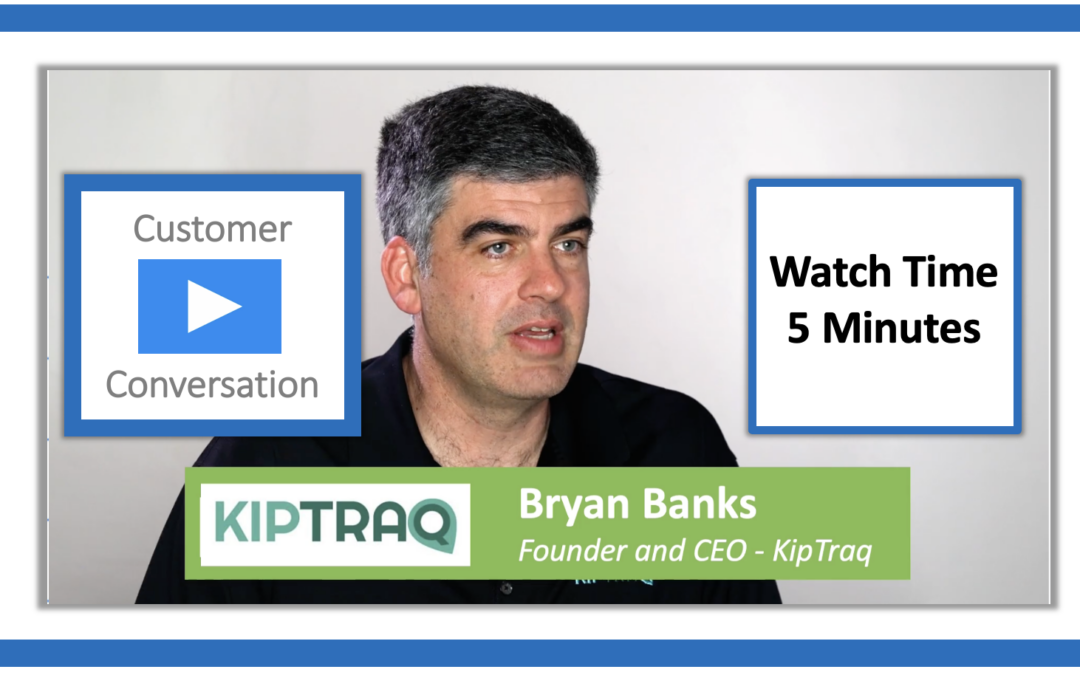
In this short video Digital Demand Center’s client – Entrepreneur and Founder Bryan Banks shares his software sales demand generation and lead nurturing success story.

(Watch Time – 5:00 Minutes)

Software Sales Lead Nurturing Success Conversation with Bryan Banks, Founder KipTraq

Bryan Banks is an entrepreneur that is focused on growing his mobile application and software business with no outside investors.  Bryan was committed to fueling that growth with sales and smart marketing decisions. In this short conversation Bryan discusses how Digital Demand Center:

  • Allowed Bryan to to focus on closing business and product development
  • Kept his funnel full with sales opportunities for his existing sales team
  • Educated his buyers so they were excited to talk to sales 

Excerpts – Software Sales Lead Nurturing Success Highlights

 “I didn’t really to focus on the sales side. I have sales reps for that, and they were doing a pretty good job, but I wanted to give them the tools that they needed to be successful. We wanted to be able to be able to scale this business in such a way that, that we could bring in leads digitally instead of having to go out sniffing for them.  And Demand Center filled that niche for us. We were able to really keep that funnel full.”

“Whenever I go buy something, whether it’s a car or a, a new microphone or, you know, from my computer or whatever it is, I do my research online. I think everybody does that these days.  I wouldn’t go to a,car dealership and, and talk to the salesperson and, and cold and say, – Hey, tell me about, you know, the, the pros and cons of these two vehicles, right? I want to come in as an educated buyer. So the thing that really stuck with me after working with Digital Demand Center is that that’s their goal as well. They want to create Educated buyers.”

“So there are three reasons that I would recommend Digital Demand Center. Number one is they’ve got a great technology stack. They helped us move it from an Excel type process into something where we could, we could scale. Number two is that their staff really work well with our team…, they know what it is, what we do, and they’re able to make recommendations in terms of how we should market this product to our potential customers…the third reason I would recommend them is because they’re really focused on educating our potential buyers. So by the time somebody is actually talking to one of our sales reps, they’ve probably seen a couple and read a couple of our blogs. They’ve watched some videos. And so when we are bringing leads in from the outside and moving them through a funnel where they’re educated, they learn what it is that we offer, they get excited about it. So by the time they actually come and are talking with us, our sales reps and myself, they know what it is they want, and they know that KipTraq is something that they need.”

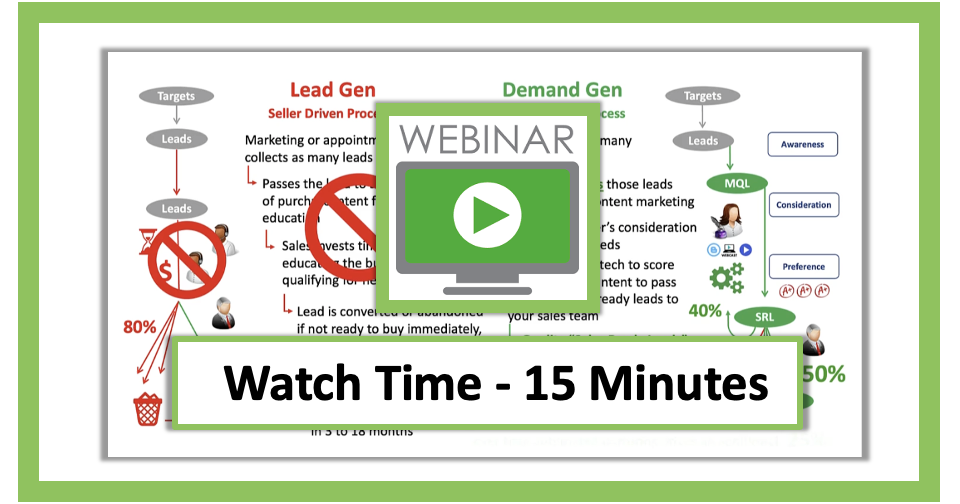
Lead Generation vs Demand Generation Webinar

Lead Generation vs Demand Generation Webinar

Part 4 in our Digital First Transformation Series

The Differences Between Lead Gen vs. Demand Gen and the Impact on Your Sales Funnel

In this Lead Generation vs Demand Generation Webinar, the final in the series, we examine tie it all together to help business owners decide if Demand Generation, Lead Nurturing and Sales Automation is the right fit for their sales process. We discuss the difference between Lead Generation and Demand Generation.  We detail the impact of both on your sales funnel production and cost of sales.  We then explain when you can just use a lead generation process and when you need demand generation.   We explain what types of businesses are an ideal fit for Digital Demand Center™ specifically.  And provide projections our typical customer realizes over the course of 18 months.

(Watch Time – 15:00 Minutes)


Topics Covered in This Lead Generation vs Demand Generation Webinar Include:

  • Clearly define lead generation and demand generation
  • Explain the purpose and limitations of both process
  • Contrast the impact of both on your sales funnel
  • Explain when you should only invest in lead generation
  • Explain what type of sales process needs lead nurturing and pre-sales automation to survive and thrive
  • Clearly define what type of business and sales process gets the best return from demand generation and Digital Demand Center™ specifically
  • How long it takes to launch a demand generation engine
  • Concrete forecasts of the sales funnel production you should expect from Digital Demand Center
  • How to calculate your KPIs and Return on Investment
B2B Buyer Trends

B2B Buyer Trends

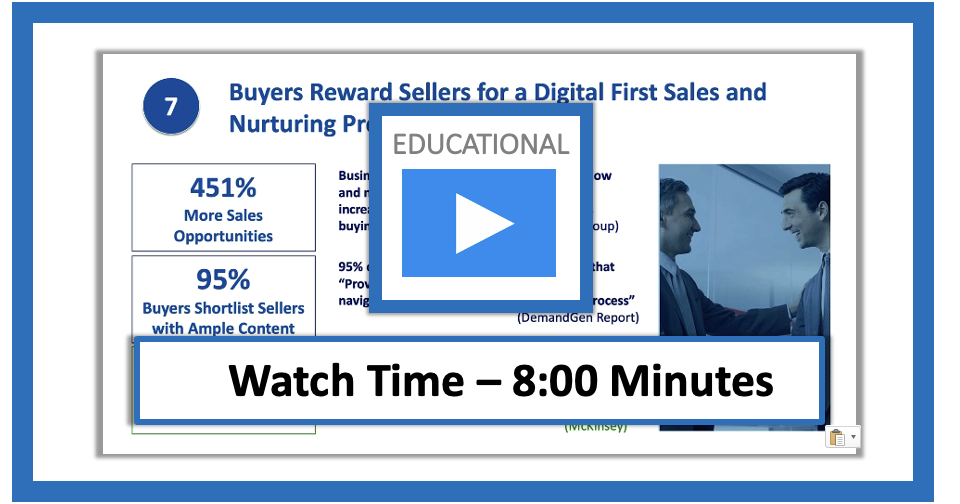
B2B Buyer Trends — Seven Things to Know

(Watch Time – 8:00 Minutes)

Summary of B2B Buyer Trends video

In this short educational  video we will give you a quick overview of B2B Buyer Trends, including:

  1. Why B2B leads and buyers need and want lead nurturing and digital pre-sales education
  2. Why buyers now expect ongoing lead nurturing and content marketing at every stage of their buyers’ journey
  3. The specific types of contents buyers use during their pre-sales education and buying process
  4. Buyers increased desire to avoid sales development reps (SDRs) until they feel educated and are ready to buyer
  5. When video is the most preferred and successful type of content
  6. How far and committed the top sellers are to sales automation and digital first sales
  7. The ROI companies committed to lead nurturing and a digital first sales are experiencing

This video (an expert from our extensive four part On Demand Training Seminar – The Digital First Transformation and Sales Automation)

Transcript of B2B Buyer Trends Seven Trends — Seven Things to Know.

Why Leads/Buyers Need Lead Nurturing

First, most buyers are not ready to buy when they first start their digital education. Initially, most buyers are just trying to figure out how to solve a problem. Less than 3% of initial email opens are ready to buy, and even more surprisingly, less than 20% of your pay per click or SEO leads or active buyers. But the positive here is that about 80% of all these early stage leads, we call them marketing qualified leads, will spend money within three to 18 months. So once they engage, you have a short list of potential buyers that expects you to educate and nurture them for an extended period of time, which means your marketing team can’t just run lead gen campaigns and expect the same sales results.

Buyers Now Expect Ongoing Lead Nurturing and Content Marketing at Every Stage of Their Buyers’ Journey (0:48)

Buyers now expect you to share content at every stage of their buyer’s journey to help them move systematically through their process. This starts by you helping them to identify and understand what problems your solution is designed to help them solve through their shortlisting process and even into their validation and consensus building stages. This means you need lead generation campaigns to create awareness to help the buyer understand what problems you solve. Then buyers also expect you to run nurturing campaigns, including both buyer education campaigns and sales automation campaigns to help them with their consideration stages and their preference stages.

Successful Lead Nurturing and Sales Automation Requires Multiple Types and Formats of Digital Sales Education (1:33)

And during these different types of campaigns, buyers want you to share the appropriate type of content in multiple channels so they can control their own buyer’s journey, and they expect you to be prepared to touch them at least 21 times for you to earn their brand awareness and initial trust in to start that process. Most buyers still overwhelmingly prefer to learn about new solutions in email marketing campaigns that are supported by educational content.

However, if you don’t eventually support these email campaigns with paper per click, social media and SEO campaigns, you’ll miss 33% of the market who prefer these channels. And at this stage, the type of content buyers prefer in all three channels are short. How-to videos, educational blog articles in industry insights and stats that help educate the buyer and also help you to demonstrate thought leadership. Then once that lead is generated, you need to be prepared to share multiple types of content to nurture and create demand for your solution. Because buyers leverage all types of content to move a decision forward if they’re consideration and preference stages to become educated enough to make a decision. So what’s required for success? In a recent Merkel survey of B2B buyer trends, 78% of buyers stated they used case studies and use cases in their process, 76% used webcast educational videos and educational blog articles.

68% used white papers, and in 20 21, 50 4% of B2B buyers are now using podcasts. So you need to be prepared to use a wide variety of content in multiple channels to make it easy for the buyer to buy using your buyer education in sales automation campaigns

Buyers Want to Avoid Sales Development Until They Feel Educated and are Ready to Buyer (3:43)

Perhaps the biggest impact of this digital transformation is that buyers now want to avoid sales reps until they feel educated. As a result of this buyer preference for digital first education, 64% of sellers state, they’re now less dependent on sales reps. 80% of buyers don’t want to speak to an SDR until they have completed their pre-sales research. 33% moving to 44% for millennials want to avoid sales completely if possible, and most buyers won’t engage with a sales rep until they’ve consumed at least six to 12 pieces of content. Digital content is now replacing some of the most time consuming in historical tasks of the sales development rep, first and foremost, being all the time and money it takes for pre-sales education of the buyer.

Video is the Preferred Content for Pre-Sales Education and Mid-Stage Buyer Education (4:33)

And in large part, most of this pre-sales education is now being done with video because when it comes to content, we’re both video and text are available on the same page. 72% of buyers would rather use video to learn about your solution using video and email campaigns boost open rates and clickthroughs and video posts have the highest engagement in social media campaigns. And probably the biggest bonus of video is that it leads to conversions or at least predicts conversions because 25 to 45% of buyers that watch a webcast convert into a sales opportunity, and most buyers state they’re ready to engage with sales after watching three to five videos.

Your Most Successful and Largest B2B Sales Competitors are Already Striving for Sales Automation (5:22)

The next thing that’s important to understand about this transformation is the competitive landscape. So Gabriel Sales has been dealing with tech and tech marketing for a long time, and we’ve seen the pendulum swing back and forth between giving SMBs an ability to compete effectively and giving the enterprise the advantage. And right now, the enterprise companies have an edge because they’ve taken meeting the needs of the digital buyer seriously and have driven digital content deeper into the sales process faster.

This was one of the really big changes that occurred during the pandemic because the enterprise was better equipped to immediately be able to deploy their existing marketing resources to digital marketing to support the virtual and remote sales process, and they were able to fund new technologies faster and more effectively when travel budgets were cut. As a result, 75% are now leading with Digital First to support their entire pre-sales process, and in a few short years, the majority of enterprise companies already believe that these new sales processes are as or more effective than their historical processes. In a full 85% of enterprise companies are now committed to building a digital first go-to-market sales process moving forward. And over the next several years, digital spend is once again predicted to double Gartner’s future of sales. Research is now predicting that by 2025, 80% of B2B sales interactions will occur in automated in digital channels.

To compete for and win business will require a commitment to content marketing and nurturing.

Sellers that Implement Lead Nurturing and Digital First Sales Automation Win More Business and Drive More Revenue (7:13)

Finally, what can your business expect when you embrace this digital first transformation? Buyers are already dramatically rewarding sellers for a digital first sales and nurturing process. Sellers that are committed to content marketing after the initial lead has been generated, see their sales team’s opportunity pipeline grow by over 450% in nine to 18 months. It’s harder to get a seat at the table with your buyers if you don’t provide content after you generate that initial lead. And most importantly, and most exciting sellers that do a good job helping buyers buy digitally are now closing at two x the rate of sellers that don’t.

 

Demand Generation vs Lead Generation

Demand Generation vs Lead Generation

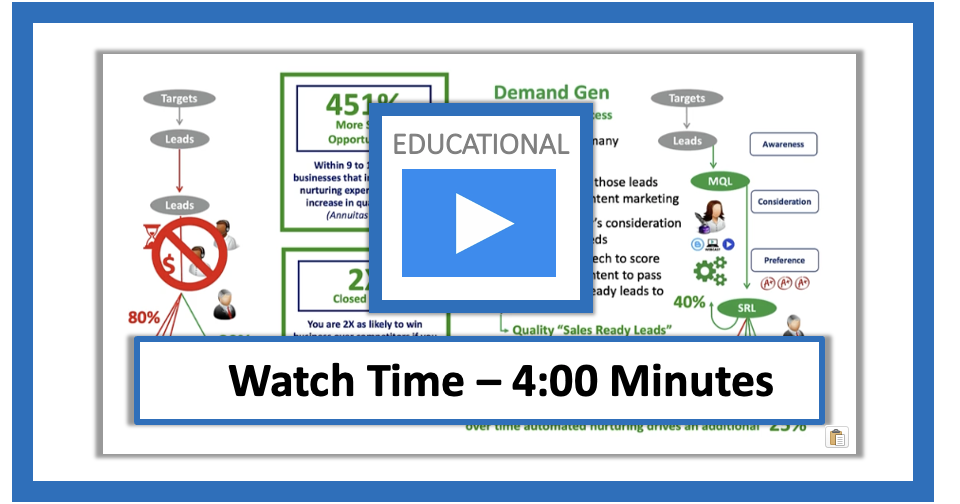
In this video you will learn the difference between lead generation vs. lead nurturing and demand generation

Watch Time – 4:00 Minutes

Summary

This short video is packed with hard data and concrete numbers as we compare Demand Generation vs Lead Generation and explain the strengths and weakness of both a lead generation process and demand generation process.  In this educational video we detail:

  • The different purposes of lead generation and demand generation
  • The results you can expect if you are running a lead generation process
  • The results you can expect if you add a lead nurturing and demand generation process
  • The impact lead nurturing has on creating well educated sales ready leads and increased conversions
  • The cost savings you can expect automating  your pre-sales process  

This video is an excerpt from The Differences Between Lead Gen vs. Demand Gen and the Impact on Your Sales Funnel Part 4 of 4 of our free comprehensive free 4 training seminar on how to effectively sell to the modern The B2B Digital First Transformation Webinar Series.


Transcript

Defining the Role of Lead Generation and Demand Generation

When you examine the entire sales funnel, Lead Generation is the first step in the sales process and buyer’s journey. Lead Generations job is to move buyers into the top of the sales funnel by creating awareness and curiosity about your solution, and then Demand Generation and Lead Nurturing takeover to automate the pre-sales education process as the buyer goes through their second step of consideration and their third stage of preference.

This process keeps you top of mind as the buyer moves deeper into the funnel and, when the buyer is ready, sales takes over to help them make a decision.

The Stages and Sales Funnel Conversion Results of a Lead Generation Process

Lead Generation is primarily a sales driven process because the seller controls the majority of the buyer education. Marketing or a cold caller targets and generates the lead. The lead is then passed to sales regardless of how ready they are to buy. Then sales invests time, money, and resources with one-on-one pre-sales education, demonstrating the solution, explaining its value, and qualifying that buyer for need, interest, and fit.

After all this time and effort, about 10 to 20% of leads are turned into opportunities and about 80% are either not the right fit or too early in their buying process and not ready to buy. These leads are discarded, with sales promising to follow-up at some future date, which only happens about 20% of the time. This is a continuous cycle requiring a continuous investment in new leads.

The Stages and Sales Funnel Conversion Results of a Demand Generation and Lead Nurturing Process

In sharp contrast to Lead Generation, Demand Generation is a buyer driven process because the buyer engages on their timelines.

A Demand Gen process starts the same way by targeting potential buyers to create awareness and collecting as many leads as possible. But then marketing, not sales, nurtures those leads, sharing educational pre-sales content the buyer can engage with on their timelines.

Demand Generation digitally automates your pre-sales process to make it easy for the lead to consider how your solution can help them solve their problems to become a marketing qualified lead until they learn how your product works and what success looks like so they prefer your solution. While all this is happening, your marketing tech stack is scoring your buyer’s engagement to predict purchase intent until they become a sales ready lead.

The first big difference is pre-sales automation and lead nurturing gets rid of all the time, money, and expense of the one-on-one pre-sales education that’s required in a standalone Lead Gen process.

The second major difference is the quality of sales ready leads. Typically, your sales team can convert about 50% of sales ready leads into opportunities versus the 10 to 20% of a Lead Gen process. Sales will only discard about 10% versus the 80% that are discarded in the Lead Gen process.

A final major difference is that they can recycle 40% back into the Demand Gen engine for extended nurturing to keep them warm until they’re ready to buy. This recycling is a major advantage Demand Generation has over a competitor running a Lead Gen process that discards 80% of their lead investment because most discarded leads buy from someone in three to 18 months so nurturing eventually turns another 25% of these recycled leads into opportunities.

Conclusion

Over time, all these incremental gains stack up, and this is why companies running a Demand Gen process generate 450% more opportunities and close two times the deals over their competitors when compared to companies that don’t.

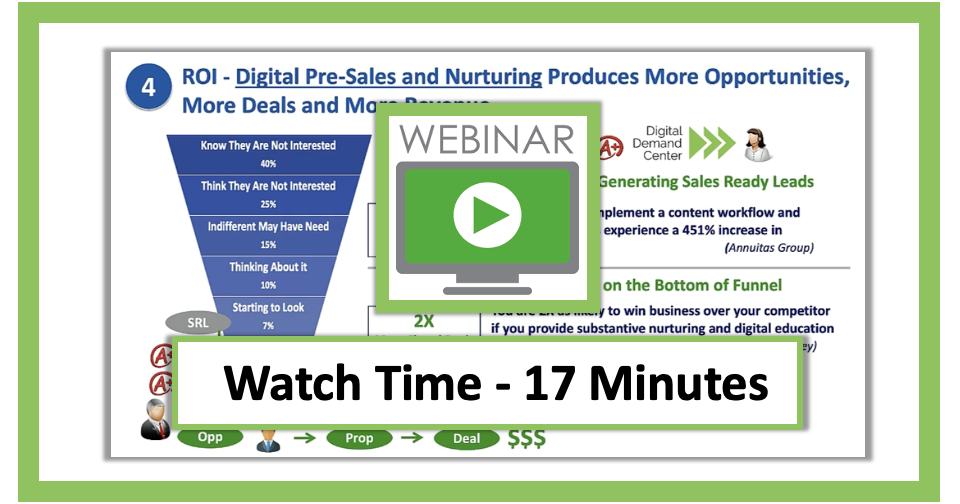
The ROI of Lead Nurturing Webinar

The ROI of Lead Nurturing Webinar

 Part 3 in our Digital First Transformation Series

The Investment Required for B2B Demand Generation and Lead Nurturing Success and the ROI You Can Expect

In The ROI of Lead Nurturing Webinar we will discuss the investment required to build a demand generation a lead nurturing engine. This lead nurturing webinar discusses the budget required to launch your engine including crafting a go-to-marketing strategy,  database acquisition, technology implementation and content production. We then detail the monthly budget to execute awareness campaigns, lead nurturing campaigns and sales automation campaigns. The webcast then shares the Return on Investment you can expect from a Digital First Process when compared to running lead generation campaigns and leveraging Sales Development Reps for pre-sales education. This ROI analysis includes both increased sales production as well as lowering your cost of sales. Finally we wrap up with how you can calculate your Return on Investment.

(Watch Time – 19:00 Minutes)

Topics Covered in The ROI of Lead Nurturing Webinar Include:

This session is broken into four detailed parts to help business owners understand the math in every area of their business and budget.  These areas include: Start Up Budget, Ongoing Monthly, Areas of ROI, and How to Calculate Your ROI.

The Budget Required to Launch a Successful Demand Generation and Lead Nurturing Engine

  • Crafting a Strategy
  • Database Aquations
  • Ad Budgets
  • Content Production
  • Automation Software Stack Implementation

Ongoing Monthly Budget  

  • Marketing and Sales Operations
  • Software
  • Additional Content Production

The Topline and Bottomline Areas Where You Can Expect and ROI (Especially with a Turnkey/Proven Solution)

  • Risk Reward vs. Historical Sales Development Rep Driven Process
  • Software
  • Increased Sales Production
  • Increased Revenue at Lower Cost

ROI Calculation

  • Pipeline Production
  • Cost Savings
  • Increased Revenue