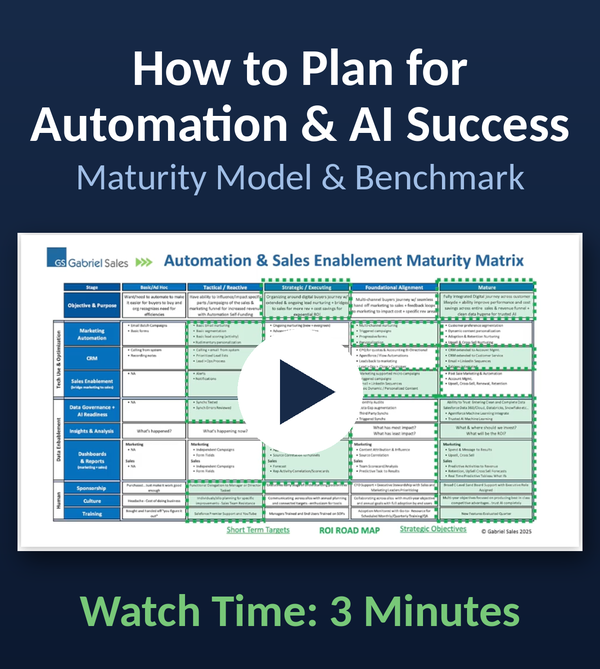
This video “How Does Achieving Successful Automation and Sales Enablement Impact Sales and Marketing Ops”, part 4 in our Full Funnel Mandate Series, explores how new technologies, full funnel automation, and sales enablement is fundamentally changing the requirements for marketing and sales operations teams and the critical need for experienced technical support.
(Watch Time – 7:30)
Summary
How Does Achieving Successful Automation and Sales Enablement Impact Sales and Marketing Ops?
This video explores how new technologies, full funnel automation, and sales enablement is fundamentally changing the requirements for marketing and sales operations teams. We explain how that marketing workloads have tripled due to buyers’ digital-first expectations and resistance to early sales meetings and the critical need for technology expertise to optimize marketing automation stacks, bridge marketing and sales operations gaps, and implement proper data governance for trustworthy analytics and AI implementation.
We then discuss how and why automation must extend beyond go-to-market funnels to encompass the entire customer lifecycle, as Fortune 500 companies work toward automating 80% of B2B sales processes by 2027, forcing organizations of all sizes to adapt to these new digital automation expectations.
Transcript
How Does Achieving Successful Automation and Sales Enablement Impact Sales and Marketing Ops Daily Marketing & Sales Operations
So how does Forrester’s call to action, these new technologies, and full funnel automation and sales enablement impact the daily and strategic requirements for successful marketing and sales operations
The Tripled Workload: Expanded Volume and Scope for Marketing Teams
First, because of your buyer’s digital first expectations and their resistance to meeting with sales reps until they have shortlisted solutions, your marketing team’s volume and scope of work have at least tripled to support your go to market process. Marketing is still accountable for their historical functions of brand management, awareness, and lead generation to generate interest, including strategy and the creation of dozens of assets shared across multiple channels to build recognition and trust.
And then your buyers need to engage with 3 to 5 assets before they convert as marketing qualified leads. Next, the most initial dramatic increase in workload and scope comes from the sustained digital engagement, development, and conversion responsibilities required for successful nurturing and accountability for sales ready leads.
Because this increases the volume and the daily requirements for the constant production, oversight, and execution of campaigns, copy, content, and creative.
To accomplish this, marketing teams need to be ready to digitally educate 6 or more buyers for 3 to 12 months until they are ready to buy with increasingly personalized content for different types of buyers. Success also requires marketing teams to develop lead nurturing workflows with increased campaign execution to share digital content that takes different buyers through every stage of the sales funnel. With the final initial workload increase for your marketing managers and creatives being driven by your buyer’s desire to engage with multiple types of educational content as they move deeper into the sales funnel.
Teams Need Technology Expertise to Support Automation Implementation and Optimization for Improved ROI
The second impact of this shift to automation is that your marketing team needs the support of technology experts with practical marketing and sales process expertise to fully capture all the benefits and ROI possible with automation.
This experienced support can quickly launch customized or fix broken implementations so your team stops wasting time struggling with tech and quickly starts to realize the ROI and the results you were promised when Salesforce and other vendors sold you their software solutions.
Next you gain momentum and maturity. It’s required to optimize technology stacks with proven tactics and best practice workflows so your marketers can focus on their top priorities, while your support team turns your team’s strategies, campaigns, content, and hard work into higher quality sales ready leads that accelerates your funnels.
Marketing Needs to Bridge the Gap to Sales by Aligning Marketing Ops and Sales Ops
Then organizations are required to bridge the gap from marketing ops to sales ops with a seamless handoff so sales can help buyers make a final decision.
Because the marketing team and automated campaigns are doing most of the initial work turning leads into sales ready opportunities at the top and the middle of the funnel, marketing now needs to help support sales productivity. At the bottom of the funnel, managing lists in the CRM of scored and prioritized leads, and they also need to help sales ops implement all the sales enablement tools needed to help their sales team competitively develop and close new business.
Because when marketing bridges the gap successfully, it leads to increased productivity because both sales and marketing are aligned to create connected customer experiences.
Then once all these processes are implemented, both marketing and sales operations need a trusted resource that is staying current with all these rapidly evolving technologies. They can educate leadership about what’s now possible and to train your frontline teams how to fully leverage, adopt, and implement all the CRM automation sales enablement dashboard and AI features that you’re already investing in.
Increased and Critical Database Management: Governance, Measurement, and AI Readiness
And these dashboards and AI integrations point directly to the 3rd major area of impact of automation, the increased need for marketing to take accountability for database management and database stewardship to create and maintain competitive advantages.
This starts with your automation support team implementing and managing data governance best practices across your media, automation, and CRM tech stacks to ensure you have the proper data workflows, field mapping, integrations, and plumbing you need to assemble trustworthy data that can be maintained and then unified for accurate measurement and decisions.
Marketing and sales ops then need to use and monetize this trustworthy and unified data to create and maintain real time dashboards and attribution reports to support both daily marketing and sales execution, to help managers manage more effectively, and to help sales and marketing executives make smarter strategic decisions. And now with increasing urgency, sales and marketing ops also need to continuously maintain strong data governance and enhanced data sets to be able to effectively implement multiple AI tools beyond the most basic automations, especially machine learning, agentic, and generative solutions.
Marketing Needs to Extend to Full Customer Lifecycle: Expanding Automation Beyond the Go-to-Market Funnel
Up to this point, all the impacts discussed have been limited to the go to market funnel, but the final major and perhaps largest long term impact will be the requirement to deploy automation across your entire customer life cycle for a fully connected customer experience.
Because close to 50% of the go to market automation first movers and innovators have already started or actively planning to deploy marketing automation and AI across all their customer funnels.
Which is why, to paraphrase, Forrester believes that to survive and thrive, marketing organizations now need to also bridge the gap from the go to market funnel to supporting every revenue funnel, requiring marketing to become the primary architects of automated customer experiences accountable for deploying the same technologies, tactics, and digital automation strategies to customer adoption, loyalty, retention, cross sell, upsell, and advocacy campaigns.
The Competitive Imperative: Keeping Pace with B2B Automation Expectations
Ultimately, most B2B companies of all shapes and sizes are now being forced to keep up with the new digital first automation expectations now being set for B2B customers as the Fortune 500 is driving towards their goal of automating 80% of the entire B2B sales process, which Gartner now predicts could happen by the end of 2027 as companies strive to lower costs and chase substantially increased results at every stage of the funnel.