Marketing Leaders Are Automating the Full Customer Lifecycle Educational Video

Marketing Leaders Are Automating the Full Customer Lifecycle Educational Video

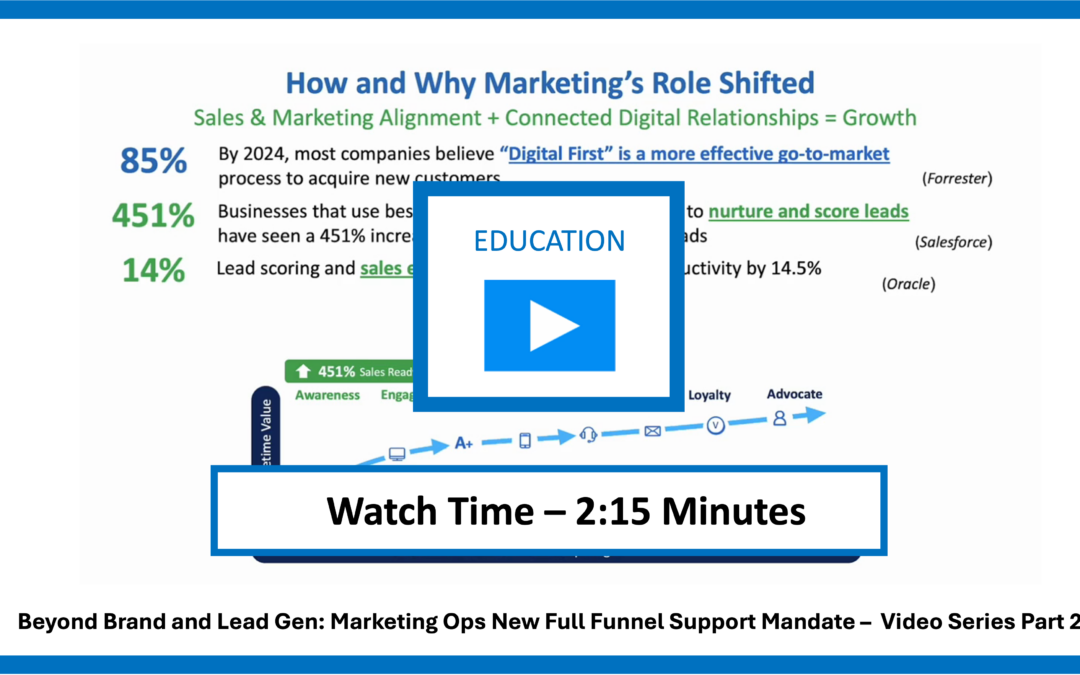
In part 2 of our video series “Marketing Ops New Full Funnel Support Mandate” we quickly explore what happens next and the increased ROI as marketing leaders are automating the full customer funnel lifecycle.

(Watch Time – 2:00)

Summary

This video explores how leading organizations are extending marketing automation and AI beyond traditional funnel stages to encompass the entire customer lifecycle. According to Salesforce, 46% of top customers are already implementing full-lifecycle automation.

Transcript


The Next Wave: Extending Automation Across the Full Customer Lifecycle

So where are these top organizations that drove the first wave of digital first automation heading next? According to Salesforce, 46% of their top customers are already in the process of extending marketing automation and AI beyond the top and middle of the funnel to their entire customer life cycle. So marketing teams can also help to personalize and support adoption, loyalty, and advocacy because marketing and sales alignment, automation, and AI combined to create a fully connected customer experience is driving even more growth.

The ROI When Marketing Automates the Full Lifecycle

According to McKinsey, companies with more mature automation are leveraging their tech stacks for life cycle campaigns and increased personalization to produce a 34% increase in revenue per customer. Connected and aligned sales and marketing campaigns extended to retention, upsell, and cross sell realize a 45% ROI across all campaigns. And over the next several years, not striving for a connected customer experience carries a much greater competitive risk because the number one customer frustration today is a disconnected customer journey.

The Future: B2B Sales Automation by 2027

Ultimately, the financial success of marketing automation combined with your buyers’ transformed expectations for a fully connected customer experience is why Gartner predicts 80% of the entire B2B sales process will be automated by 2027.

How and Why Marketing Has Full Funnel Sales Responsibilities Video

How and Why Marketing Has Full Funnel Sales Responsibilities Video

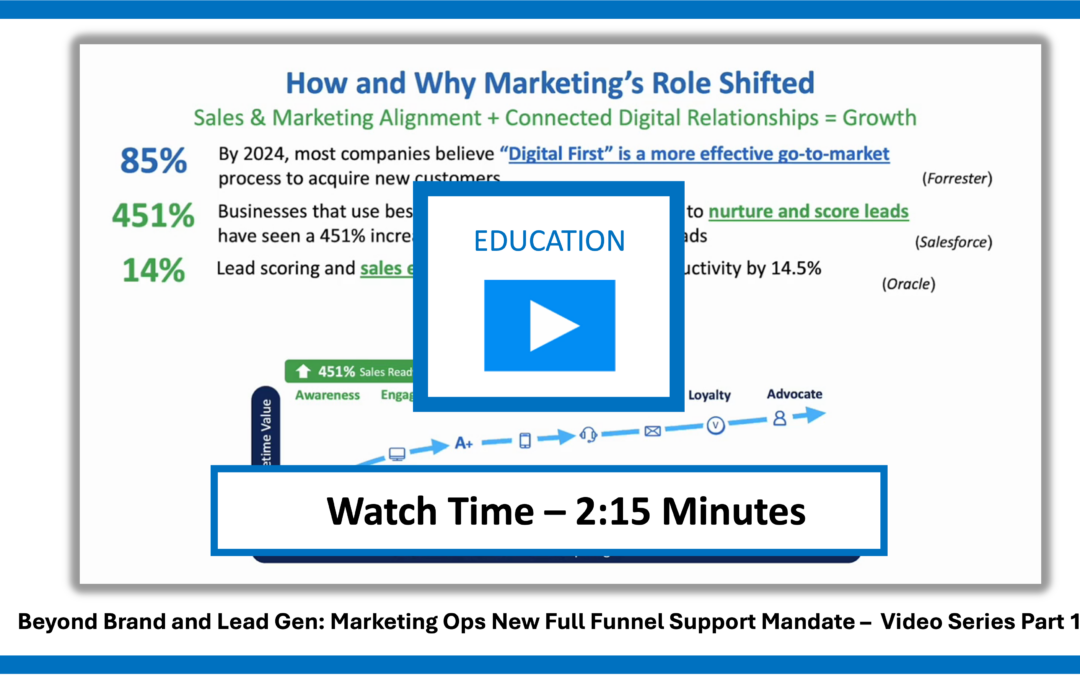
In part 2 of  “Marketing Ops New Full Funnel Support Mandate” Video Series we address how and why marketing has full funnel sales responsibilities.

(Watch Time – 2:15)

Summary

Why marketing has full funnel sales responsibilities – The pandemic fundamentally transformed marketing’s role, with 80% of enterprise companies shifting to digital-first content marketing as their primary go-to-market strategy due to remote work and canceled in-person events. This shift drove content marketing spending to double over four years, with another doubling expected. Marketing automation investment followed the same trajectory, with companies discovering that automated digital approaches are more effective for customer acquisition. By 2024, marketing became responsible for top and middle funnel activities, with 85% of companies embracing automation. The results are compelling: proper implementation generates 4x more quality leads, increases sales productivity by 14%, and improves targeting efficiency by 30%. This ROI has made marketing automation essential for 91% of marketers across all company sizes and industries.

Transcript

The Pandemic Shift: Marketing’s Move to Full Funnel

Marketing’s journey towards full funnel responsibilities was initiated by enterprise companies, reallocating both focus and budgets during the pandemic. With buyers working remotely, face to face meetings and events canceled, and direct dial phone connects plummeting, 80% of enterprise companies quickly shifted their focus to digital first content marketing as their primary go to market sales process.

Rising Investment: Content Marketing and Automation

As a result, over the next 4 years, content marketing spend doubled, and it’s expected to double again over the next 4 years as marketing continues to move deeper into the funnel. In parallel, marketing automation investment also doubled and is expected to double again over the next 5 years with the adoption of marketing automation software across all sized companies and the predicted extension of these tools across all stages of the customer life cycle.

Marketing Takes Ownership of the Funnel

So by the end of 2024, marketing became primarily responsible for the top and middle of the funnel, as 85% of companies now believed that an automated digital first approach is a more effective process to acquire new customers. They discovered that fully leveraging these tools for both sales and marketing alignment and automated connected buyer relationships drives growth.

The ROI Case: What Automation Delivers

Because when executed correctly for nurturing and lead scoring, it generates more than 4x the volume of higher quality leads. When leveraged for both lead scoring and sales enablement, it increases sales productivity by over 14%. And when the data is organized and leveraged effectively for attribution and insights, it improves targeting, content budgets, and top of the funnel ad spend by 30%.

The Verdict: Automation Is Now Essential

With this type of ROI, 91% of all marketers across all size companies and industries now consider marketing automation essential for their go to market success.

B2B Marketing’s Shifting Role and Overview of Marketing Ops New Full Funnel Support Mandate Video

B2B Marketing’s Shifting Role and Overview of Marketing Ops New Full Funnel Support Mandate Video

B2B Marketing’s Shifting Role and a quick overview of our 12 Part Educational Video Series that explains  “Marketing Ops New Full Funnel Support Mandate” Video Series 

(Watch Time – 5:50)

Summary

This B2B Marketing’s Shifting Role Video presentation addresses the rapidly evolving marketing landscape where roles have transformed more in the past five years than the previous fifty, with marketers increasingly overwhelmed by technology demands. The speaker discusses how marketing responsibilities have expanded beyond brand and lead generation to include sales support and the entire customer revenue cycle. With 56% of marketers feeling overwhelmed and 48% experiencing burnout, the presentation focuses on how Gabriel Sales can help organizations optimize their marketing automation, Salesforce capabilities, and AI processes. The three-part presentation covers the current marketing situation and future with AI, challenges teams face with technical support barriers, and Gabriel Sales’ solutions including proven frameworks, risk-free audits, and flexible service options. The goal is to help B2B companies and digital agencies reduce team frustrations while maximizing 

Transcript

The Evolving Role of Marketing

The marketing function is in the middle of an accelerating shift in roles and responsibilities. Several years ago, Adobe’s CMO made the clear point that because of the increased role of content marketing and technology, that marketing’s role has changed more in the past five years than the preceding fifty years as their responsibilities expanded from brand and lead generation to lead development. And Gartner now predicts with the rapid increase of automation technologies, data, and AI, the next five years will be even more disruptive than the past five years.

And as part of this disruption, Gartner also predicts that marketing will see increased accountability for sales and closing support. It will eventually extend well beyond the initial close through the entire customer revenue cycle.

The Burden on Marketing Teams

And with all these new technologies, processes, strategies, and channels to manage, fifty six percent of marketers are feeling overwhelmed keeping up, and forty eight percent are reporting feeling burned out over the past twelve months.

The Goal of This Presentation

So how do marketing leaders cost effectively alleviate their team’s frustrations and struggles with their evolving tech stack and support their team’s capability and capacity to maximize their use of marketing automation, sales enablement, and AI processes to accelerate specific stages of the funnel. The overall goal of the first seventy percent of this presentation is to explain why and how increasing your marketing automation and Salesforce capabilities, capacity, and support is critical at b to b companies and digital agencies when to reduce their team’s frustrations with technology, data hygiene, and advanced AI, and simultaneously empower your organization to achieve more with less.

Key Areas We Will Cover

We will discuss the impact of this support in specific areas, including the efficiencies and the competitive advantages your organization will gain when you optimize your tech stack to increase adoption, use, and the ROI of multiple processes, accelerate your funnels with proven automation workflows and lead scoring, scale sales productivity with sales enablement tools, increase visibility for smarter decisions with dashboards, attribution, and insights, implement best practice data governance for improved personalization, AI readiness, and AI deployments, and receive ongoing training and stewardship to keep up with your constantly evolving tech stack, all geared towards helping you build mature automation processes across the entire customer life cycle.

And throughout the presentation, we wanna help you decide if we are the right fit to support your team so you will gain an understanding of how Gabriel Sales can deploy certified technologists and seasoned frontline sales ops and marketing professionals to maximize your processes, tech stacks, data, and reporting with proven and strategic best practices.

Structure of this “Marketing Ops New Full Funnel Support Mandate Video Series”

We’ve organized this presentation to help organizations think about how to generate short term results while building towards long term success.

These insights and tips have been developed over ten plus years using these tools, encompassing hundreds of implementations and thousands of optimizations and campaigns, including leveraging AI for multiple efficiencies and tech stack consolidations on top of Salesforce in these datasets. We’ve divided this presentation into three parts in twelve smaller sections.

Part One: The Current Situation and What’s Next with AI

In part one, we discussed the current situation and with AI, what happens next. Topics will include why and how marketing’s roles and responsibilities shifted and where they’re headed next, how this shift permanently changed b to b buyers’ needs and expectations during the sales process, how these needs and expectations have now extended to the entire customer funnel, what is now required for your team to successfully meet and exceed your buyers’ needs and expectations, and the ROI you can expect from mature automation and sales enablement, especially with the addition of AI.

Part Two: Challenges Most Companies Face

Part two addresses challenges most companies face, including the specific tactical and technical support barriers most teams now need to overcome, what this type of support looks like and why it’s hard to find, the frustrations and challenges this lack of support creates for your teams, and the increased strategic complexities and disadvantages this can create for marketing and sales leaders, especially if your data and data governance is not AI ready.

Part Three: Why Gabriel Sales Is the Right Solution

In part three, we explain why Gabriel Sales is the right solution for companies serious about short term results and long term success. We share our proven frameworks, capabilities, services, and pricing models. We explain our risk free audits to identify quick wins and to build long term road maps, and we explain the flexible options we provide to help you achieve your goals, including technical quarterly sprints, point solutions, consulting projects, managed services, and training, all anchored in our proprietary maturity model to ensure alignment, quick results, and smarter long term investments.

We then conclude with what makes us unique in our value, including an overview of our fifteen year history in sales and marketing ops, data analytics, and our early experience with…

 

Sales Funnel Results With Lead Nurturing

Sales Funnel Results With Lead Nurturing

Sales Funnel Results With Lead Nurturing + Demand Generation

(Watch Time – 4:00)

Summary

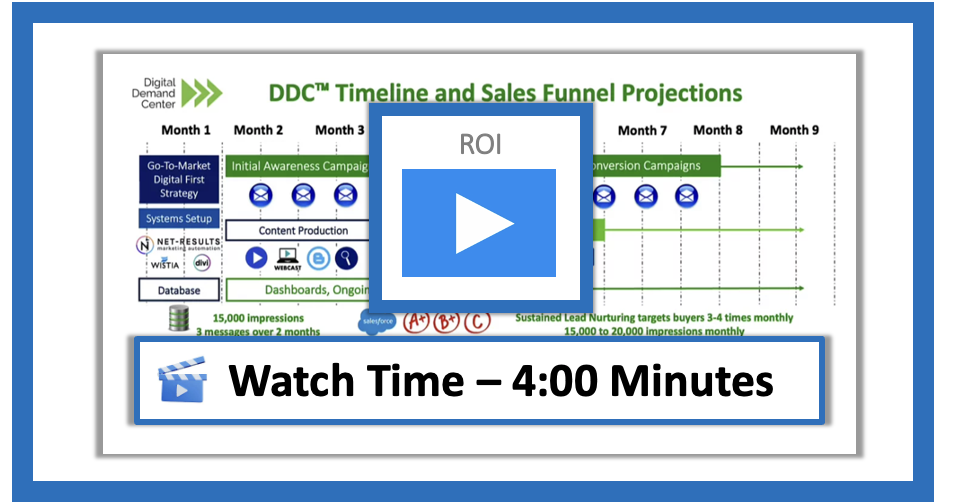
In this video we explain sales funnel results with lead nurturing, how long it takes to launch a demand generation and lead nurturing engine, and the sales funnel results you should expect running a campaign to 5,000 well targeted buyers.


Transcript

Introduction

When you examine the entire sales funnel, lead gen is the first step in the sales process and in the buyer’s journey. Lead gen’s job is to move buyers into the top of the sales funnel by creating awareness and curiosity about your solution. And then demand gen and lead nurturing takeover. Demand generation and lead nurturing automate the pre-sales education process as the buyer goes through their second step of consideration and their third stage of preference. This process keeps the seller top of mind as the buyer moves deeper into the funnel.  And when the buyer’s ready, sales takes over to help them make a decision.

As discussed in other videos in much greater detail, Digital Demand Center specializes in demand gen and lead nurturing to put well educated buyers into your CRM for your sales team to develop and close. And as part of our service, we also support your initial go-to-market strategy, awareness, and lead gen campaigns if you don’t already have a database built or a lead gen vendor or process you trust.

Time to Launch

To fully launch a demand generation engine, including our solution Digital Demand Center, typically takes about three months. In the first month, you can craft your go-to-market strategy, implement your automation systems, and deal with cleaning, augmenting, and building your database. In months two and three, you can run your initial awareness campaigns to generate early stage leads, augment gaps in your sales education content production, access your marketing automation and sales dashboards, start your reporting, and start the ongoing optimization of your marketing tech and campaigns. By month four, you are starting at execute, lead nurturing, and you’re starting to see your initial flow of sales ready leads in your CRM.

Projected Sales Funnel Results

How long does it take to start seeing the results?  So to make the math easy, let’s assume we start your awareness campaign with 5,000 targets. These 5,000 targets will be sent three different messages for the equivalent of 15,000 impressions. So, early in your campaign, you should see about 200 to 400 early stage marketing qualified leads by month four.  Marketing Qualified Leads are defined by demonstrating initial engagement with your content.  They know who you are and the basics of what you do. And if you need to be aggressive, you can start calling these early stage leads.

Then typically by month five, the marketing engine is doing what it was designed to do as the lead nurturing campaigns continue to target your buyers three to four times a month for and additional 15,000 to 20,000 impressions a month. And as a direct result of this pre-sales education, by month five, you should be producing 5 to 10 sales-ready leads a month.  Sales Ready Leads are defined by potential buyers that are engaging with multiple pieces of content, watching videos and visiting key pages that predict that they are getting ready to short list and make a decision.   This number of “Sales Ready Leads” should increase to 7 to 12 by month six. That hat number should hold steady or grow to 10 to 15 sales ready leads by month eight.

Cost Per Sales Ready Lead and Cost Per Conversion

This means that by month eight, with your steady state investment of about $3,200 a month and your launch fee is over, your engine should be producing between 7 to 15 well-educated buyers a month indefinitely. So, this means not counting your startup costs in any additional content costs that by month eight you should be generating sales ready leads at a high-end cost of $450 per sales ready lead, and a cost of $1,000 per opportunity to a low-end of $210 per sales ready lead in a cost rounding up of about $500 per opportunity.

With a closing rate of 33%, this means you should be paying between $1,500 to $3,000 per closed deal. And probably the best news for companies that are committed to lead nurturing and leveraging Digital Demand Center is that once you’ve launched your engine, the only thing that will prevent you from scaling your sales funnel and lowering your cost of sales is your ability to add more targets to the front-end of your engine. Because doubling your targets from 5,000 to 10,000 will eventually over a year or two and into year three, double your sales ready leads, which over time will cut your cost in half after about a year to 18 months of sustained lead nurturing.

Lead Nurturing Drives Sales Ready Leads Success Video

Lead Nurturing Drives Sales Ready Leads Success Video

Lead Nurturing Drives Sales Ready Buyers Success Video

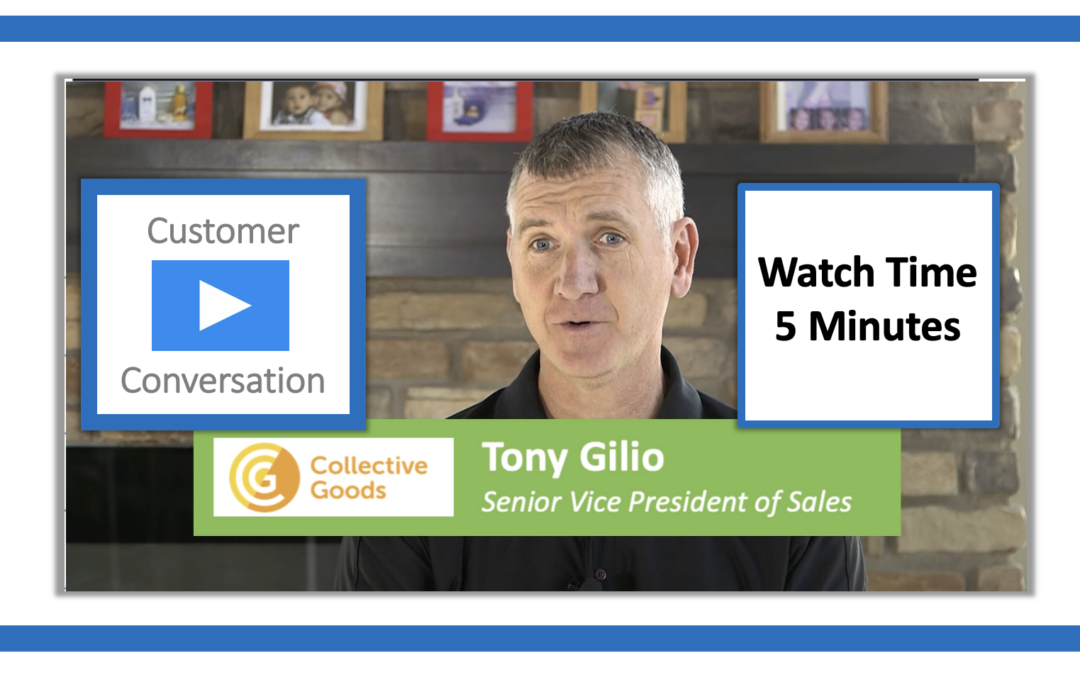
In this short video Collective Goods’ SVP of Sales, Tony Gilio, discusses how lead nurturing drives Sales Ready Leads.  He explains how Digital Demand Center allowed him to increase his flow of sales ready buyers, doubled his closing rate and reduce his Sales Development Rep headcounts cost by over 50%.

(Watch Time – 3:00 Minutes)

Conversation with Collective Goods SVP of Sales, Tony Gilio

Collective Goods was struggling to deliver a full funnel of new business and qualified opportunities to their team of over 150 outside sales reps.  Tony explains how he had Gabriel Sales and Digital Demand Center increase the efficiency of his inside sales team by implementing a digitized pre-sales process supported by a marketing automation technology stack.   In this short video Tony explains:

  • How Digital Demand Center doubled his volume of Sales Ready Leads by 50%
  • How “Sales Ready” leads reduced his telemarketing team from eight to four reps reducing his cost by 50%
  • Why his New Business closing rate went from 10% to 50%
  • How this lead nurturing and demand generation solution provided his closer the volume they needed for success

Excerpts from Lead Nurturing Drives Sales Ready Buyers

“The, the reason why I believe that Digital Demand Center had so much success with us was because they’ve done it from all angles. They are sales professionals, they are marketing experts.  The understand and see the whole business cycle. And, well I guess now they are the whole business cycle for us, right. And they’ve just digitized it and made it more efficient for us to be able to succeed. Their expertise allowed us to be more efficient in our process.”

“So the first step that we had with Gabriel Sales and Digital Demand Center was just streamlining that Sales Development Process.  The reason why we had so much more success is that the buyers we started calling were warmed up. They had already watched videos, they had already seen the content. They had basically told us that they wanted us to call them.”

“I was skeptical that digitizing this would be able to replace, um, all our portion of our telemarketing team. And the reality is really that’s how people want to transact nowadays. They, they are more digitally focused. They are less apt to pick up a call, especially because so many people are on their cell phones. They don’t want to listen to a telemarketer. So they’re transacting on a digital format through video. They’re watching as much as they want to watch. The buyer is learning about us and we are  watching and we’re learning, about their behaviors.   And then we can follow up accordingly”