Marketing Leaders Are Automating the Full Customer Lifecycle (Educational Video)

Marketing Leaders Are Automating the Full Customer Lifecycle (Educational Video)

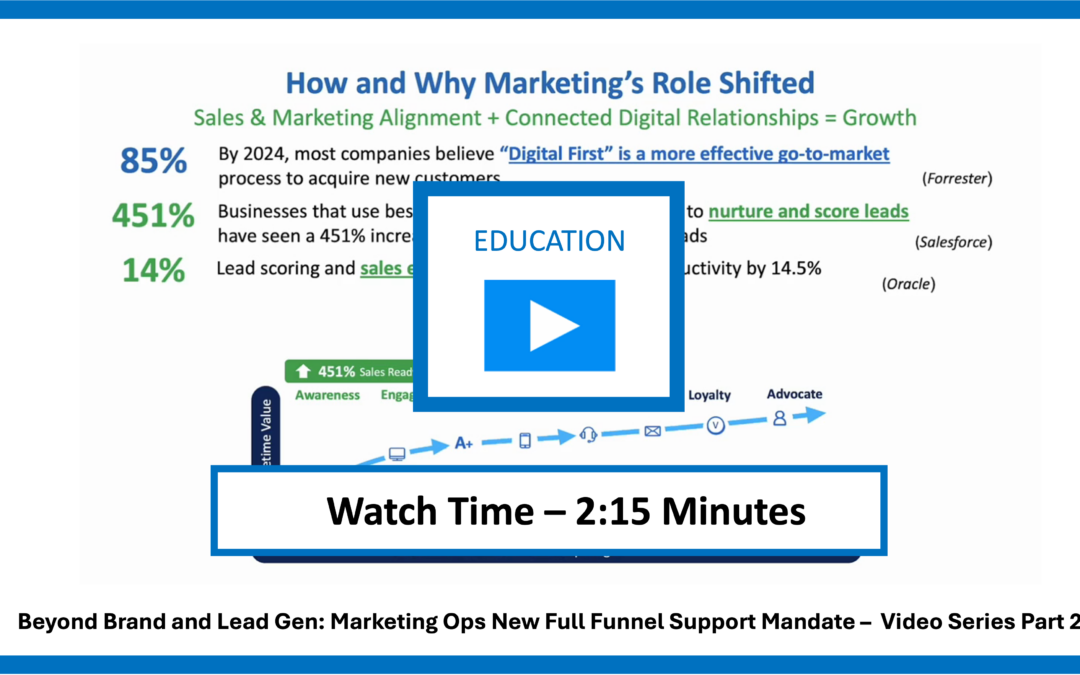
In part 2 of our video series “Marketing Ops New Full Funnel Support Mandate” we quickly explore what happens next and the increased ROI as marketing leaders are automating the full customer funnel lifecycle.

(Watch Time – 2:00)

Summary

This video explores how leading organizations are extending marketing automation and AI beyond traditional funnel stages to encompass the entire customer lifecycle. According to Salesforce, 46% of top customers are already implementing full-lifecycle automation.

Transcript


The Next Wave: Extending Automation Across the Full Customer Lifecycle

So where are these top organizations that drove the first wave of digital first automation heading next? According to Salesforce, 46% of their top customers are already in the process of extending marketing automation and AI beyond the top and middle of the funnel to their entire customer life cycle. So marketing teams can also help to personalize and support adoption, loyalty, and advocacy because marketing and sales alignment, automation, and AI combined to create a fully connected customer experience is driving even more growth.

The ROI When Marketing Automates the Full Lifecycle

According to McKinsey, companies with more mature automation are leveraging their tech stacks for life cycle campaigns and increased personalization to produce a 34% increase in revenue per customer. Connected and aligned sales and marketing campaigns extended to retention, upsell, and cross sell realize a 45% ROI across all campaigns. And over the next several years, not striving for a connected customer experience carries a much greater competitive risk because the number one customer frustration today is a disconnected customer journey.

The Future: B2B Sales Automation by 2027

Ultimately, the financial success of marketing automation combined with your buyers’ transformed expectations for a fully connected customer experience is why Gartner predicts 80% of the entire B2B sales process will be automated by 2027.

How and Why Marketing Has Full Funnel Sales Responsibilities (Educational Video)

How and Why Marketing Has Full Funnel Sales Responsibilities (Educational Video)

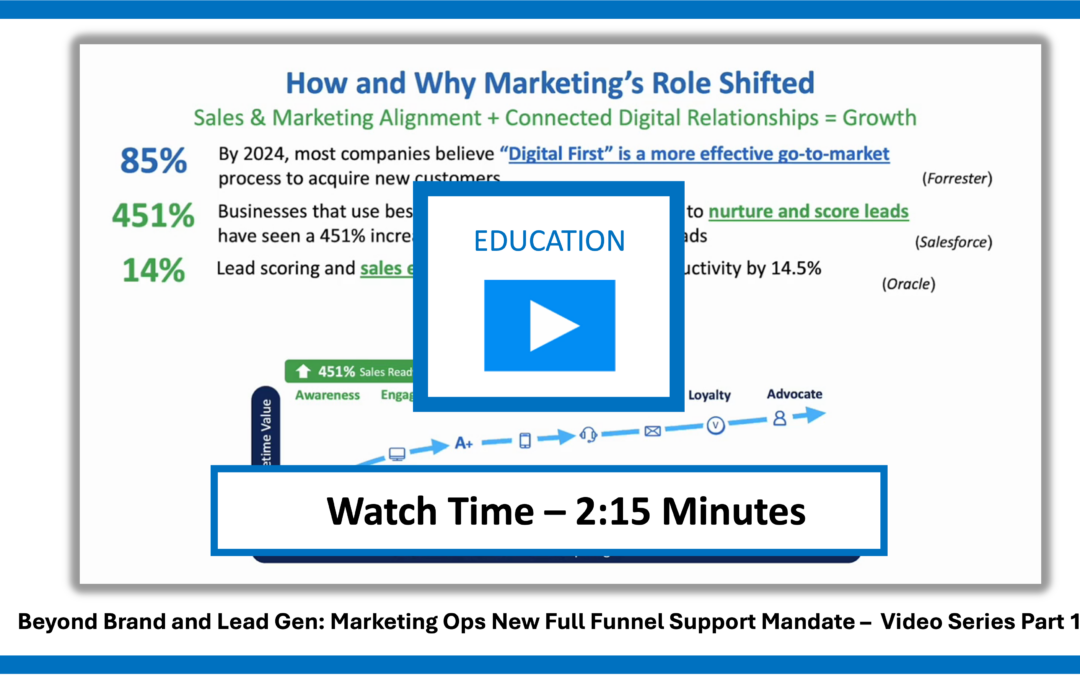
In part 1 of  “Marketing Ops New Full Funnel Support Mandate” Video Series we address how and why marketing has full funnel sales responsibilities.

(Watch Time – 2:15)

Summary

Why marketing has full funnel sales responsibilities – The pandemic fundamentally transformed marketing’s role, with 80% of enterprise companies shifting to digital-first content marketing as their primary go-to-market strategy due to remote work and canceled in-person events. This shift drove content marketing spending to double over four years, with another doubling expected. Marketing automation investment followed the same trajectory, with companies discovering that automated digital approaches are more effective for customer acquisition. By 2024, marketing became responsible for top and middle funnel activities, with 85% of companies embracing automation. The results are compelling: proper implementation generates 4x more quality leads, increases sales productivity by 14%, and improves targeting efficiency by 30%. This ROI has made marketing automation essential for 91% of marketers across all company sizes and industries.

Transcript

The Pandemic Shift: Marketing’s Move to Full Funnel

Marketing’s journey towards full funnel responsibilities was initiated by enterprise companies, reallocating both focus and budgets during the pandemic. With buyers working remotely, face to face meetings and events canceled, and direct dial phone connects plummeting, 80% of enterprise companies quickly shifted their focus to digital first content marketing as their primary go to market sales process.

Rising Investment: Content Marketing and Automation

As a result, over the next 4 years, content marketing spend doubled, and it’s expected to double again over the next 4 years as marketing continues to move deeper into the funnel. In parallel, marketing automation investment also doubled and is expected to double again over the next 5 years with the adoption of marketing automation software across all sized companies and the predicted extension of these tools across all stages of the customer life cycle.

Marketing Takes Ownership of the Funnel

So by the end of 2024, marketing became primarily responsible for the top and middle of the funnel, as 85% of companies now believed that an automated digital first approach is a more effective process to acquire new customers. They discovered that fully leveraging these tools for both sales and marketing alignment and automated connected buyer relationships drives growth.

The ROI Case: What Automation Delivers

Because when executed correctly for nurturing and lead scoring, it generates more than 4x the volume of higher quality leads. When leveraged for both lead scoring and sales enablement, it increases sales productivity by over 14%. And when the data is organized and leveraged effectively for attribution and insights, it improves targeting, content budgets, and top of the funnel ad spend by 30%.

The Verdict: Automation Is Now Essential

With this type of ROI, 91% of all marketers across all size companies and industries now consider marketing automation essential for their go to market success.

B2B Marketing’s Shifting Role and Overview of Marketing Ops New Full Funnel Support Mandate Video Series (Educational Video)

B2B Marketing’s Shifting Role and Overview of Marketing Ops New Full Funnel Support Mandate Video Series (Educational Video)

B2B Marketing’s Shifting Role and a quick overview of our 12 Part Educational Video Series that explains  “Marketing Ops New Full Funnel Support Mandate” Video Series 

(Watch Time – 5:50)

Summary

This B2B Marketing’s Shifting Role Video presentation addresses the rapidly evolving marketing landscape where roles have transformed more in the past five years than the previous fifty, with marketers increasingly overwhelmed by technology demands. The speaker discusses how marketing responsibilities have expanded beyond brand and lead generation to include sales support and the entire customer revenue cycle. With 56% of marketers feeling overwhelmed and 48% experiencing burnout, the presentation focuses on how Gabriel Sales can help organizations optimize their marketing automation, Salesforce capabilities, and AI processes. The three-part presentation covers the current marketing situation and future with AI, challenges teams face with technical support barriers, and Gabriel Sales’ solutions including proven frameworks, risk-free audits, and flexible service options. The goal is to help B2B companies and digital agencies reduce team frustrations while maximizing 

Transcript

The Evolving Role of Marketing

The marketing function is in the middle of an accelerating shift in roles and responsibilities. Several years ago, Adobe’s CMO made the clear point that because of the increased role of content marketing and technology, that marketing’s role has changed more in the past five years than the preceding fifty years as their responsibilities expanded from brand and lead generation to lead development. And Gartner now predicts with the rapid increase of automation technologies, data, and AI, the next five years will be even more disruptive than the past five years.

And as part of this disruption, Gartner also predicts that marketing will see increased accountability for sales and closing support. It will eventually extend well beyond the initial close through the entire customer revenue cycle.

The Burden on Marketing Teams

And with all these new technologies, processes, strategies, and channels to manage, fifty six percent of marketers are feeling overwhelmed keeping up, and forty eight percent are reporting feeling burned out over the past twelve months.

The Goal of This Presentation

So how do marketing leaders cost effectively alleviate their team’s frustrations and struggles with their evolving tech stack and support their team’s capability and capacity to maximize their use of marketing automation, sales enablement, and AI processes to accelerate specific stages of the funnel. The overall goal of the first seventy percent of this presentation is to explain why and how increasing your marketing automation and Salesforce capabilities, capacity, and support is critical at b to b companies and digital agencies when to reduce their team’s frustrations with technology, data hygiene, and advanced AI, and simultaneously empower your organization to achieve more with less.

Key Areas We Will Cover

We will discuss the impact of this support in specific areas, including the efficiencies and the competitive advantages your organization will gain when you optimize your tech stack to increase adoption, use, and the ROI of multiple processes, accelerate your funnels with proven automation workflows and lead scoring, scale sales productivity with sales enablement tools, increase visibility for smarter decisions with dashboards, attribution, and insights, implement best practice data governance for improved personalization, AI readiness, and AI deployments, and receive ongoing training and stewardship to keep up with your constantly evolving tech stack, all geared towards helping you build mature automation processes across the entire customer life cycle.

And throughout the presentation, we wanna help you decide if we are the right fit to support your team so you will gain an understanding of how Gabriel Sales can deploy certified technologists and seasoned frontline sales ops and marketing professionals to maximize your processes, tech stacks, data, and reporting with proven and strategic best practices.

Structure of this “Marketing Ops New Full Funnel Support Mandate Video Series”

We’ve organized this presentation to help organizations think about how to generate short term results while building towards long term success.

These insights and tips have been developed over ten plus years using these tools, encompassing hundreds of implementations and thousands of optimizations and campaigns, including leveraging AI for multiple efficiencies and tech stack consolidations on top of Salesforce in these datasets. We’ve divided this presentation into three parts in twelve smaller sections.

Part One: The Current Situation and What’s Next with AI

In part one, we discussed the current situation and with AI, what happens next. Topics will include why and how marketing’s roles and responsibilities shifted and where they’re headed next, how this shift permanently changed b to b buyers’ needs and expectations during the sales process, how these needs and expectations have now extended to the entire customer funnel, what is now required for your team to successfully meet and exceed your buyers’ needs and expectations, and the ROI you can expect from mature automation and sales enablement, especially with the addition of AI.

Part Two: Challenges Most Companies Face

Part two addresses challenges most companies face, including the specific tactical and technical support barriers most teams now need to overcome, what this type of support looks like and why it’s hard to find, the frustrations and challenges this lack of support creates for your teams, and the increased strategic complexities and disadvantages this can create for marketing and sales leaders, especially if your data and data governance is not AI ready.

Part Three: Why Gabriel Sales Is the Right Solution

In part three, we explain why Gabriel Sales is the right solution for companies serious about short term results and long term success. We share our proven frameworks, capabilities, services, and pricing models. We explain our risk free audits to identify quick wins and to build long term road maps, and we explain the flexible options we provide to help you achieve your goals, including technical quarterly sprints, point solutions, consulting projects, managed services, and training, all anchored in our proprietary maturity model to ensure alignment, quick results, and smarter long term investments.

We then conclude with what makes us unique in our value, including an overview of our fifteen year history in sales and marketing ops, data analytics, and our early experience with…


5 Situations in Which Outsourced Sales and Marketing Helps Small Business Thrive

5 Situations in Which Outsourced Sales and Marketing Helps Small Business Thrive

Should you build a strong internal team, or consider outsourced sales and marketing helps small business grow operation? The question commonly arises for growing businesses with limited resources. Accounting, production, and other department face the same general question. So naturally, the same is true for sales and marketing.

Some vendors will tell you that outsourcing is always the better idea. That’s not necessarily the case. While working with an external partner is undoubtedly beneficial in some situations, others may actually benefit from an in-house approach. Don’t be seduced by a vendor that pushes sales outsourcing simply because they want your business to build their own revenue.

Instead, approach the question strategically. Determine whether or not you should outsource your sales and marketing operations based on your unique business situation. Evaluate your environment, capacity, business goals, and priorities. The fewer variables remain, the better your final decision will be for your situation.

Make no mistake: outsourced marketing can help your small or medium-sized business thrive. And yet, according to one recent survey, only 3% of SMBs actually work with an external marketing vendor. Should you be part of that exclusive group? Your business finds itself in one of the below five situations, the answer might just be yes.

Here are 5 Situations in Which Outsourced Sales and Marketing Helps Small Business Thrive

1) Your Business Lacks Marketing and Sales Integration

The age of cold calls is long gone. Too often, business owners and decision makers consider marketing and sales to be two distinct operations. The problem is that your target audience doesn’t see it that way.

Whether they read your website content or receive a sales email, they’re thinking of the same brand. That means your messaging and strategy has to be consistent, regardless of whether you’re writing about industry trends to build credibility or delivering a sales pitch.

That means the two efforts and teams have to match up. The goal of both is to acquire and retain customers, with marketing providing the initial brand awareness and leads that your sales efforts are designed to close. Align your marketing and sales team, and the results can be astounding. Consider the statistics:

  • 56% of aligned organizations met their revenue goals, and 19% beat their goals.
  • Sales and marketing alignment delivers, on average, a 36% improvement in customer retention and 38% higher sales-win rates.­­
  • Aligned organizations achieve up to 19% faster revenue growth – and 15% higher profitability.

And yet, too often, the opposite is the case. Sales and marketing operate as distinct entities, with their own unique goals. As a result, they often become isolated, and the organization fails to reach business goals. When that happens, you might need to consider working with an external marketing and sales vendor.

Through this type of partnership, the alignment becomes more natural. Rather than having to spend time managing both units on your end, you can work with a partner who builds a wholistic, strategic approach that encompasses both. Especially to begin the integration process on your end, this can be a crucial step.

2) You Lack the Capacity or Resources to Manage an In-House Team

Managing a sales and marketing team can be difficult. Sales especially faces common obstacles, as you need to keep the balance of a confident staff not overburdened by challenging goals that still is motivated enough to meet these goals.

Beat them up too much about your sales goals, and they lose confidence. Fail to hold them accountable, and the sales pipe built by marketing never bears fruit. When you cannot hold that balance, while folding marketing into the mix, it might make sense to delegate your sales and marketing management to an external partner.

Through that partner, you can set firm goals that are both strategic and ambitious. Both the chances of hitting these goals and the satisfaction of your organizational team will increase drastically.

Resource limitations pose a similar problem. Organizational expertise takes time to develop, because it tends to be driven by measurement and verification against feedback loop. You need the historical data to benchmark your performance against, which can be impossible when you’re starting from scratch.

Plugging your sales goals into an existing sales process and operation means you can save your resources for other organizational priorities. That’s especially crucial if you need to focus your talent and executive leadership on those aspects of your core business.

Is your time better spent in business development than sales? Does your delivery, client satisfaction, or product development need more attention? Outsourcing your sales may be the key to focus on your core business needs without neglecting the growth of your customer base.

3) You Need to Control Your Operational Risk

Especially as a startup grows, but also throughout your growth cycle as a business, managing operational risk is crucial. Outsourcing your customer growth initiatives will almost always help to accomplish that goal.

Put simply, working with an external sales or marketing partner will remove a significant chunk of your fixed costs and move them to a variable expense, for a number of reasons:

  • You won’t need hard infrastructure investments n technologies and marketing platforms.
  • You won’t need to hire a full-time sales and marketing staff.
  • Your investment will be more closely tied to output, rather than becoming an inevitable expense.
  • Total costs of a fully functioning sales machine, including talent, managers, executives, and marketing support will range around the cost of a single senior enterprise representative.
  • You will not need to invest in ongoing training and development to keep your own sales and marketing staff active and successful.

In most cases, outsourced sales organizations are bound contractually to hit their targets, report on progress and benchmarks, and provide feedback that can improve your organization. The result is a more informed, data-based sales strategy that is more likely to succeed.

Managing your risk also becomes a qualitative function. Over the past few years, sales execution has become more buyer-focused, moving from the relatively linear ‘traditional’ process to a more fluid, credibility-based alternative. You either have to add new resources to account for that trend, or risk wasting your resources on an outdated, ineffective model.

But if you hire for this shift to a buyer-centric environment, you run into another risk. Adding full-time executives to your sales and marketing team might mean you begin to accumulate too many strategists, and not enough soldiers. Pulling together the strategic side and tactical execution of both sales and marketing is expensive, and can incur significant uncertainty. In an outsourced approach, that is not the case. The same partner will account for both sides of the coin, building an initial and ongoing strategy that tightly integrates with its execution.

4) You Have to Reduce Your Time to Market

The time to market for your business or product may matter for a number of reasons. You might need to contend with a highly competitive environment, satisfy your investors, or ensure the fulfillment of pre-orders. A number of factors influence that process, but don’t forget about your marketing and sales operations.

Even the most well-built product or service cannot effectively reach the market if you don’t know how to unlock your future customers. You need both an understanding of your market, as well as a strategy and a team ready to leverage that understanding into actual sales results.

When you outsource, you get the benefit of plugging into an existing mechanism to achieve those goals:

  • Your sales strategy can be built even as you’re still developing the product.
  • The technologies and platforms needed for an effective sales and marketing execution are already in place.
  • You can tap into a sales and marketing team that is already aligned and works well together.
  • You don’t have to spend time onboarding a new team for your business.
  • You can leverage existing, real-time market intelligence to keep a pulse on the market and adjust your strategy as necessary.

Time to Market is not always an important consideration. But when it is, outsourcing can quickly become a crucial step. You save valuable time in getting your product ready for and in front of your audience. Recruiting, building, and training your sales force can take months if not years. External marketing and sales can help you avoid delays that could otherwise devastate your competitiveness.

5) You Need to Scale a Growing Operation

Time to market, of course, is only one consideration. As demand grows, your business needs to keep pace. Even if you’ve built up a reliable internal sales operation for a startup, that operation may no longer be effective as you grow into  a mid-size business.

The same is true on the opposite end. In fact, downsizing your sales and marketing may be even more difficult than upsizing the same process. Thanks in part to the fixed costs mentioned above, you will be saddled with investments and resources that cannot be effectively deployed.

Now, consider the alternative of working with an external sales partner. The right provider already has the ability to manage any increase or decrease in scale built into the system. The technology platforms account for both growth and declines. The phone systems and workforce are in place to adjust as needed.

The same is also true if you want to grow to a specific size and revenue, then stabilize. During your growth phase, it might make sense to work with an outsourced vendor. As you reach majority, you can work with the same vendor to transfer the earned infrastructure and expertise in-house, and establish your own sales operations. As long as you’re open and honest about that intent from the beginning, you can find a vendor that helps both in the build-up and the transfer.

Should You Outsource Your Sales and Marketing Efforts?

There is no simple answer to that question. Instead, you should evaluate your current situation, and determine based on your existing infrastructure as well as forecasted sales whether finding an outsourced provider makes sense. If you find yourself in any of the above situations, the answer will probably be yes.

In that case, you still need to find a reliable partner who can actually accomplish everything that outsourced marketing and sales are capable of. That provider should not just possess built-up expertise in your core area of need, but also the desire to become a true partner who is invested in your business success.

We can be that partner for you. Outsourced sales and marketing helps small businesses grow. In fact, our integrated approach to modern marketing and sales makes us the perfect fit to help your business grow and optimize its sales efforts. Contact us for more information, and to start discussing a potential partnership.


About Us

Gabriel Sales specializes in helping SMBs and Startups grow their business with modern outsourced sales and marketing operations.

Our team can augment gaps in your existing sales and marketing operations or we can be leveraged for full-service campaigns that include:

  • Integrated Sales and Marketing Strategies
  • Database Research and Targeting
  • Automation and CRM Systems Best Practices Implementation
  • Inbound Lead Generation
  • Outbound Lead Generation and Lead Scoring
  • Sales Qualification
  • Closing

To learn more about how we can help you grow your business (or decide if we are the right fit for you), we invite you to visit our page that details our integrated approach to sales and marketing outsourcing. Or feel free to contact us for free initial consultation and discovery session to see if our approach is the right fit to help you hit your revenue targets.



How Marketing Automation Helps Sales Reps

How Marketing Automation Helps Sales Reps

Marketing automation helps sales reps increase their productivity in multiple ways.

Marketing automation tools are used by companies of every size to increase the value of their online presence. Whether a business needs better lead generation or an improvement in the number of sales successfully closed, automated marketing can dramatically extend your online reach, allowing you to drum up a much higher number of leads, and in turn find more good leads that will turn into sales.

However, sometimes sales departments don’t use these tools correctly. Often this is the result of misunderstanding what these tools are capable, of, and becoming overly reliant on them for help in every facet of the job. Marketing automation is powerful, but in the end still just a method for enabling a live person to do more than would otherwise be possible.

In the interests of helping people understand how to maximize the value of these automated systems, here are ten ways that marketing automation assists sales reps.

Lead scoring. If you have a good number of existing leads and a steady stream of new leads always coming to you—a fortunate situation, to say the least—you still need to know which of those leads are most likely to result in sales. Lead scoring tracks a potential buyer’s activity to determined who is most engaged. This gives sales reps an easily accessible list of priority customers, requiring no guesswork as to who should be contacted first.


Buyers indicate their interests before speaking with a sales rep. Related to lead scoring, automated marketing systems track what products and services your engaged leads are checking out. When your sales rep is ready to make contact, they can do so knowing the customers’ interests and thus what to target with their sales pitches.


Sales reps can see how effective their contacts are. Every sales rep knows the feeling of having a customer that they’re sure is interested, the customer will buy soon, it’s pretty much a lock, and so on. What helps more than a good feeling, even for the best rep, is hard data. Marketing automation tells you how often leads open your e-mails and click on the links you send. If they are, wonderful; if not, this lets you know that you need to devise a new angle for selling the ‘hot’ lead on your product, rather than continue sending the types of e-mails they’ve been ignoring.


Automated e-mail templates save your reps time and give them feedback. Once e-mail templates are programmed into the automated system, they can be put to wide scale use and their effectiveness thus gauged on a large quantity of data. If a certain template does not do enough to trigger further engagement from leads, you know and can try something else. And if you find a template that is super effective, the automated tools make it easy to streamline its use.


Automated follow-up e-mails. Follow up contacts are important for maintaining a lead’s awareness of your company and the sales rep with which they’ve spoken; you never know when a lead that is unlikely to buy now will change their mind. However, the effort takes time that could be spent pursuing different leads instead. With the ability to set up a drip campaign ostensibly coming ‘from’ the sales rep, marketing can make sure the effectiveness of follow-up contact is maintained while freeing up the rep to speak with different leads.


Quick access to past communications. Any good marketing automation software (Pardot, for example) can integrate with your CRM. Once the rep uses software that connects the two (often Outlook), their e-mail history will be loaded into the automated software, making access a swift and painless matter.


Reduced headcount for your company. Marketing automation allows each rep to handle many more potential customers than they would without those tools. No matter how many leads your company is capable of generating, it requires fewer sales reps to deal with that number than would be the case without marketing automation tools at your disposal.


Tracks top performers with statistics that can help everyone. If you have a decently-sized sales force, some reps will struggle and some will shine. Rather than let the struggling reps muddle along, or worse, firing them when they might have potential, you can find the differences between how top reps and struggling reps approach their jobs. Which leads do top reps pursue? What lead scores most commonly lead to sales? Automated marketing systems can collate this data and make sure all your reps know how to get the most out of their work hours.


Allows for timely contact. Automated systems tell you more than where or how often leads visit your site; they tell you when the leads are there. The lead deck points out to your sales rep that a lead is on your site, meaning that’s a good time to send an e-mail or make a phone call. Catch leads when they’re already thinking about your products, rather than risk doing so at a time when you’ll be easier to ignore.


Reduces or prevents lead and deal leakage. One of the unfortunate positions sales reps find themselves in is the necessity of closing enough deals to make their sales targets for the month or quarter, which can often require them to focus on more on leads who are ready to buy now and abandon contact with leads who may need more time to come around. While this can help them reach their numbers in the short term, it creates perverse incentives for the reps at the expense of the company. After all, your business needs every potential customer, both the ones buying now and those considering it down the road, and it does you no good if the reps don’t have time to nurture those long-term contacts. Automated marketing takes enough of the grind out of a sales rep’s job to allow them more time to develop a sales pipe for the future as well as for today.

Used correctly, marketing automation helps sales and is an incredible tool for maximizing sales and revenue across every rep in your company. If you’d like to know more about what marketing automation can do for you, contact us for more information.

About Us

Gabriel Sales specializes in helping SMBs and Startups grow their business with modern sales and marketing operations.

Our team can augment gaps in your existing sales and marketing operations or we can be leveraged for full-service campaigns that include:

  • Integrated Sales and Marketing Strategies
  • Database Research and Targeting
  • Automation and CRM Systems Best Practices Implementation
  • Inbound Lead Generation
  • Outbound Lead Generation and Lead Scoring
  • Sales Qualification
  • Closing

To learn more about how we can help you grow your business (or decide if we are the right fit for you), we invite you to visit our page that details our integrated approach to sales and marketing outsourcing. Or feel free to contact us for free initial consultation and discovery session to see if our approach is the right fit to help you hit your revenue targets.