


This guide is crafted and organized to help B2B business leaders that have invested in Salesforce and Marketing Automation decide if outsourcing Salesforce and marketing automation support makes sense for their organization. After the introduction the framework is divided into 7 sections. We are also including videos from our Educational Series: Marketing Operations Full Funnel Mandate for deeper dives if additional education is required in any one area.
Guide Sections Include (Quick Links):
- Section 1: What Mature & Successful B2B Marketing and Sales Operations + AI Readiness Actually Requires
- Section 2: The True Cost of Building In-House
- Section 3: What Happens When You Underinvest and The Strategic Consequences
- Section 4: The 7 Business Advantages of Outsourcing Marketing Automation, Data Governance and Sales Operations
- Section 5: A Decision Framework: When Outsourcing Is the Right Call
- Section 6: The Questions Worth Answering Before You Decide
- Section 7: Recommended Next Steps if the Math and Potential ROI Points Toward Outsourcing
Introduction
You’ve invested in Salesforce. You’ve invested in Marketing Cloud Account Engagement (Pardot) or you’re considering Marketing Cloud Next, Agentforce and Data Cloud. And somewhere between the promise of what those tools were supposed to deliver and the reality of what your team can consistently manage, optimize and execute on any day (week or month) there’s a gap. And this gap is costing you pipeline, improved spend and revenue at every stage of your GTM and Customer Funnel.
At the same time, leadership is pushing for more. More leads. More qualified opportunities. More automation post close. More from the technology you’re already paying for. And now, the question isn’t just about marketing and sales output it’s also about implementing AI. Everyone from the board down is asking when your marketing and sales operations will be AI-ready. The honest answer for most mid-market companies is: not yet, and not without significant work on the data foundation that sits underneath everything.
This is the moment most marketing and sales leaders hit the same inflection point: do we build this capability and capacity in-house, or do we buy it, or is it a combination of the two?
This page is designed to help you answer that question honestly with a balanced framework. If building in-house is the right answer for your situation we will share those conditions too. But if the math points toward outsourcing, you’ll have the business case to make it to your leadership and internal teams with confidence.
Overview: Marketing’s Shifting Role and the Full Funnel Support Mandate
(5:00 minutes) A quick summary why marketing roles have transformed more in the past five years than the previous fifty, and what it takes to compete with a fully automated, AI-ready ops model. This is also the introduction to our 12 part video series Marketing Operations Full Funnel Mandate.
Section 1: What Mature & Successful B2B Marketing and Sales Operations + AI Readiness Actually Requires
Before you can make the build vs. buy decision, you need a clear picture of what you’re actually deciding to build. Most leaders underestimate the scope and volume of all the skills, tasks and technical expertise required for mature and authentically competitive marketing and sales operations. That underestimation is where the gap starts.
This gap is ultimately driven by the changed expectations of the B2B buyer. Buyers now expect to be able to educate themselves digitally online across multiple channels. Once they demonstrate interest, they also expect marketing to continue to support their buyer journey with continued digital education. Increasingly they expect messages and content to be personalized with additional in person or virtual events to support their buying process and education around their specific use cases. They also expect a seamless hand off from marketing to sales when they are ready to buy. And more recently they also expect a seamless digital and personalized experience once they become a customer around customer service, adoption, training and personalized marketing if cross sell and upsell campaigns are leveraged.
How & Why Marketing Has Full Funnel Sales Responsibilities
(2 minutes) How and why did marketing become responsible for 70% of the GTM sales cycle
Why Marketing Leaders Are Now Automating Full Customer Lifecycle
(2 minutes) Why will marketing ops need to take on additional responsibilities for the entire customer lifecycle
As a result of these new expectations the B2B buyer has permanently changed the job descriptions and requirements for marketing and sales operations. According to Gartner, 67% of B2B buyers now prefer a rep-free buying experience. This is a number that has increased every time Gartner has measured it and once again it has jumped six percentage points in the past year. Buyers now only spend only 17% of their total purchasing time in direct contact with potential vendors, meaning 83% of their journey happens before your sales team is ever involved. And according to 6sense, 81% of buyers have already picked a winner before they talk to a sales rep. AI is predicted to increase this even more.
What this means operationally is that marketing now owns the first and most critical phase of revenue development. Not just lead generation, but sustained digital education, lead nurturing, lead scoring, and the handoff to sales at precisely the right moment. Meanwhile, the average B2B purchase involves 6 to 10 decision makers, each doing their own independent research across multiple channels and content formats.
What’s Now Required for Success
The scope, consistent effort, tech expertise, talent and skills it now takes to support this reality includes:
- Great Content
- Personalized Content
- Marketing Automation Platform Management (Marketing Cloud Account Engagement, Marketing Cloud NEXT, Pardot, Hubspot in some cases for GTM)
- Salesforce configuration and administration (Sales Cloud)
- Sales Enablement skills
- Data integrations
- Third party SaaS integrations
- Campaign strategy
- Campaign execution,
- Lead Nurturing Workflow Development
- Lead Scoring
- Lead Grading
- Dashboards
- Attribution and ROI Measurement
- Marketing-to-Sales Hand-off Design and Processes
- Training and Adoption Support
- Database Management and Data Governance
- AI data infrastructure (with increasing urgency building and maintaining the data infrastructure required to deploy AI in a trustworthy way)
- Generative AI
- Salesforce Native AI
- Additional Agentic AI
In addition to the list above you also have the increasing native capabilities that you can leverage with Salesforce’s three major platform release cycles per year. Technology is moving fast. And this increased Salesforce firepower can provide a tremendous competitive advantage. But capturing this value (that can set you apart) demands constant attention and expertise just to keep pace to ensure you get all the firepower you have paid for.
This is support is no longer just a role. It requires a team of interconnected disciplines that can collaborate effectively. Sales and marketing alignment becomes critical because your teams, strategy and tech stack now needs to function as a coordinated system that focus on creating seamless customer experiences.
The decision to build this coordinated system with all the requsite skills sets completely in-house is now also a decision to staff, manage, train, retain and carry the fixed expense of that entire team (or parts of that team) on a sustained basis.
What Type of Support Is Required for Successful Automation and Sales Enablement
(5 minutes) Learn why 70% of companies struggle to find the technical expertise and professional experience needed to maximize their automation and CRM investments and what a fully supported team looks like in practice.
Section 2: The True Cost of Building In-House
Most in-house build decisions are made with incomplete math. The salary line is visible. The recruiting fee is visible. Everything else including the ramp time, the turnover cycle, the burnout risk, the opportunity cost of the months between hiring and productivity is harder to see, which means it rarely makes it into the ROI calculation. Here is an itemized list the more complete calculations.
The budget pressure is real and documented.
Marketing budgets have fallen from 11.2% of company revenue in 2018 to 7.7% in 2025, representing a 30% reduction in proportional spend. And at the same time output expectations have grown significantly. 64% of CMOs now report they don’t have the budget to hit their stated strategic goals. This is the environment in which you’re trying to build and retain a specialized team. The additional cost and competition for proven marketing automation specialists, Salesforce admins, and data ops professionals was already difficult and is now even more difficult in this do more with less environment. And the market knows it.
Your team is already stretched and lack of support technical capability and capacity increasingly compounds those challenges.
65.3% of marketers report feeling overwhelmed in 2026, up from 58% just a year earlier. 55.1% have experienced emotional exhaustion in the past twelve months. 83.5% of marketers say they are expected to produce more content without a proportional increase in resources. This isn’t a morale problem it’s a structural one. When the professional responsible for creating great strategies, creating great content and increasingly taking over more and more of the early stage sales functions are already at capacity are also being asked to take on responsibility for implementing, optimizing and managing technology then adding technical complexity doesn’t solve the problem. It accelerates it creating multiple challenges for your existing team.
What Challenges Do Most Teams Face Without Proven Marketing Automation, Sales Enablement, Data and AI Support
(5:00 minutes) Get an honest look at the tactical barriers that keep most teams from realizing the ROI they were promised, and why adding one more hire rarely solves the underlying structural problem.
The single point of failure problem.
In most mid-market organizations, one person, often a marketing manager or a Salesforce admin (or over time a series of marketing managers or admins) is the single point of accountability, success and failure for everything in the tech stack. When that person is out, on leave, or leaves the company, campaigns stop running, automations break, data quality degrades, and nothing in Salesforce gets updated correctly. This isn’t a personnel issue. It’s a structural fragility built into the lean in-house model at mid-market scale. It is not solved by hiring one more person. It is solved by building redundancy. This requires either a larger in-house team or a different model entirely.
The opportunity cost of ramp time.
Even a strong hire takes time to become productive in your specific Salesforce environment, with your specific data model, your specific campaign history, and your specific integrations. This is typically measured in months, not weeks. During that window, the execution gap you were trying to close is still open. Pipeline is not accelerated, insights are not produced, data hygiene is not addressed and AI deployments are delayed.
Section 3: What Happens When You Underinvest and The Strategic Consequences
The barriers described above are predominantly tactical. They are manageable in isolation. But when they persist, or when the technical execution gap goes unfilled and/or processes are not transitioned methodically, and or frontline end users are not trained the challenges compound and the strategic problems are much harder to solve.
When marketing teams are not fully supported by technically experienced marketing and sales operations professionals the consequences show up at specific points in the revenue funnel. Lead quality drops because lead scoring models are configured once and never tuned so sales gets a flood of low-quality contacts and loses trust in the system. The marketing-to-sales alignment you paid for is only theoretical because the automation connecting both teams isn’t properly configured, which means the handoff is manual, inconsistent, and frustrating for everyone. And your technology investment fragments into silos, Salesforce Sales Cloud is doing one thing, your Marketing Cloud Account Engagement (marketing automation platform) is doing another, with no unified view of the customer. This means every claim you make about marketing’s contribution to revenue is difficult to prove. It also becomes impossible to extend these tools, automation and even AI deeper into the customer funnel because you lack the earlier stage foundations that you need to build toward later stage funnel success. And for companies now considering Marketing Cloud Next and Agentforce for truly competitive automation and seamless customer experience are even more at risk.
Strategic Complexities Leaders Create When They Underinvest in Automation, Sales Enablement, Data & AI Support
(3:30 minutes) Learn how underinvestment in marketing ops creates compounding strategic problems from lead quality failures and broken sales handoffs to data conditions that make AI untrustworthy.
Gartner research found that 74% of B2B buyer teams experience a disconnected “unhealthy conflict” during their purchasing decision process which can negatively impact who they short list and/or decide to purchase from. The right solution is to provide personalized communication/education and a a seamless, data-rich handoff from marketing to sales at the right moment in the buyer journey. This requires systems that are properly built and maintained with accurate information shared across both sales and marketing teams so they are working together to service the buyer. Organizations that can deliver that experience win business. Organizations that can’t lose deals to competitors who can.
The Emerging AI Challenge
And then there is the AI problem, which is different from all the other challenges your team and organization faces.
Every major technology vendor, Salesforce included with Agentforce, (its current AI agent platform) and Marketing Cloud Next (its emerging solution) for automating marketing, sales, account management and customer service workflows are now delivering AI capabilities directly into the tools you’re already paying for. The competitive advantage available from those tools is real. But the tools only work well when the data feeding them is clean, consistently mapped, and syncing correctly across your entire tech stack. Most mid-market companies’ data is not in that state. Field mapping inconsistencies, duplicate records, broken syncs between marketing automation and Salesforce, incomplete contact records become the norm, not the exception. And they are the precise conditions that make AI outputs unreliable.
The companies that will be positioned to deploy AI effectively in 2026 and 2027 are not the ones buying the newest tools. They are the ones that have maintained strong data governance as an ongoing practice because within the next 18 months everyone will have access to same publicly available data. In the future the main competitive advantage sales and marketing will have will be driven by the quality and volume of their proprietary data. This means connected clean data and data governance is not a one-time project. It is a systematic process. For mid-market companies It is maintenance work that requires sustained attention, specialized expertise, and someone who is accountable for it every week/month.
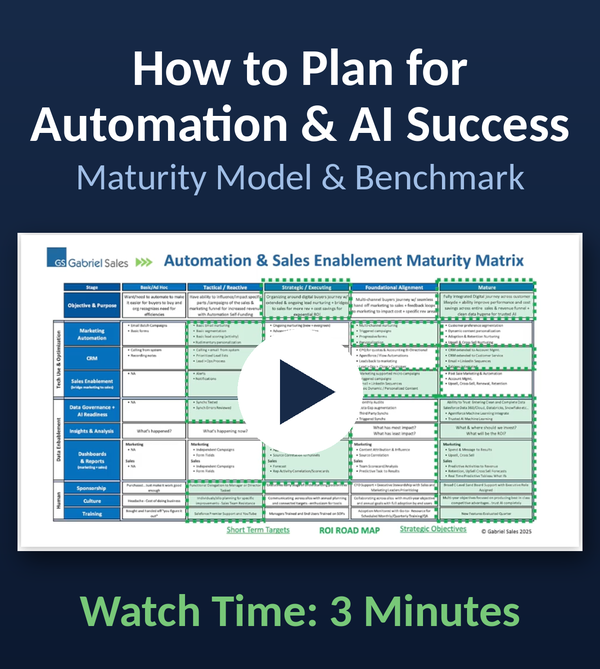
How Can Leaders Quickly Plan for Success Using an Automation Maturity Model to Address 7 Critical Strategic Question
(3:40 minutes) We use Gabriel Sales’ proprietary automation maturity model to quickly benchmark where your organization stands across sales ops and automation technology, data, and AI readiness. We then provide a clear and prioritized roadmap to help you understand where and how to close the gaps.
Section 4: The 7 Business Advantages of Outsourcing Marketing Automation, Data Governance and Sales Operations
If the analysis in the sections above is familiar and/or if you recognize your organizations gaps in any of the discussion areas then the case for outsourcing deserves a serious look. Here is what outsourcing some or even specific area means for you in business terms.
1. Speed to Competency with No Ramp/Learning Curve
An outsourced marketing operations support team brings tested frameworks, proven campaign structures, and certified platform expertise to your organization on day one. There is no onboarding period during which they are learning how to connect and leverage your tools. There is no learning curve during which they are building confidence with the features and possibilities of your Salesforce systems. The execution gap closes immediately rather than over a period of months.
Companies using marketing automation to nurture leads see a 451% increase in qualified leads compared to organizations that aren’t doing this effectively. That number is not the ceiling. It is what you should expect when your marketing team’s great content, smart strategies and hard work is supported by a team that can leverage your tools properly to enable what well executed automation and now AI can deliver. Most companies have already paid for all the tools they need for success. But not they do not execution expertise required for the level of performance they were promised. The distance between where you are and where properly executed automation takes you can start to be addressed in weeks rather than months (or even years) when the team doing the technical work, data management and managing the processes already knows how to get all the jobs done.
2. A Team for the Cost of a Headcount
Outsourcing does not buy you one person’s skill set. It can buy you a blended team based on your gaps: certified Salesforce administrators, marketing automation specialists, data management & data governance practitioners, sales enablement specialists, campaign managers, and strategic oversight each contributing the specific expertise their discipline requires, working as a coordinated unit. In most cases, this blended team costs less than a single senior full-time hire when you account for salary, benefits, recruiting fees, management overhead, and ramp time.
This matters because the scope of modern marketing operations exceeds what any single hire can cover because the task requirement in any single area are part time. When you hire one person to do the work of several disciplines, they will inevitably go deep on the areas they’re strongest in and leave gaps in the others. Outsourcing eliminates the gaps.
3. Proven ROI From a Verified Playbook
The ROI case for well-executed marketing automation is not theoretical. Nucleus Research found a 14.5% increase in sales productivity when marketing automation is properly leveraged for lead scoring and sales enablement. Sales teams using buyer-centric enablement content achieve 28% higher win rates than those working without it. For every dollar invested in marketing automation, companies see an average return of $5.44. And automated email sequences generate 320% more revenue than non-automated campaigns.
These results are available to any organization with the right tools and the right execution capability.
How Does Achieving Successful Automation + Sales Enablement Impact the Productivity and ROI of Your Sales and Marketing Operations
(7:00 minutes) Learn about the concrete business outcomes that well-executed automation and sales enablement delivers, and understand what changes operationally when your tech stack is fully supported..
4. Variable Cost Structure and Financial Flexibility
Every full-time employee is a fixed cost. Once hired, they represent a budget line that requires justification regardless of whether the workload demands on their full capacity in any given month. Outsourcing converts that fixed cost into a flexible monthly engagement. You scale up during a product launch, a major campaign push, or a Salesforce implementation. You scale back during a slower period. This flexibility is structurally unavailable when you’re managing in-house headcount, and it matters especially for organizations already operating under tightened budgets.
5. Continuity, Resilience, and No Knowledge Loss
One of the most underappreciated costs of the lean in-house model is the knowledge that walks out the door every time someone leaves. When the person who knows how your Salesforce instance is configured, how your lead scoring model works, and why certain automation rules and workflows were built the way they were decides to move on, that institutional knowledge is gone. The next person starts typically from scratch, often without even knowing what they don’t know.
An outsourced team maintains that continuity as a structural feature of the model. The knowledge lives in documented processes, in systems, and in a team, not in a single person’s head. There is no single point of failure, no campaign emergency when someone is out, and no organizational reset when someone leaves.
6. Cross-Industry Best Practices and Cross-Pollination Means You Start Ahead
A team that has executed hundreds of implementations across multiple industries and verticals brings an understanding and a library of what works and what doesn’t. They have seen the campaigns that didn’t convert and understand why. They have seen the lead scoring models that created sales friction and know how to calibrate them differently. They have seen the data governance failures that made AI deployments untrustworthy and built the frameworks and connected the required fields to prevent them.
Most organizations that are building their marketing operations in-house are starting from scratch and experimenting, iterating, and learning at their own cost. Outsourcing eliminates the trial-and-error phase. Your strategists can implement and innovate faster. You get to start where a mature team’s portfolio already landed, not where they started.
7. AI and Data Readiness as an Ongoing Practice
This is the advantage that is least discussed and most consequential in 2026 and 2027.
The marketing automation market reached $6.65 billion in 2024 and is projected to more than double to $15.58 billion by 2030, driven in large part by AI integration directly into the platforms you’re already using. The competitive pressure to deploy AI in your marketing and sales operations is real, and it is accelerating.
But the bottleneck is not the AI tools themselves. The bottleneck is the data foundation beneath them. AI outputs are only as trustworthy as the data flowing into the systems generating them. Duplicate records, broken field mappings, inconsistent data entry, unresolved sync errors between your marketing automation platform & Salesforce are just some of the conditions that make AI unreliable. Most of these issues are maintenance problems. They regenerate continuously without a governance framework and data hygiene managers and/or automation specialists in place to prevent them.
After a one time clean up an outsourced marketing automation specialist and/or marketing operations teams maintains that data foundation as a continuous practice as part of their ongoing operational discipline. For organizations being asked by leadership to get AI-ready, this is often the fastest and most reliable path.
Section 5: A Decision Framework: When Outsourcing Is the Right Call and When You Should Build In House
Outsourcing is likely the stronger strategic decision when:
- You are just getting started implementing Salesforce and/or Marketing Cloud Account Engagement. Especially if you are migrating from an existing platform like Hubspot where and outsourced partner can help you seamlessly migrate what was already working and build the new enhancement faster with best practices.
- You have Salesforce and marketing automation in place but aren’t seeing consistent, measurable ROI from the investment. The tools are there but the execution infrastructure to run them effectively isn’t. Or the person running them is stretched too thin to run them well.
- You are ready to migrate from Marketing Cloud Account Engagement (Pardot) to Marketing Cloud Next to leverage Salesforce’s native AI solutions.
- Your team’s workload has expanded to the point where strategic and creative work is being consistently crowded out by operational and technical tasks. If your best marketing people are spending significant time troubleshooting integrations, managing data quality issues, or trying to figure out why an automation isn’t firing correctly, you have a structural problem that adding one more hire won’t solve.
- You need technical depth across multiple disciplines, Salesforce administration, marketing automation management, data governance, sales enablement configuration and AI readiness where it doesn’t make practical or business sense to hire full-time resources to plug specific gaps.
- You’re under pressure to scale marketing output without proportionally scaling headcount.
- You’re being asked to deploy AI and recognize that your data isn’t ready for it. The path from “our data is a mess” to “our AI is producing trustworthy outputs” runs directly through the data governance and system configuration work that outsourced operations teams implement and manage as a core competency.
- You are concerned with compliance surrounding HIPPA and GDPR.
Building in-house may make more sense when:
- You’re at enterprise scale where a fully-staffed internal marketing operations team is the industry standard, your budget supports it, and the competitive complexity of your organization genuinely requires deep institutional knowledge that an outside team would struggle to replicate.
- Your marketing operations work involves highly proprietary processes, sensitive data environments, or regulatory requirements that make external access to your systems genuinely difficult to manage.
- You have the time, budget, and infrastructure to recruit, train, and retain senior talent across multiple specialized disciplines simultaneously and your leadership has realistic expectations about how long that build takes.
- If you have an industry leading brand or a compelling mission you should be able to attract certified ops talent that would have been inaccessible five years ago.
- If you have a company where marketing ops and or sales ops capability is also you core product offering or you are a company where go-to-market sophistication is the product differentiator you should consider building in house.
Section 6: The Questions Worth Answering Before You Decide
If you’re at an inflection point where you need more capability and capacity and have decided that mature automation, sales enablement and a strong AI foundation are all critical here are the questions that will give you the clearest picture of which direction to go and what you should keep in house vs. outsource to a proven resource. It is possible to run hybrids based on your needs, goals, specific gaps and situation.
-
What is our current fully-loaded cost to maintain marketing operations in-house including salary, benefits, recruiting fees, management time, and the cost of turnover when it happens?
-
Who is currently managing and executing the tasks required to meet and exceed or goals? Is this their core competency? Are we distracting them from higher priority and/or higher revenue producing tasks? Is this causing a retention issue for top talent?
-
What specific technical expertise are we missing right now, and what would it realistically cost to hire for it? Do we even understand what expertise we need?
-
How long would a new hire take to be meaningfully productive in our specific Salesforce environment? And what is the cost, in pipeline/insights/AI readiness, of that ramp period?
-
Are we actively using the Salesforce and marketing automation features we’re already paying for? If the answer is no, what’s preventing adoption? Is adding headcount the right solution to that problem? Is it training? Or is it a different kind of support?
-
Is our data clean enough and connected enough for AI deployment in the next 12 to 18 months? If we ran an honest audit of our Salesforce and marketing automation data quality today, would the results support the AI roadmap we’re communicating to leadership? How much pressure would data readiness relieve for our team?
-
What would our existing team accomplish if they weren’t carrying the operational and technical execution load? If we could give our strategists and creative people back the hours they’re spending on tech management, troubleshooting, feature education, what would they do with that time. What would that time and focus be worth?
Section 7: Recommended Next Steps if the Math and Potential ROI Points Toward Outsourcing
If this analysis points toward outsourcing and the question shifts from if to who, when and what Gabriel Sales can help.
We can quickly help get you started answering the “who” and “what” with our free technology health check that is followed by our risk-free audits and tactical road maps.
We make getting started easy because we know most leaders are already overwhelmed. And we are confident that we can quickly build trust with measurable results. Because after 15 plus years of helping companies build automated sales enablement and marketing engines we understand that the difference between for most organizations moving from mediocre to successful results is working with a partner that can provide the required certified technical expertise, sales and marketing operations experience and the proven track record collaborating with teams with support customized to align with your specific situation.
We are not a generalist digital agency that also does Salesforce. We are not a solo consultant who becomes your single point of failure by a different name. We are fully managed team with certified expertise across the full stack and a proven methodology for getting organizations from where they are to where they need to be. We love what we do and always lead with full transparency because when you win we win and that’s the easiest way to sell.
See how we’ve done this for companies like yours →
Learn what makes Gabriel Sales different →
More about us and FAQs →
Why Gabriel Sales Is the Right Solution for Companies Serious About Marketing Automation and Sales Enablement Success
(8 minutes) Learn how Gabriel Sales’ blended team model delivers certified expertise across the full stack from day one to make the complex simple, all with minimal ramp time, risk, or fixed cost of building in-house.
Source Reference List
All statistics cited in this page with direct source links:
- Gartner: 67% of B2B buyers prefer a rep-free buying experience (March 2026)
- Gartner: B2B buyers spend only 17% of buying time with vendors
- 6sense: 81% of buyers pick a winner before talking to a sales rep (2025)
- Gartner: Average B2B purchase involves 6–10 decision makers
- Marketing Week: Marketing budget and burnout statistics (2025/2026)
- Gartner: 74% of B2B buyer teams demonstrate “unhealthy conflict” during purchase decisions (2025)
- Oracle / Nucleus Research: 451% increase in qualified leads; 14.5% sales productivity gain
- G2: 28% higher win rates with buyer-centric sales enablement
- Revenue Memo: $5.44 return per $1 invested in marketing automation
- Thunderbit: Automated emails generate 320% more revenue
- Mordor Intelligence: Marketing automation market $6.65B in 2024, projected $15.58B by 2030