B2B Marketing’s Shifting Role and Overview of Marketing Ops New Full Funnel Support Mandate Video Series (Educational Video)

B2B Marketing’s Shifting Role and Overview of Marketing Ops New Full Funnel Support Mandate Video Series (Educational Video)

B2B Marketing’s Shifting Role and a quick overview of our 12 Part Educational Video Series that explains  “Marketing Ops New Full Funnel Support Mandate” Video Series 

(Watch Time – 5:50)

Summary

This B2B Marketing’s Shifting Role Video presentation addresses the rapidly evolving marketing landscape where roles have transformed more in the past five years than the previous fifty, with marketers increasingly overwhelmed by technology demands. The speaker discusses how marketing responsibilities have expanded beyond brand and lead generation to include sales support and the entire customer revenue cycle. With 56% of marketers feeling overwhelmed and 48% experiencing burnout, the presentation focuses on how Gabriel Sales can help organizations optimize their marketing automation, Salesforce capabilities, and AI processes. The three-part presentation covers the current marketing situation and future with AI, challenges teams face with technical support barriers, and Gabriel Sales’ solutions including proven frameworks, risk-free audits, and flexible service options. The goal is to help B2B companies and digital agencies reduce team frustrations while maximizing 

Transcript

The Evolving Role of Marketing

The marketing function is in the middle of an accelerating shift in roles and responsibilities. Several years ago, Adobe’s CMO made the clear point that because of the increased role of content marketing and technology, that marketing’s role has changed more in the past five years than the preceding fifty years as their responsibilities expanded from brand and lead generation to lead development. And Gartner now predicts with the rapid increase of automation technologies, data, and AI, the next five years will be even more disruptive than the past five years.

And as part of this disruption, Gartner also predicts that marketing will see increased accountability for sales and closing support. It will eventually extend well beyond the initial close through the entire customer revenue cycle.

The Burden on Marketing Teams

And with all these new technologies, processes, strategies, and channels to manage, fifty six percent of marketers are feeling overwhelmed keeping up, and forty eight percent are reporting feeling burned out over the past twelve months.

The Goal of This Presentation

So how do marketing leaders cost effectively alleviate their team’s frustrations and struggles with their evolving tech stack and support their team’s capability and capacity to maximize their use of marketing automation, sales enablement, and AI processes to accelerate specific stages of the funnel. The overall goal of the first seventy percent of this presentation is to explain why and how increasing your marketing automation and Salesforce capabilities, capacity, and support is critical at b to b companies and digital agencies when to reduce their team’s frustrations with technology, data hygiene, and advanced AI, and simultaneously empower your organization to achieve more with less.

Key Areas We Will Cover

We will discuss the impact of this support in specific areas, including the efficiencies and the competitive advantages your organization will gain when you optimize your tech stack to increase adoption, use, and the ROI of multiple processes, accelerate your funnels with proven automation workflows and lead scoring, scale sales productivity with sales enablement tools, increase visibility for smarter decisions with dashboards, attribution, and insights, implement best practice data governance for improved personalization, AI readiness, and AI deployments, and receive ongoing training and stewardship to keep up with your constantly evolving tech stack, all geared towards helping you build mature automation processes across the entire customer life cycle.

And throughout the presentation, we wanna help you decide if we are the right fit to support your team so you will gain an understanding of how Gabriel Sales can deploy certified technologists and seasoned frontline sales ops and marketing professionals to maximize your processes, tech stacks, data, and reporting with proven and strategic best practices.

Structure of this “Marketing Ops New Full Funnel Support Mandate Video Series”

We’ve organized this presentation to help organizations think about how to generate short term results while building towards long term success.

These insights and tips have been developed over ten plus years using these tools, encompassing hundreds of implementations and thousands of optimizations and campaigns, including leveraging AI for multiple efficiencies and tech stack consolidations on top of Salesforce in these datasets. We’ve divided this presentation into three parts in twelve smaller sections.

Part One: The Current Situation and What’s Next with AI

In part one, we discussed the current situation and with AI, what happens next. Topics will include why and how marketing’s roles and responsibilities shifted and where they’re headed next, how this shift permanently changed b to b buyers’ needs and expectations during the sales process, how these needs and expectations have now extended to the entire customer funnel, what is now required for your team to successfully meet and exceed your buyers’ needs and expectations, and the ROI you can expect from mature automation and sales enablement, especially with the addition of AI.

Part Two: Challenges Most Companies Face

Part two addresses challenges most companies face, including the specific tactical and technical support barriers most teams now need to overcome, what this type of support looks like and why it’s hard to find, the frustrations and challenges this lack of support creates for your teams, and the increased strategic complexities and disadvantages this can create for marketing and sales leaders, especially if your data and data governance is not AI ready.

Part Three: Why Gabriel Sales Is the Right Solution

In part three, we explain why Gabriel Sales is the right solution for companies serious about short term results and long term success. We share our proven frameworks, capabilities, services, and pricing models. We explain our risk free audits to identify quick wins and to build long term road maps, and we explain the flexible options we provide to help you achieve your goals, including technical quarterly sprints, point solutions, consulting projects, managed services, and training, all anchored in our proprietary maturity model to ensure alignment, quick results, and smarter long term investments.

We then conclude with what makes us unique in our value, including an overview of our fifteen year history in sales and marketing ops, data analytics, and our early experience with…
 

Sales Funnel Results With Lead Nurturing

Sales Funnel Results With Lead Nurturing

Sales Funnel Results With Lead Nurturing + Demand Generation

(Watch Time – 4:00)

Summary

In this video we explain sales funnel results with lead nurturing, how long it takes to launch a demand generation and lead nurturing engine, and the sales funnel results you should expect running a campaign to 5,000 well targeted buyers.


Transcript

Introduction

When you examine the entire sales funnel, lead gen is the first step in the sales process and in the buyer’s journey. Lead gen’s job is to move buyers into the top of the sales funnel by creating awareness and curiosity about your solution. And then demand gen and lead nurturing takeover. Demand generation and lead nurturing automate the pre-sales education process as the buyer goes through their second step of consideration and their third stage of preference. This process keeps the seller top of mind as the buyer moves deeper into the funnel.  And when the buyer’s ready, sales takes over to help them make a decision.

As discussed in other videos in much greater detail, Digital Demand Center specializes in demand gen and lead nurturing to put well educated buyers into your CRM for your sales team to develop and close. And as part of our service, we also support your initial go-to-market strategy, awareness, and lead gen campaigns if you don’t already have a database built or a lead gen vendor or process you trust.

Time to Launch

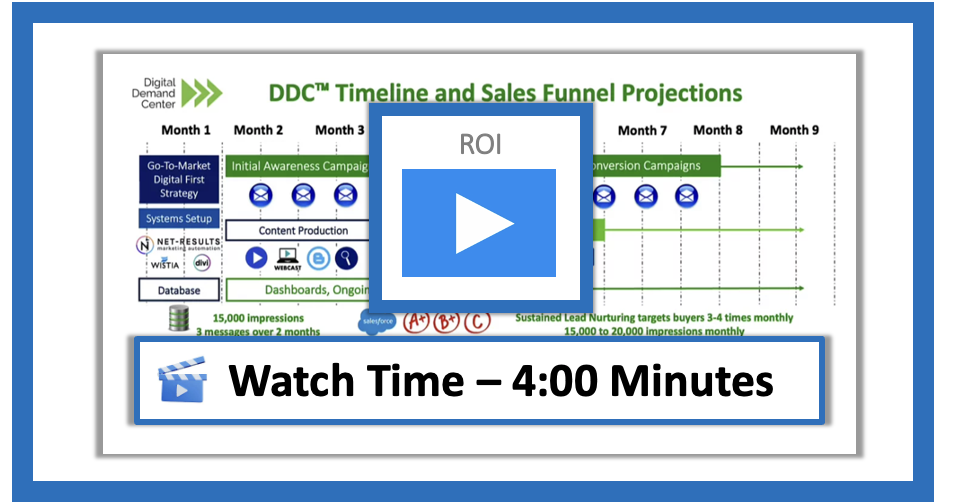
To fully launch a demand generation engine, including our solution Digital Demand Center, typically takes about three months. In the first month, you can craft your go-to-market strategy, implement your automation systems, and deal with cleaning, augmenting, and building your database. In months two and three, you can run your initial awareness campaigns to generate early stage leads, augment gaps in your sales education content production, access your marketing automation and sales dashboards, start your reporting, and start the ongoing optimization of your marketing tech and campaigns. By month four, you are starting at execute, lead nurturing, and you’re starting to see your initial flow of sales ready leads in your CRM.

Projected Sales Funnel Results

How long does it take to start seeing the results?  So to make the math easy, let’s assume we start your awareness campaign with 5,000 targets. These 5,000 targets will be sent three different messages for the equivalent of 15,000 impressions. So, early in your campaign, you should see about 200 to 400 early stage marketing qualified leads by month four.  Marketing Qualified Leads are defined by demonstrating initial engagement with your content.  They know who you are and the basics of what you do. And if you need to be aggressive, you can start calling these early stage leads.

Then typically by month five, the marketing engine is doing what it was designed to do as the lead nurturing campaigns continue to target your buyers three to four times a month for and additional 15,000 to 20,000 impressions a month. And as a direct result of this pre-sales education, by month five, you should be producing 5 to 10 sales-ready leads a month.  Sales Ready Leads are defined by potential buyers that are engaging with multiple pieces of content, watching videos and visiting key pages that predict that they are getting ready to short list and make a decision.   This number of “Sales Ready Leads” should increase to 7 to 12 by month six. That hat number should hold steady or grow to 10 to 15 sales ready leads by month eight.

Cost Per Sales Ready Lead and Cost Per Conversion

This means that by month eight, with your steady state investment of about $3,200 a month and your launch fee is over, your engine should be producing between 7 to 15 well-educated buyers a month indefinitely. So, this means not counting your startup costs in any additional content costs that by month eight you should be generating sales ready leads at a high-end cost of $450 per sales ready lead, and a cost of $1,000 per opportunity to a low-end of $210 per sales ready lead in a cost rounding up of about $500 per opportunity.

With a closing rate of 33%, this means you should be paying between $1,500 to $3,000 per closed deal. And probably the best news for companies that are committed to lead nurturing and leveraging Digital Demand Center is that once you’ve launched your engine, the only thing that will prevent you from scaling your sales funnel and lowering your cost of sales is your ability to add more targets to the front-end of your engine. Because doubling your targets from 5,000 to 10,000 will eventually over a year or two and into year three, double your sales ready leads, which over time will cut your cost in half after about a year to 18 months of sustained lead nurturing.

How to Build and Edit Reports in Salesforce  – Sales Tech Tutorial

How to Build and Edit Reports in Salesforce – Sales Tech Tutorial

Learn how to edit reports in Salesforce to quickly increase visibility and help your sales team increase productivity

(Video Length 6:00)

Topics Discussed in How to Edit Reports in Salesforce

Reports are one of the most powerful tool in Salesforce to ensure managers can support and enable sale reps to hit their daily, weekly and monthly targets.

In this quick use case video we explain the basics of building reports so sales managers (and reps if they have access) can build reports to ensure they are tracking to goals.  Building solid reports is fundamental to building dashboards and visualizations.


What You Will Learn:

  1. Starting in Reports Tab
  2. How to use fields
  3. How to access report outlines
  4. How to filter information you see in reports
  5. How to define dates for reporting
  6. How to set up reports for dashboards
  7. How to group by lead/opportunity status
  8.  How to add charts
  9. How to edit reports to refine them

About The Presenter 

Carol Springer

Founder Gabriel Sales

Carol has been working with the Salesforce platform since 2004 and Salesforce Account Engagement (Pardot) since 2012. She has launched over 100 successful Salesforce and Pardot implementations. Carol and her team hold multiple Salesforce Certifications including:  Salesforce Administrator, Pardot (Account Engagment) Specialist,  Sales Cloud, Salesforce Developer and Service Cloud Consultant.

Carol spent her early career at Gabriel Sales as a front line executive and sales professional launching, hiring, managing and then transitioning sales and marketing operations for dozens of B2B companies so she understands how these technologies and systems can be leveraged to produce real sales results for business and P&L owners. Carol started her professional sales career as both an inside sales and enterprise sales rep for several Silicon Valley Start Ups.  She founded Gabriel Sales in 2004 and shifted her focus to managing day-to-day sales and marketing operations for B2B companies of all shapes and sizes.

Salesforce and Salesforce Account Engagement Pardot Training YouTube Channel

Visit Gabriel Sales’ YouTube Channel – “Sales Tech”

Visit our YouTube Channel for additional basic training for Salesforce and Salesforce Account Engagement users just getting started.   These short training videos will help users just getting started get more out of their systems faster.

How to Log Calls in Salesforce  – Sales Tech Tutorial

How to Log Calls in Salesforce – Sales Tech Tutorial

In this 2-minute video we teach a business development and/or sales reps how to log calls in Salesforce and best practices for capturing data to ensure recall, accurate tracking and reporting.  

(Video Length 2:00)

Topics Discussed in How to Log Calls in Salesforce

In this quick use case video we help reps find where to find their activity and how log calls in Salesforce to ensure reps are recording information accurately. When information is captured correctly, they can find that information in the future to help move deals forward. It also ensures their activity so reps and managers can run accurate “Activity Tracking” reports.


What You Will Learn:

  1. Where to locate your leads
  2. Where to log activity
  3. Best practices for recall and reporting activity
  4. Where to add notes
  5. How to ensure information was saved
  6. How to edit after saved

About The Presenter 

Carol Springer

Founder Gabriel Sales

Carol has been working with the Salesforce platform since 2004 and Salesforce Account Engagement (Pardot) since 2012. She has launched over 100 successful Salesforce and Pardot implementations. Carol and her team hold multiple Salesforce Certifications including:  Salesforce Administrator, Pardot (Account Engagment) Specialist,  Sales Cloud, Salesforce Developer and Service Cloud Consultant.

Carol spent her early career at Gabriel Sales as a front line executive and sales professional launching, hiring, managing and then transitioning sales and marketing operations for dozens of B2B companies so she understands how these technologies and systems can be leveraged to produce real sales results for business and P&L owners. Carol started her professional sales career as both an inside sales and enterprise sales rep for several Silicon Valley Start Ups.  She founded Gabriel Sales in 2004 and shifted her focus to managing day-to-day sales and marketing operations for B2B companies of all shapes and sizes.

Salesforce and Salesforce Account Engagement Pardot Training YouTube Channel

Visit Gabriel Sales’ YouTube Channel – “Sales Tech”

Visit our YouTube Channel for additional basic training for Salesforce and Salesforce Account Engagement users just getting started.   These short training videos will help users just getting started get more out of their systems faster.

B2B Buyer Trends

B2B Buyer Trends

B2B Buyer Trends — Seven Things to Know

(Watch Time – 8:00 Minutes)

Summary of B2B Buyer Trends video

In this short educational  video we will give you a quick overview of B2B Buyer Trends, including:

  1. Why B2B leads and buyers need and want lead nurturing and digital pre-sales education
  2. Why buyers now expect ongoing lead nurturing and content marketing at every stage of their buyers’ journey
  3. The specific types of contents buyers use during their pre-sales education and buying process
  4. Buyers increased desire to avoid sales development reps (SDRs) until they feel educated and are ready to buyer
  5. When video is the most preferred and successful type of content
  6. How far and committed the top sellers are to sales automation and digital first sales
  7. The ROI companies committed to lead nurturing and a digital first sales are experiencing

This video (an expert from our extensive four part On Demand Training Seminar – The Digital First Transformation and Sales Automation)

Transcript of B2B Buyer Trends Seven Trends — Seven Things to Know.

Why Leads/Buyers Need Lead Nurturing

First, most buyers are not ready to buy when they first start their digital education. Initially, most buyers are just trying to figure out how to solve a problem. Less than 3% of initial email opens are ready to buy, and even more surprisingly, less than 20% of your pay per click or SEO leads or active buyers. But the positive here is that about 80% of all these early stage leads, we call them marketing qualified leads, will spend money within three to 18 months. So once they engage, you have a short list of potential buyers that expects you to educate and nurture them for an extended period of time, which means your marketing team can’t just run lead gen campaigns and expect the same sales results.

Buyers Now Expect Ongoing Lead Nurturing and Content Marketing at Every Stage of Their Buyers’ Journey (0:48)

Buyers now expect you to share content at every stage of their buyer’s journey to help them move systematically through their process. This starts by you helping them to identify and understand what problems your solution is designed to help them solve through their shortlisting process and even into their validation and consensus building stages. This means you need lead generation campaigns to create awareness to help the buyer understand what problems you solve. Then buyers also expect you to run nurturing campaigns, including both buyer education campaigns and sales automation campaigns to help them with their consideration stages and their preference stages.

Successful Lead Nurturing and Sales Automation Requires Multiple Types and Formats of Digital Sales Education (1:33)

And during these different types of campaigns, buyers want you to share the appropriate type of content in multiple channels so they can control their own buyer’s journey, and they expect you to be prepared to touch them at least 21 times for you to earn their brand awareness and initial trust in to start that process. Most buyers still overwhelmingly prefer to learn about new solutions in email marketing campaigns that are supported by educational content.

However, if you don’t eventually support these email campaigns with paper per click, social media and SEO campaigns, you’ll miss 33% of the market who prefer these channels. And at this stage, the type of content buyers prefer in all three channels are short. How-to videos, educational blog articles in industry insights and stats that help educate the buyer and also help you to demonstrate thought leadership. Then once that lead is generated, you need to be prepared to share multiple types of content to nurture and create demand for your solution. Because buyers leverage all types of content to move a decision forward if they’re consideration and preference stages to become educated enough to make a decision. So what’s required for success? In a recent Merkel survey of B2B buyer trends, 78% of buyers stated they used case studies and use cases in their process, 76% used webcast educational videos and educational blog articles.

68% used white papers, and in 20 21, 50 4% of B2B buyers are now using podcasts. So you need to be prepared to use a wide variety of content in multiple channels to make it easy for the buyer to buy using your buyer education in sales automation campaigns

Buyers Want to Avoid Sales Development Until They Feel Educated and are Ready to Buyer (3:43)

Perhaps the biggest impact of this digital transformation is that buyers now want to avoid sales reps until they feel educated. As a result of this buyer preference for digital first education, 64% of sellers state, they’re now less dependent on sales reps. 80% of buyers don’t want to speak to an SDR until they have completed their pre-sales research. 33% moving to 44% for millennials want to avoid sales completely if possible, and most buyers won’t engage with a sales rep until they’ve consumed at least six to 12 pieces of content. Digital content is now replacing some of the most time consuming in historical tasks of the sales development rep, first and foremost, being all the time and money it takes for pre-sales education of the buyer.

Video is the Preferred Content for Pre-Sales Education and Mid-Stage Buyer Education (4:33)

And in large part, most of this pre-sales education is now being done with video because when it comes to content, we’re both video and text are available on the same page. 72% of buyers would rather use video to learn about your solution using video and email campaigns boost open rates and clickthroughs and video posts have the highest engagement in social media campaigns. And probably the biggest bonus of video is that it leads to conversions or at least predicts conversions because 25 to 45% of buyers that watch a webcast convert into a sales opportunity, and most buyers state they’re ready to engage with sales after watching three to five videos.

Your Most Successful and Largest B2B Sales Competitors are Already Striving for Sales Automation (5:22)

The next thing that’s important to understand about this transformation is the competitive landscape. So Gabriel Sales has been dealing with tech and tech marketing for a long time, and we’ve seen the pendulum swing back and forth between giving SMBs an ability to compete effectively and giving the enterprise the advantage. And right now, the enterprise companies have an edge because they’ve taken meeting the needs of the digital buyer seriously and have driven digital content deeper into the sales process faster.

This was one of the really big changes that occurred during the pandemic because the enterprise was better equipped to immediately be able to deploy their existing marketing resources to digital marketing to support the virtual and remote sales process, and they were able to fund new technologies faster and more effectively when travel budgets were cut. As a result, 75% are now leading with Digital First to support their entire pre-sales process, and in a few short years, the majority of enterprise companies already believe that these new sales processes are as or more effective than their historical processes. In a full 85% of enterprise companies are now committed to building a digital first go-to-market sales process moving forward. And over the next several years, digital spend is once again predicted to double Gartner’s future of sales. Research is now predicting that by 2025, 80% of B2B sales interactions will occur in automated in digital channels.

To compete for and win business will require a commitment to content marketing and nurturing.

Sellers that Implement Lead Nurturing and Digital First Sales Automation Win More Business and Drive More Revenue (7:13)

Finally, what can your business expect when you embrace this digital first transformation? Buyers are already dramatically rewarding sellers for a digital first sales and nurturing process. Sellers that are committed to content marketing after the initial lead has been generated, see their sales team’s opportunity pipeline grow by over 450% in nine to 18 months. It’s harder to get a seat at the table with your buyers if you don’t provide content after you generate that initial lead. And most importantly, and most exciting sellers that do a good job helping buyers buy digitally are now closing at two x the rate of sellers that don’t.


Demand Generation vs Lead Generation

Demand Generation vs Lead Generation

In this video you will learn the difference between lead generation vs. lead nurturing and demand generation

Watch Time – 4:00 Minutes

Summary

This short video is packed with hard data and concrete numbers as we compare Demand Generation vs Lead Generation and explain the strengths and weakness of both a lead generation process and demand generation process.  In this educational video we detail:

  • The different purposes of lead generation and demand generation
  • The results you can expect if you are running a lead generation process
  • The results you can expect if you add a lead nurturing and demand generation process
  • The impact lead nurturing has on creating well educated sales ready leads and increased conversions
  • The cost savings you can expect automating  your pre-sales process  

This video is an excerpt from The Differences Between Lead Gen vs. Demand Gen and the Impact on Your Sales Funnel Part 4 of 4 of our free comprehensive free 4 training seminar on how to effectively sell to the modern The B2B Digital First Transformation Webinar Series.


Transcript

Defining the Role of Lead Generation and Demand Generation

When you examine the entire sales funnel, Lead Generation is the first step in the sales process and buyer’s journey. Lead Generations job is to move buyers into the top of the sales funnel by creating awareness and curiosity about your solution, and then Demand Generation and Lead Nurturing takeover to automate the pre-sales education process as the buyer goes through their second step of consideration and their third stage of preference.

This process keeps you top of mind as the buyer moves deeper into the funnel and, when the buyer is ready, sales takes over to help them make a decision.

The Stages and Sales Funnel Conversion Results of a Lead Generation Process

Lead Generation is primarily a sales driven process because the seller controls the majority of the buyer education. Marketing or a cold caller targets and generates the lead. The lead is then passed to sales regardless of how ready they are to buy. Then sales invests time, money, and resources with one-on-one pre-sales education, demonstrating the solution, explaining its value, and qualifying that buyer for need, interest, and fit.

After all this time and effort, about 10 to 20% of leads are turned into opportunities and about 80% are either not the right fit or too early in their buying process and not ready to buy. These leads are discarded, with sales promising to follow-up at some future date, which only happens about 20% of the time. This is a continuous cycle requiring a continuous investment in new leads.

The Stages and Sales Funnel Conversion Results of a Demand Generation and Lead Nurturing Process

In sharp contrast to Lead Generation, Demand Generation is a buyer driven process because the buyer engages on their timelines.

A Demand Gen process starts the same way by targeting potential buyers to create awareness and collecting as many leads as possible. But then marketing, not sales, nurtures those leads, sharing educational pre-sales content the buyer can engage with on their timelines.

Demand Generation digitally automates your pre-sales process to make it easy for the lead to consider how your solution can help them solve their problems to become a marketing qualified lead until they learn how your product works and what success looks like so they prefer your solution. While all this is happening, your marketing tech stack is scoring your buyer’s engagement to predict purchase intent until they become a sales ready lead.

The first big difference is pre-sales automation and lead nurturing gets rid of all the time, money, and expense of the one-on-one pre-sales education that’s required in a standalone Lead Gen process.

The second major difference is the quality of sales ready leads. Typically, your sales team can convert about 50% of sales ready leads into opportunities versus the 10 to 20% of a Lead Gen process. Sales will only discard about 10% versus the 80% that are discarded in the Lead Gen process.

A final major difference is that they can recycle 40% back into the Demand Gen engine for extended nurturing to keep them warm until they’re ready to buy. This recycling is a major advantage Demand Generation has over a competitor running a Lead Gen process that discards 80% of their lead investment because most discarded leads buy from someone in three to 18 months so nurturing eventually turns another 25% of these recycled leads into opportunities.

Conclusion

Over time, all these incremental gains stack up, and this is why companies running a Demand Gen process generate 450% more opportunities and close two times the deals over their competitors when compared to companies that don’t.