by Glen Springer | Nov 23, 2012
 B2B marketing is changing dramatically and it’s going to take an even greater commitment by marketers to embrace and execute effective B2B marketing. Here are the top ten things I believe you need to commit to in 2013 to be part of the transformation B2B marketing is going through.
1) Commit to multimedia content marketing that truly educates your potential buyers. You want the content to be so strong that your prospects have full-heartedly believe that they are more intelligent around the topics presented in your content than they were before they consumed it. You want it to be diverse in type (video, eBooks, blog posts, webinars, etc.) because people learn differently (and search engines will reward you for the diversified content types).
2) Develop and adhere to a content publishing schedule. This is important for a few key reasons: 1) keeping all responsible parties on track regarding the content creation and publishing cycle 2) establishing a pattern with your audience so they confidently expect new education on a regular basis 3) the ability to batch produce, plan ahead and pre-schedule posting so that when the inevitable interruption deters you, you have a backup plan to get the content out on time anyway.
3) A greater commitment to search engine optimization. The foundations of SEO are in flux with the current state and changes in social media, content marketing, vertical search, continuous search algorithm changes, and more. We believe a full-time commitment to SEO is necessary for all B2B marketing campaign portfolios. It often produces the strongest leads and, when done correctly, has longer lasting passive lead generation benefits that other B2B marketing campaigns.
4) Develop a social media marketing plan. B2B Marketers need to develop and execute an actual social media plan with functions in place to measure the social media ROI. This plan should at least include the use of Facebook, Twitter, Google+, LinkedIn and other social forums that have an industry-related focus.
5) Dig deeper into your web/data analytics goldmine. First, make sure your analytics data is well organized in some type of central reporting area/dashboard. Secondly, establish regular review periods to assess current performance across your KPIs against historical benchmarks. Third, set up instant alerts that notify you of key opportunities or concerns.
6) Implement marketing automation software. 2012 was my maiden voyage into the world of b2b marketing automation software. On the consumer marketing side, I’ve used some tools that do some components of marketing automation, but nothing like what I’ve seen done in the past 6 months. Tools like Pardot, Marketo, Eloqua and a few others are changing the B2B marketing game big time, yet the adoption rate is is still low enough to where you can gain some true competitive advantages if you implement in a timely manner. There are more than a dozen recommended marketing automation strategies that I can think of. Look for an additional blog post on this, but in the mean time read this blog post on how marketing automation helps sales teams.
7) Optimize your landing pages. You are likely sending people to various landing pages through your different marketing channels. Additionally, there are organic landing pages that reveal themselves over time (using Google Analytics data). This is often your best chance to get someone engaged with your company – make it count. There are countless resources for “landing page optimization” some with opposing views, so my number one tip for landing page optimization is make sure you split test.
8) Improve your website’s user experience. Some examples of ways to do this include: 1) Improve your page load time. Page load time is a positive or negative user experience. A fast load time gets potential prospects to your content/message faster. Slow load time keeps your prospects waiting or worse, going elsewhere. People doing research want information fast. If your site doesn’t load swiftly, you are likely losing leads. 2) Consistent and easy to use navigation. You want users to be regular visitors to your site (either for purchases or continued trust building with your site as an authoritative hub). Good navigation helps your users get to where they need to go with ease. This also includes a good internal search engine. 3) Make it easy for them to take the most desired action on each respective page they are visiting, e.g. when offering a free whitepaper, make it abundantly clear what they need to provide and how exactly the whitepaper will be delivered.
9) Create a greater mobile experience for your websites. Whether its a responsive website re-design or delivering a mobile-based theme through device detection, more and more people are using mobile devices to consume content. Personally, I keep my laptop put away late at night and use my mobile devices to do research, solve business problems and to keep communication flowing (e.g. late night email, instant messaging, texting).
10) Get more involved in the lead nurturing and sales education process. Other experts I know in this space are predicting a much greater role to be played by marketers in strengthening demand generation, lead nurturing, and using targeted content marketing for sales education (moving away from just focusing on top funnel lead generation volume). B2B marketers should expect to be more deeply involved in the prospect buying cycle. This will require a more active participation with the sales team, product experts, and, most importantly, prospects themselves.
B2B marketing requires a new breed of marketers – people who are: knowledgeable/experienced in B2B selling, technically skilled, analytical, organized, productive, and business-savvy individuals who work well across teams to champion the creation of high performing, measurable, and predictable lead/demand generation and sales conversion systems.
Now, imagine the workload and personnel commitment required to make all that happen within a single company. First, you need at least one person to get up to speed on the changing tools, technologies, language and strategies required for the new rules of B2B marketing. Then, not only do you need that individual or team to learn all of this, you need them to be able to articulate it clearly across teams so that everyone understands and is on board with the changing rules and processes. Next, you need a diehard commitment to actually managing, implementing and optimizing all the different projects that come about by committing to the 10 issues above. Projects like website redesign, new software implementation, consistent content production, streamlining reporting/analysis, and more are huge undertakings.
At Gabriel Sales, we have:
- gone through the learning curves
- championed the transformation into various companies
- stayed abreast of B2B marketing best practices
- deployed the projects required to meet our B2B marketing recommendations
- continued to hone and optimize our own strategies as well as our clients
Working with an outsourced B2b marketing firm like Gabriel Sales will help you deploy these recommendations more quickly and cost-effectively compared to doing all of the work in-house. If you’d like to learn more about how we would help you, please request a complimentary review here.
by Glen Springer | Nov 16, 2012
 The numbers are in and all the experts and your peers believe that 2013 is the year that content marketing is going to cross the chasm and become a requirement to compete and win. This article is a quick recap of several studies from the past six months. If you have not started integrating and embedding a content marketing process as a strategy to support your sales and lead generation effort yet, now is a good time to start. Here is some of the most recent data to consider:
Your Competition Has Committed to Content Marketing
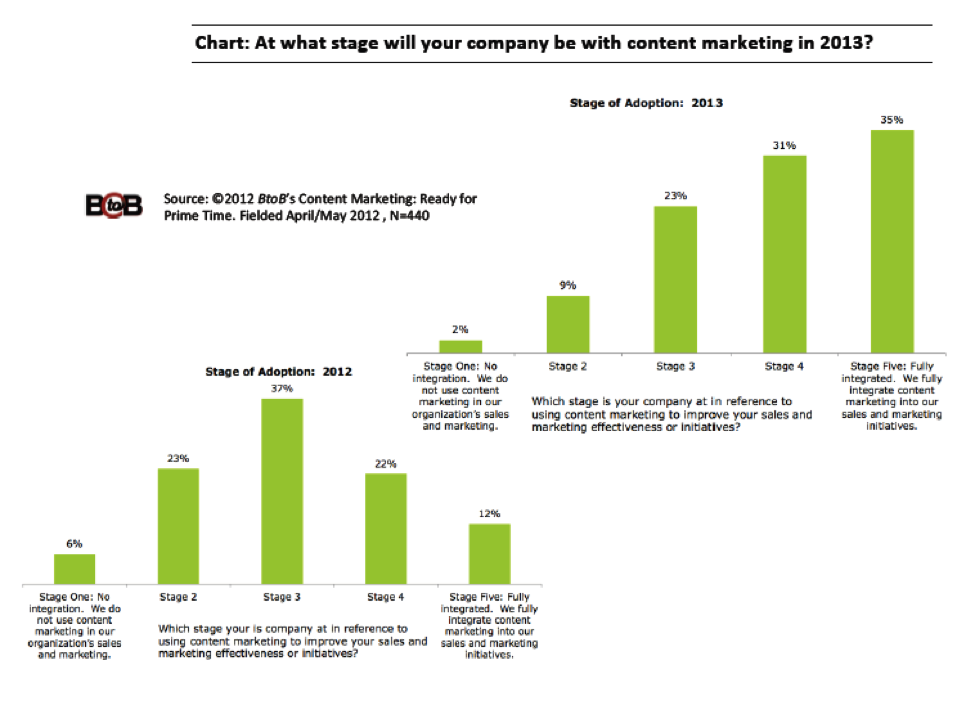
A study of 440 B2B marketing professionals points to a commitment to content marketing with two-thirds of the respondents stating they will be either “very” or “fully” engaged in content marketing by next year. This represents a 100% increase (66% to 33%) over 2012 to 2013.
 Content Marketing is Now the Number 1 Tactic for B2B Lead Generation
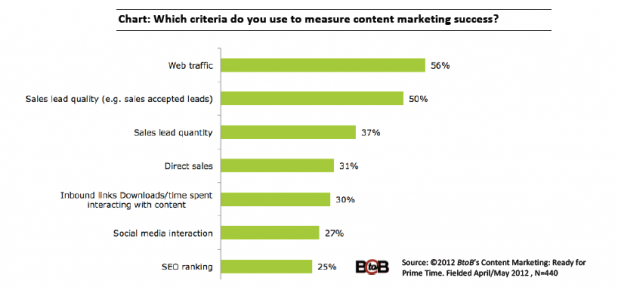
From the same study, according to marketing professionals surveyed, over 51% see content marketing as the most important tool for B2B lead generation.
Content Helps Your Sales Team with Higher Quality Leads
What’s even more dramatic is the shift that we now see in marketers’ understanding that content is critical for helping them to improve the performance of their lead generation, now that a full 50% of lead generation specialists are embracing the use of content marketing to help generate better quality leads.
Content Marketing Challenges
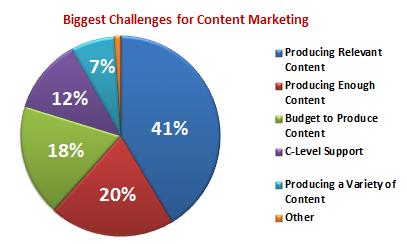
Content marketing requires a commitment and, according to a Marketing Sherpa study earlier this year surveying early adopters and champions, the biggest challenges you will face if you have not yet embedded a content marketing practice into your organization are outlined in the chart below:
This is where an outsourced sales and marketing organization like Gabriel Sales can help. To learn more about how we use content marketing to help your organization improve its B2B lead generation, sales qualification and sales education process, feel free to check out our blog series: Digital Content to Automate your Sale, which is a crash course in integrating sales and marketing efforts. Also, check out our Quick video overview that explains “How to Build a Demand Gen Engine”. If you are ready to chat, request a quick review to see if we can help.
Additional Blogs in this Series:
Part 1 – Increasing Your B2B Sales Volume and Revenue – What’s Changed?
Part 2 – What Does Your B2B Sales and Marketing Culture Need to Look Like?
Part 3 – What Core Competencies do I Need From My Marketing and Lead Generation Team?
Part 4 – How Can Marketing Automation Improve My B2B Sales Performance?
Part 5 – Why is Content Marketing is Now Required for Quality B2B Lead Generation?
by Glen Springer | Nov 13, 2012

Technology Will Accelerate Marketing’s Impact on Revenue
In Part 1, Increase B2B Sales Volume and Revenue and Part 2,What Does Your B2B Sales Approach and B2B Marketing Culture Need to Look Like?, we discussed the new situation in B2B sales and how the buying process has changed, how marketing is more important to your sales process than ever, and how you may need to alter your sales process and augment your team.
In part 3, we outlined the 11 core competencies required to build a successful b2b demand generation marketing program that puts your buyers and their buying cycle (as opposed to your sales cycle) at the center of your sales and marketing process.
Now, in part 4, we explain the five key ways that marketing automation and sales technology can quickly shift your culture and help your sales team be more effective. The five ways are:
- Lead Capture
- Lead Qualification
- Email Automation
- Lead Intelligence
- Real Time Lead Alerts
Here’s a brief explanation of how each of these features will help your sales team:
Lead Capture
For example, Pardot Marketing Automation Software allows you to identify companies that are visiting your site without the need for any information to be collected on a form. There is a database of IPs that identify the company. The major value here is identifying potential prospects without waiting for contact info to be submitted, using 3rd party data providers like Inside View, LinkedIn, One Source and SalesForceData to more quickly identify the key contacts within the companies visiting your site. These 3rd party data providers also help you pull in additional missing data points about the company and key contacts.
Just as important is actually capturing leads with landing pages and forms. That is nothing new, but the ability to then implement strong lead management rules helps hand over qualified prospects automatically.
Lead Qualification
There are two main ways to qualify leads: using implicit behaviors and activities and explicit data and demographics.
Using implicit information and lead scoring, you can rank and score activities (email, web and social) variably by importance and then set up actions to pass the top scoring prospects over to a sales rep automatically.
Using explicit data and lead grading, you can qualify a prospect on who that person is, e.g. a CEO versus a workaholic just trying to learn something new by requesting your content. You can also change grades up and down based on industry, company size and other factors. Essentially, it’s grading prospects against an ideal customer profile that your sales and marketing team identifies.
Along with helping your sales team avoid talking to bad prospects, using these grades and scores provides you another way to dynamically pre-qualify and assign the best prospects to your sales rep.
Email Automation
Email automation for sales reps takes their knowledge about and performance with their leads to another level. Reps can now use email integration tools for Outlook, Gmail, Apple Mail, and Thunderbird to send personal emails through their marketing automation tool, This allows them to personally track opens and clicks with automatic notifications being sent back to the rep when these actions are taken.
Another powerful email automation component is personalized email marketing campaigns, where the marketing team can craft a message to the companies entire pool of prospects, yet dynamically assign the “From” and “Email” field of the lead’s assigned rep. This serves two main purposes: 1) the rep will get the credit for a pleased lead being sent valuable content (yet the rep didn’t have to do anything – marketing and software took care of the touch for them) and 2) all replies to the content will go directly back to the rep (plus, the rep can also be notified when their lead interacts with that message).
A bonus aspect to email automation is the sales rep can pass back “not-yet-qualified” leads to be nurtured by marketing and allow for further lead qualification. The sales rep can be notified again once the lead qualification status has been improved based on the lead’s content interaction activities and scoring rules.
Lead Intelligence
Sales reps will be able to track all online behaviors (email, website and social) and that data can be put directly into the CRM that the sales rep works from, e.g. Salesforce, instead of requiring the sales rep to learn the ins and outs of the marketing automation prospect tracking system (though they probably will want to once they see how much more effective they are). Activities like original lead source, specific page views, keyword searches, webinar attendance, etc., can all be tracked. This allows the sales rep to profile and frame the content for conversations, voicemails and follow-up emails based on those specific prospect activities.
Real-Time Lead Alerts
Real-time lead alerts allow sales reps faster response time when companies or leads are actively engaged in the sales education collateral. Sales reps can receive instant alerts or daily email summaries regarding these activities. They can receive instant alerts via email, text messaging, mobile apps, and desktop apps, whichever they prefer.
With these alerts and summaries Reps can:
- Prioritize their day with the most active prospects
- Perform quick lookups of anonymous visitors in LinkedIn or Jigsaw to identify potential new prospects
- Click on links to trigger CRM profile lookups
- Send emails to active prospects with a few quick clicks
- Filter out unwanted activity
All of these features, Lead Capture, Lead Qualification, Email Automation, Lead Intelligence and Real-Time Lead Alerts, save your reps time and make them more successful. An effective integration and use of marketing automation can synthesize marketing and sales objectives and improve the effectiveness better than ever.
If you are still a little skeptical that marketing automation and content marketing are going to be critical to your success we invite you to check out our blog Content Marketing is Now Required for Quality B2B Lead Generation that will give you a little background on the risk you are running and the cost of delay.
If you want to learn more about how Gabriel Sales can combine your product knowledge and thought leadership with our sales and marketing automation expertise to get you in the game faster, request a complimentary review. If you want to review more information, download the White Paper for Tactics you can implement now.
Additional Blogs in this Series:
Part 1 – Increasing Your B2B Sales Volume and Revenue – What’s Changed?
Part 2 – What Does Your B2B Sales and Marketing Culture Need to Look Like?
Part 3 – What Core Competencies do I Need From My Marketing and Lead Generation Team?
Part 4 – How Can Marketing Automation Improve My B2B Sales Performance?
Part 5 – Why is Content Marketing is Now Required for Quality B2B Lead Generation?
by Glen Springer | Nov 11, 2012
 In Part 1 and Part 2 of this series, we discussed how buyers have changed the way they buy and why your approach to sales and marketing needs to change if you want more deals, to grow revenue, and to increase profit. We also discussed why your strategy needs to align sales and marketing around a pure focus on the customer “buying” cycle.
We pointed to the fact that companies who:
- Are ready for a longer sales cycle
- Educate their buyers first
- Create a shared scorecard to align sales and marketing
- Embrace emerging sales and marketing technologies
- And budget appropriately
have grown revenue 157% over the past 2 years while also reducing the total cost of sales.
In Part 3 of this series, we will discuss the core competencies and disciplines you’ll need to support to make this type of growth a reality.
What is B2B Lead Generation vs. B2B Demand Generation?
Before we get started it’s helpful to understand what we mean by b2b lead generation vs. b2b demand generation.
B2B Lead Generation – For Gabriel Sales, lead generation is about putting targets into your sales funnel at the very front end of the pipe. Adding a lead is simply finding a qualified person from a particular company that is interested in learning more about your product or service.
B2B Demand Generation – Is the process of moving that lead through a sales and marketing process to educate the buyer, bolster interest, and prepare them for speaking with the sales team.
Once you have a team in place that’s able to get the “B2B Demand Generation” process right, lead generation will become much easier.
1) Content Strategy: First, you’ll want to talk to your best sales reps to understand who your ideal targets are by decision maker type. Next you want to clone the sales process of these top sales reps to figure out what is the best thing to say to early-stage targets, what are the best early-stage offers, and what are the most frequent objections or questions in the early-stage sales cycle. You then need a content mapping tool and calendar to prioritize educational content based on the needs of your buyer and your sales team. We have developed a simple tool using Excel that is then shared in the cloud so it’s a live, agile marketing document. Someone will need to manage this document. It’s important that your content ultimately supports the sales script so the two work together to move deals into the pipe in tandem always focused on moving the buyer to the next step.
2) Content Production: It’s cliché but content is king. It drives traffic, provides value and converts visitors to subscribers and customers. Producing quality content is essential. Creating content is not the place to cut corners or try to shave costs. If done well and consistently, you’ll become recognized as a thought leader in your industry. This is a fantastic opportunity for you to differentiate yourself from your competition, because most companies don’t commit the time and resources to actually produce regular, quality content. Content then becomes quite literally an asset.
You’ll also want to leverage each piece of major content at least 3 times. So for example (and why we love webcasting) – if you commit to 1 to 2 webcasts per quarter you can typically turn that webcast into a white paper, create 3-5 shorter 1 to 2 minute video clips, and generate 7 to 8 blogs all from that initial piece of thought leadership. Take the content that you already know is engaging and working for your sales reps and product specialists in a live context and convert it into alternative, digitized pieces of content to distribute and share with your larger, not-yet engaged audience of early-stage buyers.
3) Content Management: Selecting a quality Content Management System (CMS) like WordPress is the first step in the content management process. You’ll also need to staff a resource to maintain your content schedule, add and edit content, and publish it into the right channels. Ideally, this same someone would also know how to contextually repurpose and publish your content. You also need to have the capability and capacity to create landing pages at will for specific verticals and decision makers to aggregate and focus your content for specific markets and buyer types. Gabriel Sales Digital Sales Base Camp™ was created to make this part of your content management seamless and efficient.
4) Email Management: Learning the rules, regulations and best practices of email marketing and management is not a core competency of many companies. A ‘Ready Fire Aim’ approach that doesn’t work when doing email marketing. Proper messaging, design (e.g. smart-phone compatibility), list segmentation, privacy/spam rules, auto-responder optimization, and more are all major factors in doing email marketing correctly. Many companies just blast their entire list and hope for the best, time and time again. Many others simply don’t do email marketing at all! The discipline is still required as a B2B lead generation tactic.
5) CRM Integration and List Acquisition: Making sure that all of your communication and analytic tools are synchronized with your CRM is an under-utilized practice, but one that can be the defining difference between converting a hot lead and losing a deal. Without conversions, b2b lead generation efforts mean nothing. You also need to make sure you are not spending money acquiring lists that don’t make sense or are redundant.
6) Landing Page Optimization: Use landing pages to deliver your critical content in an organized way that also promotes a compelling, ‘easy to take’, and singular call to action. This is an essential but usually undeveloped practice in many businesses’ web marketing/lead generation efforts.
7) Analytics and Database Management: The tools and methods of data discovery go into greater depths than ever before, but solid logic for how business decisions are made against all of this data are still lacking for many organizations. Companies spend incredible amounts of money for the tools but lose out on much of the ROI by not investing in the staff and education to actually use them to demonstrate meaningful insights. See Analytics Expert, Avinash Kaushik’s often-cited blog article on the 90/10 rule of web analytics success.
8) Graphic Design and Video Production: Having quality graphic design at the right times can set you apart from many competitors. Having the ability to take your existing presentations, customers and thought leaders and allowing them to get their best material circulating digitally will save your team 100s of hours annually educating customers.
9) Social Media and Reputation Management: Creating active engagement with your potential customer base in the major social media channels (Facebook, Twitter, LinkedIn and Google+) is an ideal to which your business should strive. Getting these profiles going is a step that many businesses have been reluctant to take and is necessary for mature b2b lead generation. Further, setting up tools to manage your company’s on-line reputation (e.g. creating alerts anytime your product, brand, management team is mentioned online) is becoming increasingly important to properly leverage positive feedback from brand champions and limit the influence of detractors out to destroy your business’ reputation.
10) Marketing Automation: This is the wave of the future for marketers and sales people, alike. Aside from investing in one of the top marketing automation tools (such as Pardot or Marketo), making an equal or greater investment in human resources to optimize your marketing automation is the next logical step. The added intelligence gained (e.g. lead scoring, real-time visitor analysis) and the powerful tools available (e.g. automated rules, logic-based drip campaigns, page actions) will transform your lead generation and sales prospect prioritization beyond anything you’ve done before. If you are unfamiliar with marketing automation, now is the time to educate and get on board. GS is an authorized Pardot Agency Partner (among several other technologies) so we have a bias for Pardot and we can offer unparalleled ability in implementing and optimizing these tools to quickly accelerate marketing results for any business. If you have never checked out a marketing automation demo don’t hesitate and take the time for a 5 Minute Overview of Marketing Automation right now!
11) Phone Resources: Effective lead generation and lead nurturing still requires people to pick up the phone. You need to strongly consider attaching reps to your marketing team and not your sales team. In terms of demand generation there is a difference between ‘educating’ buyers vs. ‘selling’ buyers. Getting this part wrong can destroy your entire investment up to this point. Getting this part right will give you a huge leg up on your competition because:
- 70% of leads are passed to Sales Reps before they are ready to engage (Marketing Sherpa -2012)
- 80% of mishandled leads will buy from a competitor (Forrester -2011)
And if you have the other pieces we’ve described above in place, like quality content production, marketing automation and social media management, your phone reps will have an easier time with b2b lead generation and creating engaged, meaningful discussion with prospects and the end results will be far more beneficial to your conversion goals.
Summary
The seismic shift we are seeing right now essentially means that marketing now needs to own the prospect much earlier in buying process and take them much deeper. The goal is to connect the buyer with the sales rep when the buyer is ready to buy. This approach leads to faster transactions and maximizes the sales reps time. The line between sales and marketing as it applies to demand generation is getting blurred and this trend is not going to abate any time soon. You need to softly press for next steps with both your reps and your content. This is why its key to pull in a marketing automation platform will accelerate your ability to pull it all together to score a prioritize leads. In Part 4, we’ll discuss in more detail how marketing automation can help your sales and demand generation process.
The job and landscape is getting more complex. So who is going to actually do all this work? How do you find marketers that understand sales and sales staff that understand marketing? This is where considering to outsource to a b2b lead generation company with expertise in outsourced sales and marketing may be able to help. So feel free to request a free consultation if you are curious how we can help.
Part 1 – Increasing Your B2B Sales Volume and Revenue – What’s Changed?
Part 2 – What Does Your B2B Sales and Marketing Culture Need to Look Like?
Part 3 – What Core Competencies do I Need From My Marketing and Lead Generation Team?
Part 4 – How Can Marketing Automation Improve My B2B Sales Performance?
Part 5 – Why is Content Marketing is Now Required for Quality B2B Lead Generation?
by Glen Springer | Nov 11, 2012
 In Part 1 and Part 2 of this series, we discussed how buyers have changed the way they buy and why your approach to sales and marketing needs to change if you want more deals, to grow revenue, and to increase profit. We also discussed why your strategy needs to align sales and marketing around a pure focus on the customer “buying” cycle.
We pointed to the fact that companies who:
- Are ready for a longer sales cycle
- Educate their buyers first
- Create a shared scorecard to align sales and marketing
- Embrace emerging sales and marketing technologies
- And budget appropriately
We have grown revenue 157% over the past 2 years while also reducing the total cost of sales.
In Part 3 of this series, we will discuss the core competencies and disciplines you’ll need to support to make this type of growth a reality.
What is B2B Lead Generation vs. B2B Demand Generation?
Before we get started it’s helpful to understand what we mean by b2b lead generation vs. b2b demand generation.
B2B Lead Generation – For Gabriel Sales, lead generation is about putting targets into your sales funnel at the very front end of the pipe. Adding a lead is simply finding a qualified person from a particular company that is interested in learning more about your product or service.
B2B Demand Generation – Is the process of moving that lead through a sales and marketing process to educate the buyer, bolster interest, and prepare them for speaking with the sales team.
Once you have a team in place that’s able to get the “B2B Demand Generation” process right, lead generation will become much easier.
1) Content Strategy: First, you’ll want to talk to your best sales reps to understand who your ideal targets are by decision maker type. Next you want to clone the sales process of these top sales reps to figure out what is the best thing to say to early-stage targets, what are the best early-stage offers, and what are the most frequent objections or questions in the early-stage sales cycle. You then need a content mapping tool and calendar to prioritize educational content based on the needs of your buyer and your sales team. We have developed a simple tool using Excel that is then shared in the cloud so it’s a live, agile marketing document. Someone will need to manage this document. It’s important that your content ultimately supports the sales script so the two work together to move deals into the pipe in tandem always focused on moving the buyer to the next step.
2) Content Production: It’s cliché but content is king. It drives traffic, provides value and converts visitors to subscribers and customers. Producing quality content is essential. Creating content is not the place to cut corners or try to shave costs. If done well and consistently, you’ll become recognized as a thought leader in your industry. This is a fantastic opportunity for you to differentiate yourself from your competition, because most companies don’t commit the time and resources to actually produce regular, quality content. Content then becomes quite literally an asset.
You’ll also want to leverage each piece of major content at least 3 times. So for example (and why we love webcasting) – if you commit to 1 to 2 webcasts per quarter you can typically turn that webcast into a white paper, create 3-5 shorter 1 to 2 minute video clips, and generate 7 to 8 blogs all from that initial piece of thought leadership. Take the content that you already know is engaging and working for your sales reps and product specialists in a live context and convert it into alternative, digitized pieces of content to distribute and share with your larger, not-yet engaged audience of early-stage buyers.
3) Content Management: Selecting a quality Content Management System (CMS) like WordPress is the first step in the content management process. You’ll also need to staff a resource to maintain your content schedule, add and edit content, and publish it into the right channels. Ideally, this same someone would also know how to contextually repurpose and publish your content. You also need to have the capability and capacity to create landing pages at will for specific verticals and decision makers to aggregate and focus your content for specific markets and buyer types. Gabriel Sales Digital Sales Base Camp™ was created to make this part of your content management seamless and efficient.
4) Email Management: Learning the rules, regulations and best practices of email marketing and management is not a core competency of many companies. A ‘Ready Fire Aim’ approach that doesn’t work when doing email marketing. Proper messaging, design (e.g. smart-phone compatibility), list segmentation, privacy/spam rules, auto-responder optimization, and more are all major factors in doing email marketing correctly. Many companies just blast their entire list and hope for the best, time and time again. Many others simply don’t do email marketing at all! The discipline is still required as a B2B lead generation tactic.
5) CRM Integration and List Acquisition: Making sure that all of your communication and analytic tools are synchronized with your CRM is an under-utilized practice, but one that can be the defining difference between converting a hot lead and losing a deal. Without conversions, b2b lead generation efforts mean nothing. You also need to make sure you are not spending money acquiring lists that don’t make sense or are redundant.
6) Landing Page Optimization: Use landing pages to deliver your critical content in an organized way that also promotes a compelling, ‘easy to take’, and singular call to action. This is an essential but usually undeveloped practice in many businesses’ web marketing/lead generation efforts.
7) Analytics and Database Management: The tools and methods of data discovery go into greater depths than ever before, but solid logic for how business decisions are made against all of this data are still lacking for many organizations. Companies spend incredible amounts of money for the tools but lose out on much of the ROI by not investing in the staff and education to actually use them to demonstrate meaningful insights. See Analytics Expert, Avinash Kaushik’s often-cited blog article on the 90/10 rule of web analytics success.
8) Graphic Design and Video Production: Having quality graphic design at the right times can set you apart from many competitors. Having the ability to take your existing presentations, customers and thought leaders and allowing them to get their best material circulating digitally will save your team 100s of hours annually educating customers.
9) Social Media and Reputation Management: Creating active engagement with your potential customer base in the major social media channels (Facebook, Twitter, LinkedIn and Google+) is an ideal to which your business should strive. Getting these profiles going is a step that many businesses have been reluctant to take and is necessary for mature b2b lead generation. Further, setting up tools to manage your company’s on-line reputation (e.g. creating alerts anytime your product, brand, management team is mentioned online) is becoming increasingly important to properly leverage positive feedback from brand champions and limit the influence of detractors out to destroy your business’ reputation.
10) Marketing Automation: This is the wave of the future for marketers and sales people, alike. Aside from investing in one of the top marketing automation tools (such as Pardot or Marketo), making an equal or greater investment in human resources to optimize your marketing automation is the next logical step. The added intelligence gained (e.g. lead scoring, real-time visitor analysis) and the powerful tools available (e.g. automated rules, logic-based drip campaigns, page actions) will transform your lead generation and sales prospect prioritization beyond anything you’ve done before. If you are unfamiliar with marketing automation, now is the time to educate and get on board. GS is an authorized Pardot Agency Partner (among several other technologies) so we have a bias for Pardot and we can offer unparalleled ability in implementing and optimizing these tools to quickly accelerate marketing results for any business. If you have never checked out a marketing automation demo don’t hesitate and take the time for a 5 Minute Overview of Marketing Automation right now!
11) Phone Resources: Effective lead generation and lead nurturing still requires people to pick up the phone. You need to strongly consider attaching reps to your marketing team and not your sales team. In terms of demand generation there is a difference between ‘educating’ buyers vs. ‘selling’ buyers. Getting this part wrong can destroy your entire investment up to this point. Getting this part right will give you a huge leg up on your competition because:
- 70% of leads are passed to Sales Reps before they are ready to engage (Marketing Sherpa -2012)
- 80% of mishandled leads will buy from a competitor (Forrester -2011)
And if you have the other pieces we’ve described above in place, like quality content production, marketing automation and social media management, your phone reps will have an easier time with b2b lead generation and creating engaged, meaningful discussion with prospects and the end results will be far more beneficial to your conversion goals.
Summary
The seismic shift we are seeing right now essentially means that marketing now needs to own the prospect much earlier in buying process and take them much deeper. The goal is to connect the buyer with the sales rep when the buyer is ready to buy. This approach leads to faster transactions and maximizes the sales reps time. The line between sales and marketing as it applies to demand generation is getting blurred and this trend is not going to abate any time soon. You need to softly press for next steps with both your reps and your content. This is why its key to pull in a marketing automation platform will accelerate your ability to pull it all together to score a prioritize leads. In Part 4, we’ll discuss in more detail how marketing automation can help your sales and demand generation process.
The job and landscape is getting more complex. So who is going to actually do all this work? How do you find marketers that understand sales and sales staff that understand marketing? This is where considering to outsource to a b2b lead generation company with expertise in outsourced sales and marketing may be able to help. So feel free to request a free consultation if you are curious how we can help.