

Marketing Cloud Next & Data Cloud Migration
Activate native Salesforce Agentic Marketing AI at the right time, in the right order, in the right way.
Migrate From Account Engagement to Marketing Cloud Next Without Losing Data, Productivity or Sleep
We assess your readiness, recommend the right edition, prepare your data and execute your migration while we keep your current instance producing pipeline.
Gabriel Sales provides certified Salesforce talent for our Marketing Cloud Next Migration services, which also includes full Data Cloud migration support, for B2B companies using Salesforce Marketing Cloud Account Engagement. We help you assess whether a move makes sense and what it will really cost. If it is the right decision, we clean and prepare your data for Salesforce Data Cloud, we help you choose between Marketing Cloud Growth or Advanced, and then we execute a phased migration with no data loss while keeping your current Account Engagement instance performing and productive. And if waiting is the right call, we will tell you.


What Is Marketing Cloud Next? And What Is Data Cloud?
What is Marketing Cloud Next?
Marketing Cloud Next is Salesforce’s AI-powered marketing platform and it represents a real architectural change which enables Agentforce Marketing and dramatically enables marketing and sale alignment. For the first time, marketing runs on the same Salesforce platform as your sales team’s CRM. So you are running one system (instead of two systems connected by a sync) so there is no connector to maintain and no copying between two databases.
One point of naming confusion worth clearing up: “Next” is not a product you buy, it is the platform. You actually purchase one of its two editions, Marketing Cloud Growth or Marketing Cloud Advanced. So the real decision in front of you is: should I stay on Account Engagement (Pardot), or move to Growth or Advanced.
Marketing Cloud Next includes Agentforce Marketing, Salesforce’s native AI agents that can help build campaigns, draft content, and create audience segments from plain-English instructions within the Salesforce Eco-system. (Sales can use Agentforce already without Marketing Cloud Next but Marketing Cloud Next makes Agentforce even more powerful for Sales too.)
But one insight some technical partners skip: AI speeds up execution, but strong marketing still depends on understanding your customers, understand your segments and designing journeys people want to experience. And sales success still requires executing the right activities at the right time to move the deal through the required stages to close revenue. AI will augment but will not replace. The platform still needs marketing and sales expertise. So does the
“Salesforce’s own research finds high-performing marketing teams are 2.4x more likely to have unified their data sources and 2.8x more likely to use customer data to create relevant experiences. Unified data is the entire premise of the Data Cloud foundation under Marketing Cloud Next.” Source:Salesforce State of Marketing, 10th Edition, 4,450 marketing decision makers (Feb 2026)
What is Data Cloud?
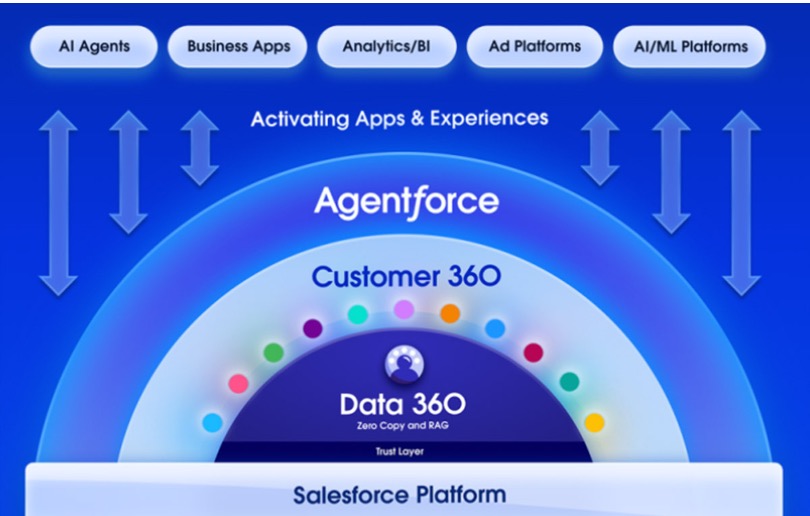
You cannot evaluate Marketing Cloud Next without understanding Salesforce Data Cloud, because the platform is built on top of it the way a house is built on a foundation. Data Cloud connects and organizes all of your customer data. This includes CRM records, email engagement, website activity, event attendance and campaign & specific content engagement into a single reliable profile for each individual. For example: It recognizes that [email protected] from your webinar list and Robert Smith in your CRM are the same human being, and merges them into one unified profile. Salesforce calls this identity resolution. This is what allows both sales and marketing to create more personalized journeys for every buyer and influencer engaged in the purchase decision.
“Only 31% of marketers are fully satisfied with their ability to unify customer data. Salesforce Data Cloud, which connects and organizes all your customer data into a single reliable source, is Salesforce’s answer, and it is the foundation every Marketing Cloud Next feature sits on.” Source: Salesforce State of Marketing, 10th Edition (2026)
The power for your sales and marketing teams is that every critical feature of Marketing Cloud Next (audience segments, personalization, journey triggers, the AI agents) is driven by these unified profiles so both teams can align (in near real time) to move deals through the funnel
This is why the data work makes or breaks these projects. Clean, unified data in, smart marketing out.
Do you have to buy Data Cloud separately? No. Marketing Cloud Next licenses include Data Cloud with an allocation of usage credits. It gets provisioned and configured as part of implementation but usage beyond the included credits is billed on consumption. Understanding this consumption and cost is currently one of the biggest hurdles leaders face in making their final decision. We can estimate this for you as we help you make your decision and then configure your implementation.
Where Does Snowflake Fit into The Equation?
This is a changing dynamic that impacts token payments. Expect it to continue to change and we will stay informed to help.
Many of the orgs we work with keep product usage, billing and ERP data in a warehouse like Snowflake rather than in Salesforce. Until recently that forced a choice during a migration: copy the data into Data Cloud and pay to unify it, or leave it out and accept that your AI cannot see it.
Salesforce and Snowflake now support zero-copy sharing, which means Data Cloud can read and use that data where it already sits instead of importing a second copy. It works in both directions, so Snowflake can read Data Cloud.
This changes the math. Identity resolution, the process of matching duplicate records into a single customer profile, is the highest-cost meter on Salesforce’s rate card. Every row you do not copy is a row you never pay to match. Two companies running identical campaign volume can face very different consumption costs depending on where their data lives and how much of it got duplicated on the way in.
So we assess it before you commit. We tell you what data belongs in Salesforce and what should stay in the warehouse.
Advanced Data Capabilities
Gabriel Sales helps you implement Salesforce Data Cloud as part of Account Engagement Migrations. Data Cloud connects and organizes all of your customer data from Salesforce eco-system and your ERP, billing systems, product usage platforms, and customer support tools for a single, unified profile.
Once you have confidence in your unified profiles, we can build the data streams, identity resolution logic, and Calculated Insights that make it valuable. Calculated Insights are AI-powered scores such as lifetime customer value, propensity-to-buy, engagement depth that update automatically on every unified profile. We also build ICP lookalike scoring that rates every open lead and account against the measurable profile of your existing best customers.
The Challenge
The Questions Every Account Engagement (Pardot) Team Is Asking
“Is Marketing Cloud Next right for us?”
“What are the real benefits?”
How long will a migration take?”
“Can we keep running Account Engagement and test it in parallel?”
“Do we even have to do this? Is Account Engagement (Pardot) going away?”
“What will it actually cost?”
If you lead marketing and you’re running Salesforce Marketing Cloud Account Engagement, Salesforce is probably incentivizing you to migrate. Some partners are pitching migration as a foregone conclusion. Practitioners on the forums are urging caution. But your board may be putting pressure on you for AI adoption at scale right now. And nobody seems to be answering the six questions above in plain language.
So let’s start with the reassurance: Account Engagement is not being retired (only the old Pardot Classic app was retired). Account Engagement is still actively supported and still receiving new features. There is no emergency, no forced deadline, and no reason to migrate out of fear.
There is, however, a strategic decision with a right time and a wrong time and a right way and a wrong way. The good news is that there is a methodical path to decide, prepare, and, when it makes sense, move without losing data or pipeline.
Every question above gets a direct answer on this page.
“75% of marketers have adopted AI yet 84% admit they are still running one-way, generic campaigns. Owning the platform has never been the problem. Running truly personalized journeys on it is, and that is the gap Marketing Cloud Next is built to close if you migrate with your data ready.” Source: Salesforce State of Marketing, 10th Edition (2026)
The Solution
Built for Both Marketing and Sales
A Marketing Cloud Next migration is not a marketing-platform swap. It rewires the connection between marketing and sales, the data model, the scoring, the routing, the attribution, and the handoff your revenue depends on. Treat it as a marketing-only project and the sales side could be impacted.
What makes Gabriel Sales unique is that after 100s of implementations and 1000s of optimizations across both Salesforce Sales Cloud and Account Engagement we understand the sales and marketing operations best practices both team require for short term results and long-term success.
And because Gabriel Sales understands both sides of the funnel the marketing-to-sales connection is designed into your migration from day one so our support for your potential migration has five parts. We help you
Marketing Gets
- Honest segmentation & suppression
- Triggered campaigns off buyer intention
- Triggered campaigns from sales events/activity
- Full visibility into how sales worked leads
- Near real time attribution
- Cross-channel campaign insights
- Data driven multi-channel strategy insights
- Data driven content insights
- Ability to support stalled deals
- ABM campaigns simplified
- Full access to Native Salesforce AI at scale
Sales Gets
- The whole story in one record
- Clean view of all deal decision makers & influencers
- Better first coversations
- Clean marketing hand-offs with no sync lags
- A trustworthy foundation for AI
- Content recommendations for buyers
- Personalized content for buyers
- Sales-to-marketing pass back automated
- Pre-qualified and prioritized leads
- Far less data entry and admin work
What We Do
Assess, Decision Support, Choose, Migrate, Activate, Support and/or Train, Scale
We follow methodical steps to help you get it right. Migration work only compounds if it doesn’t happen in the right ay in the order. Assessing your readiness is critical to make the right decision. Making the right decision and timing your migration is critical to your team and funnels well-being. And preparation improves short term results and keeps you from paying to fix things at a higher cost mid migration. Smart sequencing is how every dollar you invest produces value no matter which platform you end up on.

Five stages, in a deliberate order with smart sequencing is how every dollar you invest produces value, no matter which marketing automation an Salesforce Agentic AI platform you end up on
Assess
- Free Technology Health Check & Maturity Benchmark. A fast, free technology health check provides a no-cost read on where you stand, benchmarked against the Gabriel Sales Automation & Sales Enablement Maturity Matrix™. It ends with a straight move on to audits-or-wait recommendation. In some cases waiting is the right call.
- Data Hygiene & AI Readiness Audit We conduct a data hygiene and AI readiness audit as a first prerequisite step. We assess data quality, governance, and Data Cloud/AI readiness, and hand you a prioritized remediation roadmap. Because the new platform’s value and its Agentic AI runs on Data Cloud. This is the work that determines whether a future move succeeds.
- Account Engagement Marketing Automation Performance Audit This Account Engagement Audit s the second pre-requisite step. We examine the health, performance and utilization of your current platform. Complete with a prioritized roadmap of optimizations. In some cases we find that marketing is leveraging a fraction of the features available. Some teams decide that they don’t need to move onto Marketing Cloud Next with the automations and features that are still available.
- Edition Fit. Honest guidance across Account Engagement vs. Marketing Cloud Growth vs. Advanced, sized to your needs and budget. Along with potential timing.
- Feature Parity Check. Your must-have Account Engagement capabilities mapped against the target edition before you commit to anything.
- Cost Modeling. A projection of your license, consumption, and migration costs against your current all-in Account Engagement spend, using our cost decision framework
- Yes, you can run both platforms at the same time. Parallel running is Salesforce’s intended path, not a workaround: Account Engagement customers on every edition are granted permission licenses to use Marketing Cloud Next features alongside their existing setup. Your nurture programs keep running while you pilot the new platform on new campaigns. This is like moving into the new house room by room instead of all in one weekend.
- Potential Pilots. Based on everything we learn as part of this process we provide a list of potential pilots.
Decide – With Unbiased Tactical Decision Support
You Choose “Yes” or “No “ or Not “Yet” & Select “Right Pilot(s)”
- Decide, You decided if and when this is the right decision for your team and organization with all the information you need.
- Select the Right Pilot When You Are Ready. We collaborate with all the required stakeholders on pilot selection based on the ease of migration vs. data readiness vs. the ROI & strategic benefit vs. our Automation & Sales Enablement Maturity Benchmark to help you think through that decision. Even if your waiting knowing where your head helps you to optimize the right data, content and processes now.
- Gabriel Sales Creates Final 60 to 90 Day Project Plan/Sprint. We build the final project plan with critical dependencies, timelines and key milestones that are achievable. All geared towards your desired strategic and tactical outcomes in areas where AI activation at scale can have the biggest impact.
Prepare – Data and Assets
- Data Repair, Remediation and Augmentation. We get your data migration-ready before anything moves. The reason this comes first: Data Cloud’s identity resolution multiplies the value of clean data far more than it repairs dirty data and it re-runs (and re-bills) every time the rules or the records have to be fixed after the fact. We fix broken synch errors and connection issues. We remove duplicates. Standardize and normalize picklist & fields and purge stale and invalid records. We also document consent and opt outs so compliance survives intact. Finally we fill what’s missing so Data Cloud has the AI-critical fields required for Agentic scoring, segmentation, and personalization. This includes enrichment with third-party data where gaps remain. All this is available as part of our Data Hygiene and AI Readiness Services and Audit. Learn More →
- Prepare Assets, Process, an Requirements Inventory. Some content, emails, forms, landing pages, scoring models, and journeys will move. Some won’t. (Depends on when, where & how these were built and what features you were using in Account Engagement). We document for rebuild so nothing you still need gets lost. Also a valuable house cleaning exercise.
- Keep Account Engagement Optimized and Productive While You Migrate. Optimization and marketing automation support is our core business. So, if required, Gabriel Sales can offer this same optimization support for your current Account Engagement prior to and/or during your current deployment so you keep driving pipeline until cutover. Learn More →
Migrate
- Turn on Data Cloud. Data Cloud comes provisioned with your license; the real work is configuring it correctly. We activate it, stand up the Account Engagement–Data Cloud connector, and ingest a deliberately minimal first data footprint. You do not need a full Data Cloud build to launch, and holding that line is what keeps a 60-day launch plan from quietly becoming a six-month data project that goes sideways.
- Unify and Verify. We configure identity resolution rules, run unification on your cleaned data, and verify the unified profiles against your source systems so both Marketing Cloud and Sales Cloud know the same version of every prospect. We align email consent between Account Engagement and Marketing Cloud Next. We help you set up consumption monitoring in your Digital Wallet. This is currently the black box in Salesforce pricing that is deterring so many migrations (and driving buyers to Claude). This is what causes/takes token credit burn from a $500 configuration that could turn into a $15,000 issue in a week. We will do our best to help you avoid (but no guarantees until Salesforce becomes more transparent). This is the one of the top reasons we suggest Account Engagement users wait.
- Asset Rebuild. Working from the inventory we built in Prepare, we rebuild in priority order: emails and content blocks in the new builder and CMS workspace, forms and landing pages, segments recreated on Data Cloud, scoring rebuilt in the new model, and Engagement Studio programs redesigned as Flow-based journeys. We start with your chosen pilot, reuse existing assets wherever possible, and favor standard configuration over customization so the first win lands fast. Nothing is retired in Account Engagement until its replacement is tested and live.
- Marketing-to-Sales Connection. We align the visibility sales needs with access to scoring, routing and alerts. We then align the sales activity to the Marketing Campaign to support attribution.
Activate, Support and/or Train
We don’t just turn it on and leave
- Help You Implement and Activate Pilot Processes. The platform only pays off if the operating processes around it change too. We help you stand up the first pilot(s) process and/or campaign(s). This also includes naming governance so the new workspace(s) stays clean. We help test and QA the necessary processes, journeys, segmentation, and consent before they touch real prospects.
- Train Your Team. Once the setup is complete we will build training materials and guides to support your team with the goal to eventually be self-sufficient. These processes and architecture are considerably different than Account Engagement so wewill also execute several live training sessions for your team until they gain the muscle memory to continue. We share these recording for future reference. The good news is once live Agentforce will also be able to help with adoption. For a monthly fee we can also be retained as your go-to support team.
- Managed Services and/or Additional Projects We can also become your execution team and Marketing Cloud Next Admin and support staff so your marketing team can focus on working with Agentforce strategically and creatively while we take on any technical issues required to scale and activate additional AI for increased personalization and increasing sales automations for superior and powerful customer journeys.
Who Delivers It
Our Certified Data Team, Account Engagement Specialist & Salesforce Team Works Together
Your migration is delivered by Certified Data Team, Account Engagement Specialists and Salesforce Administrators. We are expert technologists who are also proven frontline sales and marketing professionals with AI expertise. It is the same blended team that has already successfully delivered hundreds of Salesforce and automation implementations and thousands of optimizations over 15+ years, now also spanning Account Engagement, Sales Cloud, Data Cloud, and Marketing Cloud Next. Meet the team →

Some of the Most Common Challenges, Frustrations & Headaches Our Migrations Frameworks and Marketing Cloud Next Solutions Resolve For Leaders & Their Teams
Some of the Marketing and Sales Leaders who come to us already know exactly where they’re stuck and are ready to move to Marketing Cloud Next But most still need to figure out what makes sense for their organizations. Here are the most common problems we currently solve and how we solve them.
“We don’t know if we should move.”
We provide a free Health Check and maturity benchmark that ends in an honest go/wait recommendation (not a sales pitch dressed up as an assessment).
“Our data isn’t clean enough for Data Cloud or AI.”
We run structured deduplication across multiple marketing and sales stages then build prevention rules so records stay clean because duplicates don’t just waste time, they corrupt AI scoring, split attribution, and make every report less accurate. All our part of our data hygiene and AI readiness services.
“We don’t know which edition fits.”
We provide feature-parity analysis and cost mapping across Account Engagement and Marketing Cloud Growth or Advanced grounded in what your team actually uses today.
“We’re afraid of losing data, history, or pipeline mid-move.”
We manage your migrations with a phased, no-data-loss methodology: audit, data mapping, asset rebuild, parallel testing, controlled go-live.
“Nobody on our team knows Flows or Data Cloud.”
The new platform replaces Engagement Studio with Salesforce Flow and adds Data Cloud skills your team hasn’t needed before. We bridge the gap and train as we build.
“We can’t pause marketing to migrate.”
You don’t have to. We keep Account Engagement driving pipeline until cutover, and the platforms run in parallel by design.
“A partner or Saleforce rep wants us to migrate immediately. Should we?’
Get a non-biased second opinion, benchmarked against our maturity model. Across the Salesforce orgs Gabriel Sales has audited in 2026, roughly 90% of teams were not yet ready to migrate. Our most standard recommendation is a data-readiness sprint before any migration date is set. We explain why.
“Salesforce quoted us a license price. What will it really cost?”
A total-cost model covering license an estimations of token consumption credits, email volume, and migration services (after we conduct audits).
“We can’t keep up with our current workload. How will we deal with this?’
Gabriel Sales can help you manage your migration with all the talent you need. And we can continue support with managed services after you pilot and migrate. We can also help you with Account Engagement optimization right now and/or provide marketing automation managed services to buy your team more bandwidth for higher priority tasks immediately.
What is the Right Strategic Decision, Right Salesforce Edition & Right Agentic Solution for My Team and Organization?
There are really three choices but four product names now show up in the same conversation, which is a source of confusion. Marketing Cloud Engagement (MCE) is the original large-scale B2C platform, mentioned only for context, because it is generally not the path for a B2B team coming from Pardot. The real comparison is between the product you have and the two editions of the new platform. So the question is – Do your keep Account Engagment (Pardot)? Or do you move to Marketing Cloud Growth or Marketing Cloud Advanced?
Account Engagement vs. Marketing Cloud Growth vs, Marketing Cloud Advanced
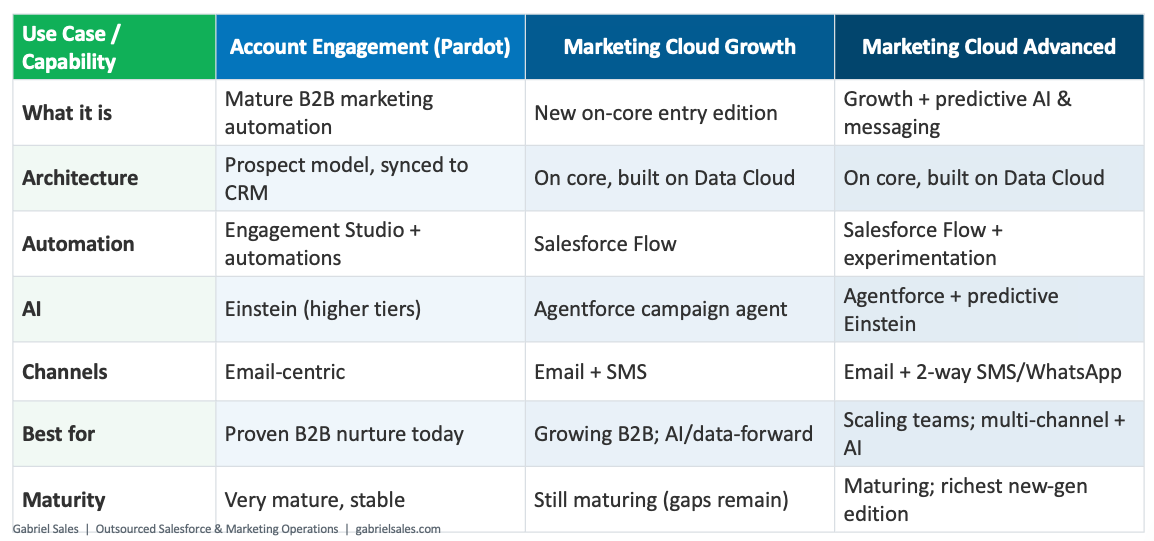
A comparison of your three options at a glance including what each platform is, how it’s built, and who it’s best for
Quick Pros and Cons of Each Option
Some of the Marketing and Sales Leaders who come to us already know exactly where they’re stuck and are ready to move to Marketing Cloud Next But most still need to figure out what makes sense for their organizations. Here are the most common problems we currently solve and how we solve them.
Account Engagement (Pardot) – Staying put
- Pros: mature and proven; deep, trusted lead scoring and Engagement Studio; tight sales alignment; the largest talent pool for support; lower entry price; stable, well understood, and actively supported by Salesforce – it is not being retired.
- Cons: a legacy prospect-based data model; limited real-time personalization; email-centric; and Salesforce’s biggest innovation is now going to the on-core platform, and AI features have not been integrated in Account Engagement.
Marketing Cloud Growth – The entry point
- Pros: native to the core platform with Data Cloud’s unified customer profile; Agentforce built in; Flow-based automation; email + SMS; one platform shared with sales and service; aligned with where Salesforce is heading with Agentic AI.
- Cons: still maturing, with real feature gaps versus mature Account Engagement programs; very small talent pool for support; requires new Data Cloud and Flow skills; migration effort is real — different data model, rebuilt assets; capabilities still arriving release by release. Data and Flex credits required (as mentioned above) still a black box on real cost.
Marketing Cloud Advanced- The scaling edition
- Pros: everything in Growth plus predictive Einstein AI, path experimentation, and two-way SMS/WhatsApp; the most complete new-generation edition and the natural foundation as you grow into the full Marketing Cloud Next vision.
- Cons: roughly double the cost of Growth; still on the maturing platform; demands stronger data and AI readiness to be worth it; overkill for teams with simple email-nurture needs. Developed to support B2C Marketing and overly complex for most B2B Marketers.
Who Should Move Now and Who Should Wait
Good candidates to move (or seriously plan for it) now
- New Salesforce marketing buyers with no Pardot legacy. If you are going to start new, it makes sense to start with the most advance AI ready system. This avoids the need for a future migration entirely.
- Companies already invested in Data Cloud, or unifying B2B and B2C marketing on one platform.
- Teams making AI, agentic marketing, and real-time personalization a near-term priority with extreme pressure from market competitors or in some cases investors and/or board of directors. You need to be willing to immediately invest in the data foundation to support it.
- Organizations that want marketing, sales, and service on one platform and one shared data model. The fastest ROI will be automating customer service.
Better to wait and optimize Account Engagement for now
- Teams running complex, mature programs that are working well should stay the course. With our optimization services we can typically find automations and workflows that can give you increased firepower and increased bandwidth for your existing team.
- Companies without clean, unified data, or without the appetite to invest in Data Cloud readiness first.
- Risk-averse or lean teams without Flow and Data Cloud skills, where stability matters more than being early.
- Anyone whose only reason to move is fear that Pardot is going away. It isn’t.
One Consideration For Waiting is Clearer Cost Transparency
Gabriel Sales believes that this will at some point be a must have more most companies as increased and micro personalization becomes the competitive norm. And from our Automation and Sales Enablement Maturity Benchmarks it appears many B2B companies are headed that direction but are still planning and putting the fundamental pieces in place. We also believe Salesforce will be forced to provide a great deal more clarity about token consumption and costs in place soon. This will probably start during Dreamforce 2026. And will be followed by additional pressure after Anthropic and OpenAI file their IPOs and/or go Public. They will have to stop giving away there tokens so Salesforce is really in a waiting game. Eventually tokens will all have the same cost as they become utilities that are not subsidized by Venture Capitalists. You don’t need to Future Proof yet investing in the immediately. But you do need to be getting your Data in order. And that will lift the production of both your current Account Engagement and Sales Cloud deployments immediately. So “Future-proofing your data” is a the one way to prepare as you continue to build skills and get ready to pilot.
A Simple Way to Decide Summary
You are new to Salesforce marketing, no Pardot legacy
Start on Marketing Cloud Growth (on-core from day one)
Account Engagement works, data is messy, no urgent AI driver
Stay put; run a data-readiness audit; plan a future move
Account Engagement is hitting limits on personalization, advanced ABM and/or attribution pressoures
Pilot Growth/Advanced on one use case;pilot with a well planned and phased migration
Account Engagement is hitting limits on personalization, advanced ABM and/or attribution pressoures
Pilot Growth/Advanced on one use case;pilot with a well planned and phased migration
AI at scales and agentic marketing is a board and/or C-Level priority
Prepare your data now; move to Advanced when readiness is proven
Unifying B2B + B2C on one platform
Strong case to move to the Advanced platform
Companies ready to extend AI to account management & customer service for post close automation
Move to Growth to activate Data Cloud for downstream cost saving and customer funnel campaigns
Want to learn more? Let’s talk!
If you think you’re ready to scope a migration, want to evaluate your data readiness, or just need an unbiased opinion to see if a migration makes then let’s talk.
Learn More About our Data Hygiene and AI Data Readiness Services