by Glen Springer | Apr 3, 2013
 In January, Forbes called 2013 the ‘year of the customer’, and when it comes to B2B sales, this statement could not be more true. The customer, not the seller, now controls B2B buying cycles. This means that your marketing strategy and content must be based on a full understanding of who your customer is and structured around meeting the customer on their own terms.
In order to meet the customer where they’re at, you need to have a clear understanding of where he or she is in the buying cycle for your product or service. Knowing the stage of the buying cycle the prospect is at tells you what marketing content is appropriate to move them to further down the pipe. Giving someone the wrong content at the wrong time will confuse or annoy your prospect, neither of which is an effective sales strategy.
Just as you would not serve crème brulee as a breakfast dish, you should not give a prospect a video of a complex software demo after their first interaction with your company. You need to provide your prospect with a full menu of content options and let their behaviors inform you of what they would like to be served. Using a marketing automation solution, you can watch prospects interact with different “menu options” and gauge if they are in the mood for breakfast or lunch.
Following this metaphor, here are the different stages of the buying cycle for B2B customers along with what type of marketing content is appropriate for each stage.
Stage #1: Breakfast
Prospect expresses interest.
Content types: basic info about value proposition, “welcome” emails, educational blogs, best practices articles, introductory videos
Stage #2: Lunch
Prospect is engaging.
Content types: Invitations to webinars/webcasts, demo videos, segmented content based on specific page views
Stage #3: Dinner
Prospect is ready to make a decision.
Content types: case studies, software demonstrations, service/product options, feature comparisons, white papers, testimonials, pricing
Stage #4: Dessert
Prospect becomes an ongoing customer.
Content types: new product/service info, review/testimonial requests, newsletters, requests for customer data updates
These four stages (or meals) of the buying cycle comprise the majority of the B2B marketing process. However, the problem remains: what if the prospect isn’t hungry?
In cases where the prospect is showing no interest in digesting your content, you need to prove to them how great it tastes. Maybe your prospect is hungry, but you haven’t offered them anything appealing yet. These prospects need to be nurtured with content like surveys to better assess their specific business needs. Prospects that aren’t hungry also need to be given incentives to engage in your content; offering a promotion of some kind may be able to initiate reengagement (e.g. “Today Only: FREE Samples!”).
In summary, we have gone over the various stages of the B2B customer buying cycle and explained what marketing content each stage necessitates. If you have any questions or would like to know more about B2B buying cycles or content marketing, please contact us.
by Glen Springer | Apr 1, 2013
 Marketers in nearly all industries are calling 2013 the ‘Year of the Customer’. This insight reflects the fact that in recent years, the sales cycle for B2B companies has shifted to focus much more on consumer demand. Developments in technologies and the globalization of business have created a world where marketers need to meet their prospects and customers on their own level, when and where the customer choses.
Customers now want to be treated like individuals with individual needs and desires. For marketers, this means providing individualized marketing content based on each prospect’s preferences and habits. Without marketing automation, this task can be daunting for B2B companies trying to reach hundreds or even thousands of prospects. When leveraged properly through a well-designed content marketing strategy based on buyer insights, a marketing automation solution can severely decrease the workload required for both B2B marketing and sales teams by reaching hundreds of prospects with a few clicks.
There are nearly endless pieces of the B2B sales and marketing process that can be automated with marketing automation. Here are 3 things that B2B marketers should always automate that will drive revenue while simultaneously decreasing the sales effort required to close:
- Customer/Prospect Data. In terms of new prospects, marketing automation is a great way to start a relationship while exerting very little effort. By creating and automating an email “Welcome Campaign,” you can offer basic information about the business problems you solve and request more information regarding prospects’ needs. You can also use marketing automation to maintain your existing customer relationships by asking them to update their information with any recent changes, which may present you with new opportunities to upsell.
- Reviews & Testimonials. Reviews of your product or service by your existing customers have tremendous value in the new, customer-centric sales cycle. Using marketing automation, you can solicit these reviews and then turn them into marketing content in the future. In addition to requesting reviews or testimonials of your product or service, you can ask reviews of the marketing content your prospects engage in as they move through the nurturing process. This will allow you to give your prospects more incentive to engage in your content (e.g. “This whitepaper was extremely insightful on industry changes and offered amazing tips for generating demand!”–John Smith, CEO) while also giving you feedback on how to improve your own marketing strategies.
- Events. Events are becoming more and more popular in B2B sales and marketing. Digital events like webinars and live demos are a great way to generate new leads and educate and nurture prospects. You can use marketing automation to send out many different types of messages related to an event, depending on a prospect’s behavior. After the initial invitation, you can automate different responses based on if the invitation was opened or if the prospect registered for the event. You can also automate “thank you for attending” emails containing new marketing content to prospects who actually attended your event while sending “sorry we missed you” emails offering recorded versions of the event to no-shows.
Marketing automation has the potential to take all (or at least most) of the guesswork out of the B2B sales cycle. Using marketing automation, you can gather customer insights at the same time you nurture prospects and close deals. Marketing automation puts the information you need to sell at your fingertips, as long as you know what to do with it.
If you would like to know more about how marketing automation helps B2B companies streamline their sales and marketing efforts into one easy-to-manage process, please feel free to contact us.
by Glen Springer | Jan 16, 2013
 Many B2B companies try so hard to generate more leads that they do not come up with a clear strategy for how to do so most efficiently and effectively. What these companies do not understand is that a successful campaign requires clearly defined goals and a well-articulated strategy.
This blog is meant to educate those with less experience in B2B sales and marketing about the fundamentals of lead generation. Specifically, we will address the difference between soft vs. hard lead generation for B2B sales and when each is most appropriate to use.
The first step in creating a strategy for lead generation is to formulate your overall goals. You should ask the following questions:
• Who are you trying to target?
• What is the number of leads you want to generate?
• What do you want to achieve in terms of sales?
• Are you willing to pay for a lead? How much?
• Where do you want your leads to be in the sales cycle?
The answers to these questions become essential in determining which lead generation technique will be most effective for your business. Depending on what your goals are, you will usually choose either a soft or a hard lead generation strategy. Hard techniques usually generate a higher quality lead, while soft strategies tend to produce large numbers.
The soft offer:
Using an incentive with an apparently low risk factor, soft strategies will give you huge numbers of leads. For example, if you offer free tickets to the World Series, you are likely to get a massive number of responses. The downside of the soft lead, however, is that most of these respondents are more excited about baseball than learning about your business. So, while the soft lead may give you the numbers you want, most leads generated in this way do not progress any further in the sales cycle.
However, in our experience as an outsourced sales and marketing company, we have found that offering an iPad or a gift card can be quite effective, especially in terms of generating a quick opt-in database. We have also seen that the soft lead generation strategy is most effective for businesses trying to target leads early in their sales cycle. This method will take much more time because of having to sift through large numbers and so should be used primarily when attempting to generate activity or jump-start your sales.
The hard offer:
In a hard lead generation strategy, you offer something that is relatively higher risk than free tickets or an iPad. When you make this type of offer, which may require some type of commitment from your prospect, the leads you generate are usually going to be much further along in their sales cycle. Some things you can use as hard offer incentives are free consultations, preliminary audits, invites to webinars, etc.
When engaging with these types of leads, you should be aware they have a much greater chance of becoming closed deals. We have found that a hard lead generation method is most effective for businesses that have little time to weed through huge numbers of leads and are therefore looking to talk to leads much closer to making a purchase.
If you are still having trouble deciding between soft vs. hard lead generation for B2B sales, a good place to start is deciding who you are trying to target. If your goal is to reach marketing teams, a soft offer may be the most appropriate. On the other hand, if you are looking to speak to buying executives, you may want to go with the hard offer. Once you decide the kind of lead you desire and determine what will be of value to them, you will be able to come up with a successful strategy for generating leads.
Gabriel Sales has over 12 years of experience as an outsourced lead generation company. For more sales basics, please feel free to visit our Blogs on Sales and Content Basics.
by Glen Springer | Dec 11, 2012
 Once you’ve kicked off an initial marketing automation software implementation, ongoing maintenance and management are key to getting the most out of this resource. Here are 9 ways to optimize your marketing automation software once you’ve gone live (and a bonus file at the end):
1) Review the commonly consumed content by people who convert to buyers, assigning higher value scores to prospects when that content is consumed. Further, consider building it into an automated drip campaign, especially if there is a consistent sequence of content consumed by your buyers.
2) Analyze drip campaign stages for high metric-based performance e.g. CTR or unsubscribe rate and adjust your campaigns accordingly. If there is a piece of content that people commonly unsubscribe from, remove it immediately. If there is a email that has a high CTR, optimize the respective landing page.
3) Monitor and disable inactive automation rules. Outdated automation rules may be conflicting with how you want your software to function. Be sure you are doing a schedule maintenance on automation rule behaviors and removing ones that no longer serve you.
4) Confirm that new prospect notification rules take in account when there is newly published forms/landing pages and when new people on team that require notifications. Having instant notification go to the required parties is essential to getting the most out of your tool.
5) Assuming you have the Google Analytics connector enabled, be sure that the campaign URL builder is filled out for all respective content and custom redirects, allowing you another analytic view of content consumption and visitor behavior.
6) Build a testing protocol for quality control. Example items to QC are: emails include dynamic field insertion, forms work and submission notifies respective parties, landing pages are checked for spelling, grammar and working links, page actions are properly being applied, automation rules work properly, etc.. Create an internal list of test users and a test plan template.
7) Implement dynamic segmentation liberally for highly targeted campaigns and ease of suppression. Examples include:
- segmenting users by location (city, state, zip) so that targeted messages can be sent if you are going to be visiting an area
- segmenting by industry/vertical for customized content
8) Use embedded personalization to deliver the highest targeted website and email messages. This can be complex, but here is a step-by-step example:
- Create a rule that applies a tag called “whitepaper_request” to a prospect who submits a form for a download request
- Design a personalization script that looks for that tag on an existing cookied prospect and replace that whitepaper download call-to-action with an alternative call-to-action. Note: in the personalization design, the default will need to be the original whitepaper call-to-action code.
- Insert the code provided from the personalization script and replace it on your site where the current static whitepaper call to action resides.
9) Create a shared implementation map/checklist and historical change document. Consider using something like Google Docs, with a form and spreadsheet integration so that each change will be entered into a form and tracked in the corresponding spreadsheet, allowing all of the necessary change details to be documented.
Request an Excel download for a basic implementation checklist with status tracking:
by Glen Springer | Nov 29, 2012
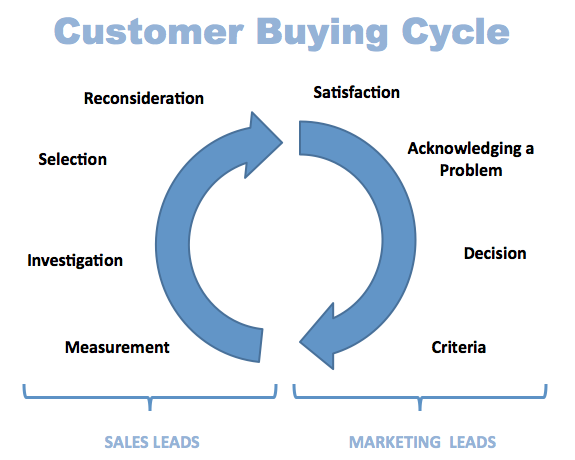
Understanding the difference between a Sales Cycle vs. Buying Cycle may be the most critical shift an organization needs to make to see significant and sustained revenue growth, especially for complex or highly competitive sales.
In a nutshell, the Sales Cycle is how your company looks at moving deals through their own sales pipe and sales process to close deals. Typically the flow looks something like a lead, marketing qualified lead, sales qualified leads, needs analysis, proposal, negotiation, verbal, and closed. This is a company centered view.
A buying cycle is looking at your sales cycle from what the customer needs. Probably the best example we have seen of a buying cycle is from Robert Jolles book Customer Centered Selling. Below is our brief explanation of how we look at this cycle, addressing some of the implications it has for us as an outsourced sales and marketing company with how we divide the sales and marketing functions.
Phase 1 – Intention to Buy
- The buyer starts satisfied with their current solution
- The buyer acknowledges to themselves that they are not satisfied
- The buyer makes the decision to do something about it
- The buyer starts to think about “what are the criteria” to consider moving forward
As a lead generation and a demand generation company, we understand that intention is meaningless without action. The world is full of people with great intentions that never actually take any action. Your job as a sales person and marketer is to understand that your first task in generating demand for your solution is to help educate a buyer on the “criteria” they need to consider. You need to appreciate that given a choice, most buyers will sit on the fence for as long as possible. They want to move forward, they know it’s good for them to move forward, so you need to help educate the buyer enough so they do in fact move forward. Your first job as a sales and marketing professional is to inspire and catalyze the desire that gets your buyer to move from the passive buying process to the active buying process. More and more, this is becoming the function of your content marketing and inside team.
Phase 2 – Active Buying
- The buyer needs to figure out how to measure the solution to: justify the purchase, understand the impact of doing nothing vs. changing, see the impact on topline, recognize the implications for bottom line, feel subjective relief of pain or risk
- The buyer investigates deeply, typically with short list of solutions and a deep dive into one or more solutions
- Selection is made; a front-runner is chosen
- The buyer reconsiders their decision
During the “Active” buying process, your sales team is typically on point. It’s at this point that marketing should take a back seat – with one exception: marketing needs to continue to support the sales team with the content they need to help deal with the reconsideration phase of the sale. Your marketers need to be prepared to help the buyer remember why they were no longer satisfied and embarked on their buying cycle in the first place.