
by gabriel_sales | Jul 8, 2011

This is part one of a two part series that explains how being strategic in planning how you target customers will produce significantly better results on the back end. Part two can be found here,How to Build a Winning Ideal Customer Profile.
An Ideal Customer Profile is a process for identifying what customers you should be targeting to get the best return from your sales lead generation efforts. As an outsourcing sales organization this is one of the key areas we focus on when providing our initial sales consulting during the launch of a client. We believe this aspect of the sales process deserves careful attention because what goes into the sales funnel is going to have a huge impact on what comes out of the funnel. It is also the critical first step in building an aligned sales and marketing effort, so you can create a sales machine.
Ultimately, an Ideal Customer Profile should allow you to find and target your potential customers based on a number of hard criteria related to both the company and the specific decision maker:
- Annual revenue of the company
- Number of employees
- Level of Contact – C-level, senior Manager, middle manager
- Functional Area – business Area, technical Area
- Title
- Revenue Responsibility – budget maker or budget spender
- Geography – global, national, local
- Technology Adopted – in some cases knowing what ERP, CRM, and if they have virtualized may be critical
- Their Clients – e.g. are they doing business with a Procter and Gamble, Federal government, education (local gov.) Walmart, Intel, EMC etc.
In addition, there well could be some softer qualitative criteria:
- Business Pain/Need
- Vertical Industry Trend – established or in transition, growth or decline
- Competitive – large competitors or a volume of competitors
- Psychographics – company culture, leadership style, corporate values
It is also important to know who you don’t want to sell to:
- Decision makers whose jobs could be threatened
- Internal Support Functions – for example, if you are selling data analytics you may want to avoid MR groups, or if you are selling operational efficiency services you may want to stay away from operations managers and start with supply chain directors
The purpose of this type of hard and soft segmentation is to establish clear, hard criteria that can be leveraged across your sales and marketing machine to:
- Purchase direct dial contacts for cold calling
- Purchase direct mail and Electronic direct mail contact information
- Filter leads from publishers
- Leverage for a “Cost Per Click Campaign” like Google Adwords
- Decide where to place your online advertising budget
- Instruct your social media outreach program
We realize this can look like a daunting task. But, as an outsourcing sales organization with 10 years of data we can guarantee that if you give this the attention it deserves upfront, you will see significant returns within 6 -12 months. You will see exponential returns in months 12-18 when your first wave of nurturing deals start to fall out of your pipe as closed deals.
For additional information on how to build and Ideal Customer Profile, we recommend you check out our companion piece entitled, interestingly enough, How to Create an Ideal Customer Profile.
by gabriel_sales | May 24, 2011
As an outsourcing sales company, outsourcing lead generation company, a sales strategy consulting and a digital sales marketing execution company, we have a great deal of conversations with existing and potential clients about what sales and marketing alignment mean. For Gabriel Sales it means that you have a sales machine where your team is focused on closing business. That means:
- Marketing is focused on putting leads in the pipe that will close
- Marketing drives deals forward with the right sales collateral at the right time.
- Sales provides marketing with the insights they need
- Marketing provides “Sales Collateral”, that moves deals through specific stages of the pipe
- Sales will actually use the collateral
- Sales trusts marketing to do its job to nurture deals that are not yet ready to buy
The first step in building Sales and Marketing alignment is to agree on your Ideal Customer Profile.
The second step is to agree on definitions for early stage leads. You need to do this so you can build a lead generation machine that matches the buyers readiness to buy with the expectations of your sales team. This way they will understand how much time, effort and money should be invested. To do this you need to clearly define your lead generations and lead qualification stages.
The following are quick definitions that Gabriel Sales uses:
Marketing Qualified Lead (MQL) – A lead that has accepted information and is open to understanding what you have to offer. They have registered for an event, or engaged in conversation with a telemarketer and indicated an openness to be contacted again.
MQL Hot – They are actively digesting your content. They have registered for and attended a webcast. They are opening multiple pieces of digital content. They are asking your telemarketer buying questions.
Sales Accepted Leads (SAL) – There is a fit between the customer’s pains or needs and your product or solution. It makes sense to invest sales resource time to do some initial discovery. A telemarketer can identify this fit by asking some pain questions and then setting an appointment. A marketer can do this by noticing a shift in the content they are absorbing. Are they moving from digesting digital sales content that is educational to digesting digital content that is verifying content? Are they moving from opening emails onto white papers, case studies, testimonials or your blog? (This is why an investment in marketing automation software like Marketo or Pardot becomes critical).
Sales Qualified Lead (SQL) – Your inside rep has established the decision making process, budget and/or path to budget and confirmed the need, which includes some combination of the following:
- Vertical
- Public or Private
- Annual Revenues
- Spend in Solution Area
- Strategic Initiatives
- Contact(s) title and role(s) known
- Basic understanding of need/pain
- Spoken to lead several times
- Potential opportunity identified- product matched to pain
- Timeline identified 3-12 months (depending on sales cycle
- Stakeholders identified)
- Initial compelling event identified that drives the timeline
- Decision makers identified
- Agreed to meeting with “Senior Sales” or “Executives” and a next step beyond that meeting (even if that next step is a yes or no on moving forward)
Nurture – Not yet ready to buy. Have expressed interest, but have not shown an interest in moving beyond Sales Accepted Lead. In some studies and across several of our clients we are seeing as many as 77% of our deals coming from the pipe a year after we have made first contact. This requires we stay in touch with digital content and an occasional voice mail on a sustained and consistent basis.
Once you have agreed on the definitions it is much easier to give your marketing team a sales quota by evaluating their tactics and giving each tactic both a primary and secondary function in building sales momentum.
by gabriel_sales | May 4, 2011
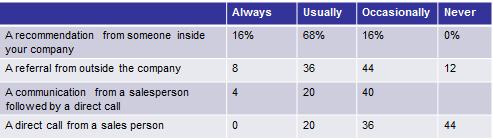
In Selling to the C-Suite Nicolas Read and Stephen Bistritz (page 84) provides some fantastic data that gets to some of the realities of what it now takes to get to the Senior Decision Maker. Below is what they found (detailed in the table), our strategic insight and how we approach the challenge of how to get a meeting with an executive.
Question – “When would you take a sales meeting?”
Answers:


Point #1
Strategic Take Away – You have an 80% shot of getting to the Decision Maker with an internal champion. You are almost guaranteed (4 out of 5 is as close to a guarantee as you will ever get in sales) a meeting if you can gain the trust and confidence of the technical buyer whose job it is to screen for the DM.
Action Item – Focus on creating content and a pitch that addresses the needs of the technical buyer first.
Point #2
Strategic Take Away – An outside referral works about 50% of the time.
Action Item – Success stories and on-record clients need to be part of your content and pitch mix. This also takes the pressure off of your technical buyer being out there solo recommending you especially if the recommendation is from the equivalent of a peer of the Decision Maker at a comparable company.
Point #3
Strategic Take Away – Just Cold Calling Senior Executive no longer works.
Action Item – A home run for Gabriel Sales has been getting very pointed video testimonials from Decision Makers. This allows your technical buyer to easily share them with the Senior Decision Maker.
We hope this blog has been helpful in understanding how to get a meeting with an executive. For more information, please contact us.
by gabriel_sales | Mar 4, 2011
At Gabriel Sales, we have over 12 years of experience helping B2B companies drive sales results and meet their business goals. Over the years, we have come to understand when and how a prospect likes to be pitched to. This blog outlines the option of digitizing your first pitch to save you time and money.
We have all been there. That first presentation you give a potential customer can be done in your sleep. Even worse after a month or two the sales rep (or the executive) can get so bored with it they start diverting slightly and it becomes less effective or even worse it starts to sound rote to the prospect.
One significant opportunity we have seen emerge over the past several years to increase our pipe velocity is the ability to take that first presentation digital. With the tools now at our disposal we can do that without completely losing the customization required for the technical buyer and the business buyer. And even more powerful, once we have the sales conversation mapped and we understand the first level of objections we can take that first sales presentation, script it for the product specialist and/or even a senior executive. Prospects love this because this first experience is with the team that will be serving them. All these in combination create wins for everyone across the board.
To learn more about Gabriel Sales and the B2B sales and marketing outsourcing work we do, please contact us. For more on B2B sales content development, please check out our Knowledge Center.

by gabriel_sales | Feb 25, 2011
How to know if sales outsourcing and marketing is right for you
Here are 5 final considerations to share with your potential B to B Sales Outsourcing and Marketing Partner as you are thinking about engaging.
1. Is reducing your speed to market critical? When you outsource you are plugging into a fully functioning machine. The technologies to execute are in place, the processes are built and you have a sales and marketing team that already knows how to work together to execute towards closed business on day 1. To recruit, build and train a team can take quarters if not years and even as you build that team you don’t know if they will work well together (we call it playing nice). Do you have the time to bring that team together and manage them?
2. Am I looking for Operational Expertise? Operational expertise takes time to develop because operational expertise is driven by measurement and verification against feedback loops. To truly drive operational expertise you need to benchmark against historical data. One of the major benefits of plugging into your outsourced partner’s existing sales machine is that you are not starting from scratch. There is a machine, feedback loops and historical data already in motion. You start smarter and you learn faster.
3. Do I want to build Operational Expertise and then bring it in house? You don’t need to be clear on this upfront but the reality of outsourced sales is that once the code is cracked and the process is built you can reduce your costs of sales by bringing it in house. If this is something you may be interested in it makes sense to discuss this with your partner sooner rather than later. We have found that if done effectively we can often times transition all or parts of the process at the right strategic time for our partners so everyone wins.
4. Is Scalability important to me? Sales outsourcing and marketing partners already have the ability to manage the increase and decrease of scale built into their system. All the infrastructure and process from the technology platforms, to the phone systems, recruiting and training systems etc. are already in place. Adding and decreasing headcount and the itinerant headaches are removed. Would it be of benefit to you to get rid of these headaches?
5. Do I really need to add full time executives (and the long term fixed costs) to my management team? The kiss of death to any company is too many strategists and not enough soldiers. Outsourced providers can bring the right strategic expertise to the table at the right time and then get rid of those costs. Getting the initial sales efforts off the ground takes strategic insight and leadership and often requires Senior Executive Talent on both the Sales and Marketing fronts. Pulling the technologies together also takes some advanced expertise. All this requires a significant investment. The beauty of going to an outsourced provider is that once this investment is made you don’t need to continue to carry these fixed costs. The senior team moves to the background and the machine and sales reps continue to generate revenue.
For more on Gabriel Sales or B to B Sales Outsourcing and marketing, please contact us.