by gabriel_sales | Dec 4, 2012

Unlike Facebook and Google+, which are used by both individuals and businesses, LinkedIn is built primarily for business professionals. The people who use LinkedIn are generally older and more affluent than those on Facebook or Twitter and are using the site primarily for business connections. For these reasons, LinkedIn is extremely important for B2B sales and marketing.
Here are some tips on using LinkedIn effectively for B2B marketing:
- Create a Page for Your Company. Like Facebook, your page is the platform from which you do all of your communication. You cannot get around having one if you want to be successful on LinkedIn.
- Customize Your Page. Give your readers something to look at by adding photos and videos to your page. LinkedIn also lets you create tabs for different topics like specific products or services, career opportunities and a description of what you do.
- Add Presentations. LinkedIn gives you the ability to upload any presentations or slideshows you may have to your page. They offer a few different applications for this, but PowerPoint and SlideShare are the most common.
- Use Polls to Attract. LinkedIn also has an app that lets you create polls. You can use this feature to gauge opinion on a new product or industry trend, and simply to engage with your audience. If your conversation is interesting enough, you will attract new potential customers.
- Add Blog and Twitter Feeds. LinkedIn has a feature that allows you display feeds from different sites. The two main feeds you want to add are your Twitter and blogs feeds. This makes it possible to have several different flows of information all aggregated in the same place, making everything that much easier for your potential customer to find.
- Create a LinkedIn Group. Like ‘circles’ on Google+, groups on LinkedIn allow for people to come together to discuss a certain issue or topic. You should create a LinkedIn group related to your industry and take part in the conversation. This is a great place to discuss best practices and industry insights.
- Promote Your Group. Once you have a group, you want people to know about it. Use all the media platforms you have to get the word out about your group and invite people to join.
- Participate in Different Groups. You should not only care about your group on LinkedIn. Your customers and potential customers are involved in other groups, and you need to interact with them in those places as well. Remember, communication works two ways, and you need to participate in the conversation.
For more tips from Gabriel Sales on using LinkedIn for B2B marketing, please feel free to contact us.
by gabriel_sales | Nov 30, 2012
 In a previous blog, we discussed 12 reasons why using an outsourced sales company for corporate blogging in B2B sales is effective. In this blog, we will outline exactly how to craft those blogs to make sure they are effective at every step of the sales cycle. While there are many different ways to purpose a blog, writing for reach and for acquisition are two of the most important.
Blogging for Reach
Creating an outsourced sales blog can be a great way to attract new potential customers. The best way to do this is to provide your potential customer with something informative and useful. Make sure it is something they would actually like to read, not a notice about moving offices. The key to blogging to reach new customers is to keep it general and related to your industry overall.
Your blogs posts should seek to strike a balance between opinion, advice and news. Posts about specific products or services are good, but are not likely to catch the attention you are looking for. By offering your readers your opinion about what is happening in the industry, you are able to get your name out there and position yourself as an expert at the same time.
Blogging for Acquisition
Blogs can also be extremely effective in turning those potential customers into actual leads. In today’s market, the decision makers for B2B sales are going online to do their research. This means you have an opportunity to put the information they need right in front of them.
Rather than the general industry related blogs you wrote for reach, blogs for acquisition should be more specifically about your company. Here is your chance to discuss your products and services and why you think they can solve business problems. This is also a great place to answer frequently asked questions and display your success through case studies.
Blogging for acquisition should also include posts that familiarize your reader with who you are. You can do this by writing posts about key staff members or even have staff write blogs themselves. There is also no harm in writing up blurbs about any awards you have won. This adds a more personal aspect to your blogs, which makes you look more human and therefore easier to work with.
The goal to using an outsourced sales blog for acquisition is giving your potential customers information they are looking for. Help them to understand who you are as a company and how you help your customers succeed. If you give your reader all of the information they need to make a decision, you are one step closer to closing.
by gabriel_sales | Nov 29, 2012
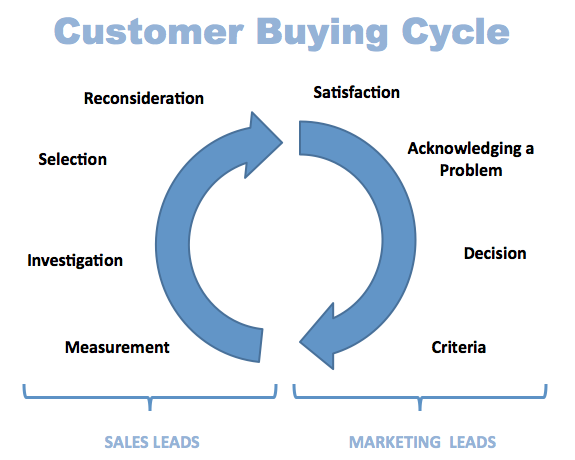
Understanding the difference between a Sales Cycle vs. Buying Cycle may be the most critical shift an organization needs to make to see significant and sustained revenue growth, especially for complex or highly competitive sales.
In a nutshell, the Sales Cycle is how your company looks at moving deals through their own sales pipe and sales process to close deals. Typically the flow looks something like a lead, marketing qualified lead, sales qualified leads, needs analysis, proposal, negotiation, verbal, and closed. This is a company centered view.
A buying cycle is looking at your sales cycle from what the customer needs. Probably the best example we have seen of a buying cycle is from Robert Jolles book Customer Centered Selling. Below is our brief explanation of how we look at this cycle, addressing some of the implications it has for us as an outsourced sales and marketing company with how we divide the sales and marketing functions.
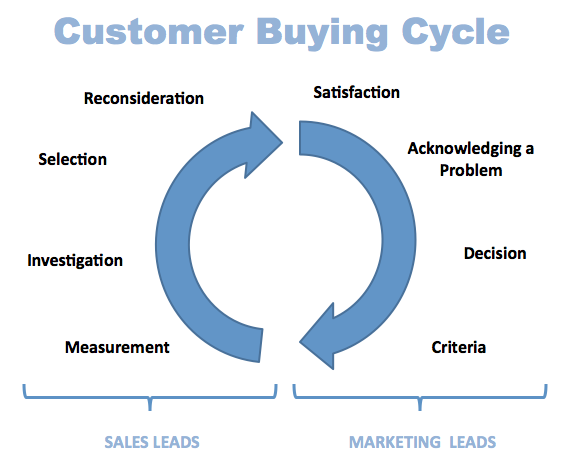
Phase 1 – Intention to Buy
- The buyer starts satisfied with their current solution
- The buyer acknowledges to themselves that they are not satisfied
- The buyer makes the decision to do something about it
- The buyer starts to think about “what are the criteria” to consider moving forward
As a lead generation and a demand generation company, we understand that intention is meaningless without action. The world is full of people with great intentions that never actually take any action. Your job as a sales person and marketer is to understand that your first task in generating demand for your solution is to help educate a buyer on the “criteria” they need to consider. You need to appreciate that given a choice, most buyers will sit on the fence for as long as possible. They want to move forward, they know it’s good for them to move forward, so you need to help educate the buyer enough so they do in fact move forward. Your first job as a sales and marketing professional is to inspire and catalyze the desire that gets your buyer to move from the passive buying process to the active buying process. More and more, this is becoming the function of your content marketing and inside team.
Phase 2 – Active Buying
- The buyer needs to figure out how to measure the solution to: justify the purchase, understand the impact of doing nothing vs. changing, see the impact on topline, recognize the implications for bottom line, feel subjective relief of pain or risk
- The buyer investigates deeply, typically with short list of solutions and a deep dive into one or more solutions
- Selection is made; a front-runner is chosen
- The buyer reconsiders their decision
During the “Active” buying process, your sales team is typically on point. It’s at this point that marketing should take a back seat – with one exception: marketing needs to continue to support the sales team with the content they need to help deal with the reconsideration phase of the sales cycle. Your marketers need to be prepared to help the buyer remember why they were no longer satisfied and embarked on their buying cycle in the first place.
by gabriel_sales | Nov 27, 2012
 A landing page is where your potential customer is sent after he or she clicks on one of your ads, an email, or a search engine result. A landing page can be your main website, your blog, a specific product page, etc. But, while it is possible to simply send someone to your homepage, it will be much more effective to create a specific landing page that is meant to match the link that was clicked on.
When people click on an advertisement, they are only willing to stay on the page they are sent to if that page contains further information that interests them. If you force people to look around for the information they want, they will leave your site before they even know who you are.
For this reason, landing pages are extremely important for B2B lead generation. Because landing pages are usually your first point of contact with new potential customers, you need to set up a well-designed and organized page that catches their interest.
The best way to make a successful lead generation landing page is to present information that is directly related to the ad, email link, or search engine result clicked on. This information can vary depending on the exact intent of the landing page, but you should always include a call to action, like a downloadable offer with lead capture form. Because you need to tailor your lead generation landing page to match your specific advertisement, this means that if you have multiple ads, you need multiple landing pages.
While it may be easier to send everyone to your homepage and have them go from there, this is not an effective sales approach. The more clicks it takes for people to find the information they are looking for, the more likely they are to leave your site altogether. It is therefore your job to make the information they want as easy to find as possible by making separate pages for each ad.
When designing landing pages, it is important to keep in mind that their intent is to push people along in the sales cycle. So, your lead generation landing pages should contain information and tools that will help this happen. You should design each page to give readers key information about only the product or service featured in the advertisement.
The goal of designing multiple landing pages for each advertisement is to simplify the process of giving and receiving information. By creating a separate page for each of your products or services, you make it easier for your customers to find the sales content they want and for you to get their contact information in return.
by gabriel_sales | Oct 30, 2012
 One question we keep hearing around the B2B sales world is, “Does blogging work for B to B?”. This is because recently, many B2B companies have started catching on to the trend of blogging. Forrester reported that in 2010, 49 percent of B2B companies kept a corporate blog and in 2011, 114 Fortune 500 companies were regularly updating their blogs. So, why are corporations taking part in this social media trend? Because it works!
Here are 12 reasons blogging works in B2B sales:
- Blogging Makes You Human. B2B customers like to interact on a personal level and blogging helps you seem more personable. Blogs can be less formal than e-newsletters or white papers and therefore give you the opportunity to express your humanness and unique personality. By putting out a public and personal face to your customers, you can interact with them on an individual level, motivating more people to purchase your product or service.
- Blogging Gets People to Your Website. In your blog, you should have links that go back to your main website. These links are one of the most effective ways you can drive traffic to your website.
- Blogging Generates Leads. HubSpot recently found that 57 percent of organizations with blogs report having gained new customers through their blogging efforts. Blogging is arguably more effective at generating leads than either Facebook or Twitter.
- Blogging Keeps Your Website Fresh and Relevant. The basic information on your website is likely pretty static. Mission statements and contact information do not change often. However, with a blog, you can give your potential customers a reason to come back repeatedly by mirroring all of your blogs on your website. If a potential leads find something new and fresh every time they visit your site, they are likely to think you are informed and up-to-date on market trends.
- Blogging Improves Search Engine Optimization. Blogs are great for SEO because, unlike your website, each individual blog you write can end up as a separate search result. Having multiple blogs with similar keywords increases the likelihood that you will show up multiple times on a search results page.
- Blogging Synergizes Social Media Efforts. Blogs should have links to your social media sites and vice versa. A recent study found that companies with blogs have two times as many followers on Twitter than companies without blogs. This shows that blogs are an effective means of driving people to your various social media sites.
- Blogging Improves Branding. With a blog, you are able to control the information that goes out to the public. Therefore, you can use a blog to exercise control over your brand image in a way that is impossible on other social media sites.
- Blogging Shows You Are an Expert. Informative or educational blogs can be used to position yourself as an industry expert. If you can demonstrate expertise to your readers, your product or service starts to look much more appealing.
- Blogging Captured Media Interest. If you are successful in positioning yourself as an expert and have something timely or interesting to say, your blog can become news. The media is always looking for the newest, greatest ideas and media coverage of blogs is a great way to expand brand awareness.
- Blogging Provides Feedback and Builds Community. Blogging creates a two-way communication model through the opportunity to leave comments. It is therefore an excellent tool for gaining understanding of your target audience. Comments let you have instant feedback on the blogs you write, allowing you to make constant adjustments to your message based on your readers’ reaction. These comments can then turn into lively conversations, which also can help you build a network of relationships with potential customers and other industry leaders.
- Blogging Distributes News & Information. This is one of the main ways a corporate blog is used. Blogging lets you share news about changes in corporate policy, a new location opening, or information about future seminars or trade shows. Pretty much anything you want your customers to know can go in a blog.
- Blogging Promotes Your Products/Services. You can also use blogging in a purely promotional manner. Similar to writing a press release, you can translate ad copy into a news style article and promote new products, services, promotions and more all through your corporate blog.
If you still need convincing that blogging works for B2B sales or would like to discuss a strategy for creating a corporate blog of your own, please feel free to request a review.