by Glen Springer | Jul 23, 2016
Magic bullet for sales outsourcing
There is no grey area for Gabriel Sales that sales outsourcing for new product launches is ultimately about closing business. However as a sales consulting firm that has driven millions in closed deals and over 200M in exits with successful new product and service launches over the past 10 years we also understand that we can drive wealth for the entrepreneurs, executives and investors that we serve by empowering the entire organization. This is done with the right feedback loops and insights so our clients can make the right strategic decisions for their business. Below are ten business intelligence and strategic areas that the right sales outsourcing partner for new product launches can and should execute against as sales consultants drive the entire enterprise. For additional resource for new products launches and go to market strategies please visit our Sales Strategies for New Product Launches Resource Page.
Sales Strategies for New Products
Rapid Communication – It’s critical that direct feedback loops are created from the sales team directly back to product development, the marketing team, and the CFO. These feedback loops need to be available all the time. Speed directly from the market back to the team is critical. One of the advantages of a sales outsourcing firm that specializes is new product launches is that we have designed our internal systems to provide these feedback loops and are contractually accountable for them. The right internal feedback loops will improve the product and align sales and marketing for shared success.
Commit to Digital Content…especially Blogging – We are a sales outsourcing firm making 1000s of outbound calls a day. Customers are not waiting for us to call. If we get them on the phone being able to share a quick piece of content (video, landing page, short demo) goes a long way to getting them to spend more time with us on call two and the same content can also be leveraged to disqualify prospects. The average customer leveraged 10.7 pieces of content in their buying decision in 2011 and this is projected to increase in 2012. If you have a limited budget we have strategies and tactics we leverage for our customers that allow them to take advantage of our sales outsourcing for new product launch tactics that turn your blog into a virtual sales rep.
Be Prepared to Educate the Market – Most new products are offering a new solution that is disruptive to the market. Many new product companies are enamored with their technology (since they have passionately developed it) and forget that in many cases before you get to share those technical specs you need to help the customer understand and define the business problem they are trying to solve. You also need to be prepared to educate your customer how to calculate return. Don’t underestimate the value of keeping it simple for the prospect especially in the early stages of the sales cycle. For more info on how to frame your content strategy, please check out our B2B content framework graphic in our blog What is Successful Sales Collateral?
Sell from Scripts – This is one of several areas where a new product launch sales outsourcing firm has some strategic value over hiring individual internal reps or rolodex reps. Outsource sales firms are designed to sell using a repeatable process so selling from scripts is critical. It gives us something to measure and a way to anchor the success of the sale in the message and the story as opposed to the personality.
Commit Focused Energy to your Initial Ideal Customer Profile – If you don’t know what this is we have a short blog series dedicated to this. CLICK HERE TO READ MORE. You need to take your best guess at what verticals and what decision makers will buy and champion your product. And then test those assumptions and measure those results.
Document the Buying Process and the Sales Process – As you take your first customers from MQL or Cold Call through Sales Accepted to Sales Qualified to Closed deal you need to understand the key events in that cycle. As a sales outsourcing firm this is one of the sales consulting functions we offer our clients. We believe it’s critical because when combined with the right sales metrics (see below), mapped to the Ideal Customer Profile (see above) it gives us the ability to start to more accurately forecast dollars in and dollars out investments for the entrepreneurs and boards we serve. It’s also critical to remember that the same digital content we discussed in point 2 at the top of this blog is contributing to the sale. You need to get your sales reps and marketing team to score that as part of the buying process as well. Documenting the buying process allows you to build a sales process that allows the buyer to buy on their terms which means a sales ramp that consistently moves up an to the right and we are all in this entrepreneurial business to build sales machines that turn growth rates into hockey sticks.
Measure the Right Success Metrics – You need to measure the success of your early pipe efforts from day one. A sales outsourcing solution for new product launches has the advantage of having years (at least 10 years in our case) of historical data to benchmark your efforts against similar sales to similar markets and similar decision makers. This is especially critical for new product launches that have no historical data to benchmark against. To learn more about the metrics Gabriel Sales feels are most critical feel free to reach out to us to Learn if you can Build a High Velocity Sales Machine.
Know Why You Win and Why You Lose – If you are measuring the right data you will already be well on the way to knowing why your new product launch is successful. Its also important to understand why you are not winning when you lose. One value-add we provide as a sales outsourcing consulting service for new product launches is that after losing a deal we will call the decision maker if possible and ask “ for own learning, is there anything we could’ve done better?” We will take notes and pass that information on to our clients.
Commit to Marketing Automation and Nurturing Prospects “Not Yet Ready to Buy” – Our clients are investing in more than closed deals when they are choosing to outsource part or all of their sales and marketing operations. We are not going to win every deal the first shot we take especially for new products. Some may not have budget immediately, others may be waiting for our clients to have a couple more customers, others may need to champion into their organization. Data from Forrester states that 70% of Marketing Qualified Leads will buy in a solution area they invest time in exploring within 18 months. If nurtured correctly 25% of your MQLs will hit your pipe within a year according to Aberdeen. If you put 400 MQLs into the pipe in your pipe during your initial launch this means (assuming your product hits the mark) that you will have 100 SALs by year if you invest in nurturing out of the gate. Gabriel Sales provides sales consulting to assist with multiple nurturing from lead scoring, to social media outreach, content testing and marketing automation software implementation.
Lead with Value Proposition but Sell with Differentiators – Selling starts when a customer says “No” and arguments are never made in a vacuum. Value propositions are a great lead but they only take you so far. To close a deal your business case needs to make sense in the context of a category. We take all of our new product launch sales outsourcing clients through a quick and proprietary process that helps us and them to tell that story. This does not mean that you need to sell directly against the competition it simply means that the story will include what the prospect/marketplace has heard from the competition. In many cases we find that that competition is an internal competitor.
To see if our Sales Consulting and/or Sales and Marketing Outsourcing Solution is right for taking your new product to market we invite you to visit our New Product Launch Sales Strategies Resource Page. CLICK HERE
For a custom Go-To-Market Evaluation please feel free to CONTACT US to benchmark the market and see if a High Velocity Sales Machine is a possibility for you.
by Glen Springer | Nov 11, 2015
This is a guide to five ways that marketing automation and sales technology can quickly shift your internal culture and help your sa les team be more effective, and most importantly, win more deals.
The five avenues through which adoption of marketing technology and sales automation will have an immediate positive impact on your performance are as follows:
- Lead Capture
- Lead Qualification
- Email Automation
- Lead Intelligence
- Real Time Lead Alerts
Below is a brief explanation of how each of these features will help boost the performance of your sales team and the success of your marketing efforts.
Lead Capture
Tools come onto the market and promise to help sales and marketing teams improve their efficiency. Pardot Marketing Automation Software, for example, allows you to identify companies and targets that are spending time on your site without the need for any information to be directly supplied by the prospect. The major value established here is through the ability to identify potential prospects without having the lag time of: contact info needing to be input or using a 3rd party data provider like Inside View, LinkedIn, one Source and SalesForceData. This method more quickly identifies the key players within a company, spending time digesting your marketing material. These 3rd party data provides are used to pull in additional data to fill in holes for contacts that are already established.
It is important to not downplay the necessity of being able to capture leads with landing pages and forms. That is not a new concept or strategy and will help increase your ability to hand over qualified prospects smoothly, when combined with strong lead management rules.
Lead Qualification
In today’s B2B markets, there are two main ways to directly and successfully qualify leads: using implicit behaviors and activities or explicit data and demographics.
By using implicit information and dynamic lead scoring, you will have the ability to rank and score formerly unquantifiable activities (email, web, social) variably by importance and then set up response actions. These sales automation efforts seamlessly pass top scoring prospects over to well-prepared sales reps in real time.
In using explicit data and lead grading, you gain the ability to qualify a prospect on who they actually are, and the habits they have exhibited – ex. a CEO versus a workaholic just trying to learn something new by requesting your content. You can also adjust grading up and down depending on industry, company size and other various metrics. Essentially, you are able to grade your prospects against an ideal customer profile that your sales and marketing team identifies.
These tactics will directly help your sales team avoid talking to bad prospects that won’t convert, and these grades and scores provide you with another way to dynamically pre-qualify and assign the best prospects to the best sales reps.
Email Automation
Email automation is a major facet in helping your sales reps take their knowledge about and performance with leads to the next level. Reps now have the ability to use email integration tools for programs like Outlook, Gmail, Apple Mail and Thunderbird to send personalized emails through the marketing automation tool. This integration results in a new way to personally track opens, clicks, and site time that comes with the option to receive real-time automatic notifications sent to reps.
Email automation also allows for new approaches to personalized email campaigns. The marketing team can craft a message or series of messages to the company’s entire pool of prospects, yet dynamically assign the various fields of the email as they apply to each prospect. This serves two main purposes: 1) reps are accredited by leads to having provided appropriate information with no effort (the marketing software and sales engine took care of everything) and 2) all replies to specific content go directly to the assigned rep, and can be analyzed to provide further insight for future targeting.
A consequential bonus of email automation is that sales reps can pass back “not-yet-qualified” leads to be furthered nurtured by the marketing automation program. This allows for continued exposure, lead qualification and reduced lead exit. Sales reps are notified if the lead “comes back to life” and the lead is automatically sent more digestible content.
Lead Intelligence
Through marketing automation and sales technologies, reps are able to track all online behaviors (email, web, social) and that data is put directly into any CRM (Salesforce) instead of requiring the sales rep to learn the ins and outs of the back-end functions of the marketing automation prospect tracking system and put the information in themselves. Actionable data including the original lead source, specific page views, keyword searches, webinar attendance etc. can all be tracked. This allows for sales reps to profile and frame the content for anything from conversations, voicemails and follow-up emails based on the prospects specific actions and activities.
Real-Time Lead Alerts
This function of sales technology and marketing automation is crucial if you want to compete effectively against competition in the market. Timing is everything, as any good sales rep knows. Real-time lead alerts allow sales reps to reduce response time almost entirely when companies or leads are actively engaged in the sales education collateral. Sales reps receive instant alerts via email, text, mobile applications, and desktop notifications – whichever medium they prefer.
With these alerts and summaries, reps can:
- Prioritize their day with the most active prospects
- Perform quick lookups of anonymous visitors in LinkedIn or Jigsaw to identify potential new prospects
- Click on links to trigger CRM profile lookups
- Send email to active prospects with a few quick clicks
- Filter out unwanted and distracting activity
All five of these features: Lead Capture, Lead Qualification, Email Automation, Lead Intelligence, and Real-Time Lead Alerts save your reps time and help them close more deals. An effective integration and strategy surrounding marketing automation and sales technology will help you to synthesize marketing and sales objectives and improve overall company success.
For more information on how to increase B2B sales volume and how you can adjust your B2B lead generation, demand generation and sales tactics, look for our 5th and final blog of this series, out next week.
If you would like to learn more about how we at Gabriel Sales can combine your product knowledge and thought leadership with our sales and marketing expertise to increase your success and beat out competition, please contact us.
by Glen Springer | Jun 10, 2013
This week, we have received a lot of questions from our clients, potential customers and friends asking us two questions:
- How do we feel about the acquisition of ExactTarget by Salesforce.com?
- How did they get that kind of multiple? (Salesforce.com paid $2.5 billion with ExactTarget’s expected revenues of $120M for fiscal year 2014).
How do we feel about the acquisition?
As a company, we couldn’t be more pleased!
A year ago to date, we made the decision that we would no longer take clients on without a marketing automation implementation because of the productivity increase we witnessed with our first three implementations. We have done a dozen marketing automation implementations over the past 18 months for our clients. 100% have been with ExactTarget’s Pardot, and 90% have been with Pardot and Salesforce.com. So to pat ourselves on the back, we strategically picked the winners for our customers.
This acquisition is going to make our ability to serve our clients even more productive and powerful, especially as Pardot and Salesforce.com start to fold even more powerful Social Media and Analytics Tools into the mix over the coming years.
How did they get that kind of multiple?
Marketing is undergoing a radical and accelerating transformation where more and more products and services are bought and not sold. This is because self-directed B2B consumers can now leverage a broad variety of digital content instantly available to provide the information they need online.
As a company, this means you now need to fundamentally change how you engage with prospects and customers, which requires a new kind of technology solution – one that allows you to create ongoing dialogue with your buyers across channels. A technology solution that allows your sales team and your marketing team to focus on the needs of your buyers is critical. The combination of Pardot and Salesforce.com makes it easier for your teams to serve your buyers and to hold each other accountable with deep insights and analytics. The combination of Salesforce.com and ExactTarget and Pardot simply make serving this new buyer easier for your sales team, your marketing and your executives. ExactTarget got that multiple because the combination of Salesforce.com and Marketing Automation works for its customers.
Here are several supporting pieces of data:
Market Adoption of the integrated platforms (across both CRMs and Marketing Automation) is still somewhere between 14% to 18% depending on whose numbers you look at. Of those with the platforms (and this is anecdotal talking to other marketers, service firms etc. that we know), less than 25% of the companies using the platforms are pushing them hard and with focus, which means we are still early in market adoption.
It takes about a year to 18 months to have your engine humming, but once it is, we are seeing three significant jumps in conversion numbers.
- Leads properly nurtured convert to Sales Accepted Leads with far less outbound phone calls. With no nurturing, it would typically take 850 to 1000 phone calls to put the same percentage of Sales Accepted Leads you can now put in the pipe with only 120 to 200 phone calls. This makes for an 8X increase in the efficiency of the middle stage of your pipeline development.
- This also transfers to closing at the bottom part of the funnel. Well-nurtured leads are converting into 3X more closes. This doesn’t happen overnight, but when it does, teams are pumped.
- Combining the two points above – according to several studies we have seen, (and some of the numbers we are seeing internally) within 18 months, companies that have done solid implementation are seeing a 157% increase in sales and a lower cost of sales %.
Analysts are predicting that the CMO is expected to spend more on technology than the CIO by 2017. And, according to one analyst report we read in one fell swoop, “Salesforce did what it had to do so they now can call their solution the first Marketing Cloud.”
If you are struggling with your marketing automation implementation, struggling with getting your sales team fully integrated, or just curious and want to learn more, feel free to contact us for a quick consultation to learn more. You can also download our whitepaper Increase Revenue by 157% with Integrated Sales and Marketing . Or check out this quick video for more details about Why Did Salesforce Pay 2.5B for Exact Target?
Watch the video now
by gabriel_sales | Nov 29, 2012
Understanding the difference between a Sales Cycle vs. Buying Cycle may be the most critical shift an organization needs to make to see significant and sustained revenue growth, especially for complex or highly competitive sales.
In a nutshell, the Sales Cycle is how your company looks at moving deals through their own sales pipe and sales process to close deals. Typically the flow looks something like a lead, marketing qualified lead, sales qualified leads, needs analysis, proposal, negotiation, verbal, and closed. This is a company centered view.
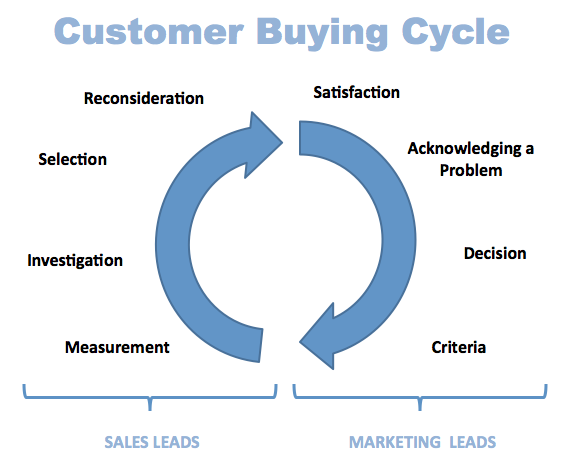
A buying cycle is looking at your sales cycle from what the customer needs. Probably the best example we have seen of a buying cycle is from Robert Jolles book Customer Centered Selling. Below is our brief explanation of how we look at this cycle, addressing some of the implications it has for us as an outsourced sales and marketing company with how we divide the sales and marketing functions.
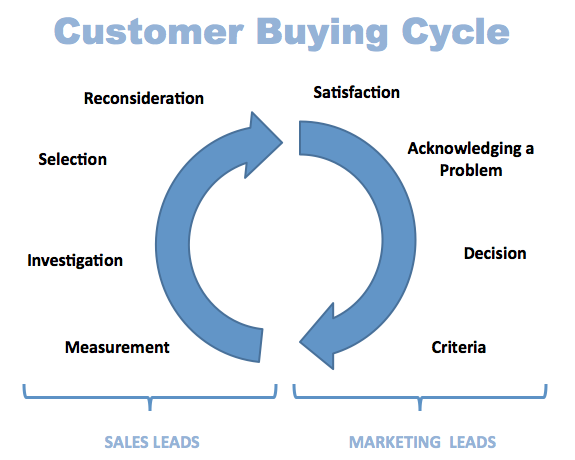
Phase 1 – Intention to Buy
- The buyer starts satisfied with their current solution
- The buyer acknowledges to themselves that they are not satisfied
- The buyer makes the decision to do something about it
- The buyer starts to think about “what are the criteria” to consider moving forward
As a lead generation and a demand generation company, we understand that intention is meaningless without action. The world is full of people with great intentions that never actually take any action. Your job as a sales person and marketer is to understand that your first task in generating demand for your solution is to help educate a buyer on the “criteria” they need to consider. You need to appreciate that given a choice, most buyers will sit on the fence for as long as possible. They want to move forward, they know it’s good for them to move forward, so you need to help educate the buyer enough so they do in fact move forward. Your first job as a sales and marketing professional is to inspire and catalyze the desire that gets your buyer to move from the passive buying process to the active buying process. More and more, this is becoming the function of your content marketing and inside team.
Phase 2 – Active Buying
- The buyer needs to figure out how to measure the solution to: justify the purchase, understand the impact of doing nothing vs. changing, see the impact on topline, recognize the implications for bottom line, feel subjective relief of pain or risk
- The buyer investigates deeply, typically with short list of solutions and a deep dive into one or more solutions
- Selection is made; a front-runner is chosen
- The buyer reconsiders their decision
During the “Active” buying process, your sales team is typically on point. It’s at this point that marketing should take a back seat – with one exception: marketing needs to continue to support the sales team with the content they need to help deal with the reconsideration phase of the sales cycle. Your marketers need to be prepared to help the buyer remember why they were no longer satisfied and embarked on their buying cycle in the first place.
by Glen Springer | Apr 30, 2012
So now you that you have purchased a marketing automation platform you are ready to implement and it’s not as simple as you were led to believe. As an outsourced sales and marketing company we have already helped to implement several platforms (as well as implementing our own) and helped companies with several stalled implementations. Here are some best practices in marketing and sales automation because, as one vendor recently told us, ‘we can sell them the car but we can’t drive it for them’. Here are some basic tips and some best practices to help you avoid some headaches and to learn from our mistakes and success. If you have not checked out what these platforms can do here is a quick overview from Pardot 5 Minute Overview of Marketing Automation and this post will make a whole lot more sense.
Think about your Content in a Different Way – The whole point of a marketing automation platform is to drive more business in a more effective way. This starts with how you are speaking with your buyer. If your content is still all about your product – tech sheets, features and benefits etc. its -time to think about being customer centric rather than product centric.” Your drip campaigns will drive more business if you talk to your customers about their problems and their needs. You may need to look at the “voice” of your messages and refine your language a bit. As a starting point look at how may time you talk about “Our’ product, “our” team vs. “your” needs, “your” business and “your” customers. Stop being product centric and start being customer centric. Here is a series of blogs on how to shift your content approach and get sales and marketing on the same page.

Organize your Content Ahead of Time. For a marketing automation platform to run effectively it helps to do two things with your content. First you should isolate all your webcasts, white papers, blogs, videos on individual website pages. This allows you to easily understand what your customer specifics needs are which in turn allows you to score your leads more effectively as you track their digital interest. Secondly, it really helps to also create landing pages that offers your customer content for all three stages of their buying cycle so you can track when your buyers are moving from educating themselves (kicking the tires) to being ready to buy (e.g looking at pricing or testimonials). Gabriel Sales has created an easy to use sales content management technology – Gabriel Sales Digital Base Camp™ that can help you do this in a matter of weeks. Below is an example of one of those lead scoring features.

Involve Sales and Invest the Time Integrating with your CRM – What we have found is that even a basic integration can take an IT professional too much time. Most of the marketing automation platforms we have seen have huge volume of really cool features and bells and whistles so you can tend to over design before you know how you want to use them. Ultimately this is about empowering your sales team and recognizing your IT teams expertise is not sales. Probably one of the biggest bottle necks we have seen is that IT folks get proprietary and a project that they thought would take weeks can take a developer three months or more . The challenges are not with the system’s API or stability; they were with our client’s requirements, process definitions and prioritization. Like most development work that starts “easy” it quickly gets complex when they don’t understand the underlying business processes. Unfortunately as the time line expands it ends up being sales and marketing that are on the hook for results and not the developers. Salesforce.com has been the easiest integration for all the platforms we have seen.
Keep your Initial Drip Campaigns Simple. This is probably one of the biggest lessons we learned. When we first started we came up with a very complex IF/ then workflow so if they opened this piece of content on a topic area we would send them another piece of content on topic area B and then if they didn’t open that we would send them content Z. It was too much and just writing about it confuses me. What we found is about 80% of the value you are going to get from your initial drip campaigns is going to come from simply implementing them. It takes time to learn a new software and the biggest value the software provided initially is simply keeping your brand and solution in front of your buyers over time so your reps don’t have to. A simple five to seven touch campaign without any IF/then work flows was enough to get more deals flowing at less cost. Don’t frustrate yourself. You will quickly learn from your wins. If you are a smaller company, as a best practice, we recommend that you start by talking to your sales reps about their sales process and simply take that sales process map and create your initial drip campaigns for about three target markets.
Tap your vendors (and other vendors) knowledge centers – This industry is not that old. Eloqua, Pardot and Marketo (to name a few) all have fantastic knowledge centers that can teach you the basics of lead scoring and nurturing etc. Our vendor Pardot has been a huge help but we have also found both Marketo and Eloqua’s knowledge centers to be valuable as well. Obviously as an outsourced sales and marketing company we also recommend that you strongly consider working with an organization like ours. We have the advantage of having worked in the space across multiple enterprises so we have made a great deal of the mistakes already so you don’t need to.
We hope this blog has been helpful. Marketing Automation is a relatively new concept for most marketing teams and we have found that once you start to gain some momentum you will quickly realize that it’s clearly how business will be done for the next decade. We are just at the beginning of a new paradigm starting with marketing automation and then, as we are quickly discovering, if your marketing automation implementation is done correctly this will drift towards sales automation. Ultimately this will begin to drive more deals fast at less cost. We are experiencing some fantastic initial success reducing cost of sales percentages for both ourselves and our clients. The learning curve is exponential. So have fun.
If you have not checked out what these platforms can do here is a quick overview from Pardot 5 Minute Overview of Marketing Automation. If you have a stalled with your marketing automation implementation or if you would like to know more about best practices in marketing and sales automation, feel free to contact us for a quick consultative call.
by Glen Springer | Apr 11, 2012
Why Are My Sales Flat?
In Part 1 of this little snapshot of facts and figures we discussed the pillars of sales and marketing alignment and shared some facts and figures discussing the challenges of implementing a marketing automation platform. In Part 2 we discussed, from our vantage point of providing you with outsourced sales and marketing insights, why we feel like your leadership buy in is important to getting a sales process off the ground that sells to the buyer the way the buyer wants to buy.
As an outsourced sales and marketing company it’s our job to stay on top of the latest research data so you can stay focused on your business. What follows are some facts an figures about the current state of sales and marketing alignment:
According to Marketing Sherpas 2011 State of B2B Demand Generation report:
- 80% of leads that are turned over to sales people are raw leads.
- Of these leads 77% are long term leads (future opportunities) often ignored by sales people (which makes sense because its their job to transact this quarter).
- 80% of marketing leads consequentially wind up lost, ignored or discarded
- 73% of companies have no process for re-engaging or nurturing leads after sales. (e.g. no nurturing process).
What all this means is that about 80% of the leads marketing turns over to sales reps are not qualified. The buyers is not ready to buy yet. So this means that as much as 60% t0 70% of your companies potential revenue is being squandered.
What Can Your Company do to Turn this Around Immediately
With the right resources you don’t necessarily need an outsourced sales and marketing solution long term. In our White Paper Sell Faster and Sell Smarter 12 Tips you can implement immediately to turn around your B2B Demand Generation Team today we get into some detailed tactics. What follows below are some high level approaches we advocate exploring to start to shift your culture now.
Aligning Sales and Marketing – Best in Class companies know that both Sales and Marketing must get on the same page.
• A Mutual Definition of a “Lead” – agreed upon by Marketing and Sales
• Service Level Agreement (SLA) – Sales commits to timely follow up and closes the loop on every Marketing Generated Lead, agrees to reject unqualified leads back to marketing for nurturing
• Measure – Ongoing communication between both parties to evaluate progress toward goals and gaps in the process
Prompt Follow Up – Forrester says 46% of marketers at firms with mature lead management processes have sales teams that follow up on more than 75% of marketing-generated leads. As a sales outsourcing organization we staff sales account profilers and B2B lead profilers to support our own internal sales reps and your sales reps
Higher Conversion Rates –Gartner says when greater integration is accomplished between marketing and sales, conversion rates for leads (defined as earning the designation as qualified and/or committed to the sales pipeline) can increase by as much as 50%. We have our B2B lead profilers follow up with all leads to determine their readiness in a friendly and customer service oriented way.
Why is all this critical. Because bottom line you end up with More closed deals – CSO Insights says – Companies with mature, defined lead generation and management practices have 7% higher sales win rate.
Implement a Marketing Automation Platform and take some of the pressure off your sales team. You can nurture your not ready to buy customers and ensure that when they do you are the first in line. If you have not checked out what these platforms can do here is a quick overview from Pardot 5 Minute Overview of Marketing Automation. You can also start to leverage your content consumption to determine if the buyer is ready to buy by scoring that consumption, which a marketing automation platform allows you to do. Here is a quick sample.

To see if an outsourced sales and marketing solution or sales and marketing sales process consulting engagement may be able to help you accelerate your ability to take advantage of the current competitive advantages that technology and a quick cultural shift can provide please feel free to contact us for a quick consultative call.
We also invite you to visit our knowledge centers for more detailed tips:
Tactics to Lift or Launch B to B Demand Gen
New Product Launch Sales and Marketing Tactics
Digital Content Strategies to Give Marketing a “Sales Quota”
Sales Strategies for Tech, Software and SaaS Sales
Sales Strategies for the Professional Service Sale