Marketing Automation Implementation Best Practices – Sales and Marketing Needs to Start with an Agreement on Sales Lead Definitions

This blog is part of a two part series that discusses two marketing automation implementation best practices to accelerate your demand generation engine implementation using Sales Lead Definitions. These marketing automation implementation best practices allow marketers we work with to increase their initial lead volume from our initial Gabriel Sales Ramp™ Campaign (to keep the sales team happy) while we also help to build your engine.

As background – as Gabriel Sales works with our clients building a repeatable telesales process and demand generation engine,  we often discover that your company has great metrics and processes to move deals  from “Sales Qualified Opportunity” to “Close” but limited visibility into the Early Stage Pipe metrics.  Just like late stage pipe velocity, using Sales Lead Definitions to define the discrete stages of your early stage pipe is critical to success of any integrated content marketing and sales effort to put more sales qualified leads into the pipe.

The purpose of this blog is to introduce a marketing automation implementation best practice using Sales Lead Definitions to help accelerate agreement on how the early stage pipe can be scored so your sales team:

  • Can quickly help marketing create the lead definitions and get back to selling
  • Has the flexibility to successfully take early stage leads from the pipe in the short term to take advantage of the initial lead volume
  • And as the engine reaches maturity, the sales team reaps the benefit of more sales qualified leads in the mid and long term

Starting with the End in Mind with your Marketing Automation Implementation

Building a Demand Generation engine does not happen overnight but once created it pays huge dividends. The top three short term benefits are:

  • Turn buyers ready to buy into Sales Qualified Leads faster to increase your sales pipeline’s velocity
  • Maximize your lead generation budget by effectively nurturing leads not ready to buy so when they are ready to buy they buy from you, (which will eventually increase the size of your sales qualified pipeline)
  • Reduce the cost of time spent by your senior sales reps and product specialists educating and selling to buyers that are not ready to engage with sales yet (or buyers who are just kicking the tires and never plan on buying) so your top resources spend their time focused on “closest to the dollar” activities.

Once the engine is built the end goal is to take your increased revenue and the bottom line savings your demand generation engine is producing to:

  • Put more even more leads into the pipe

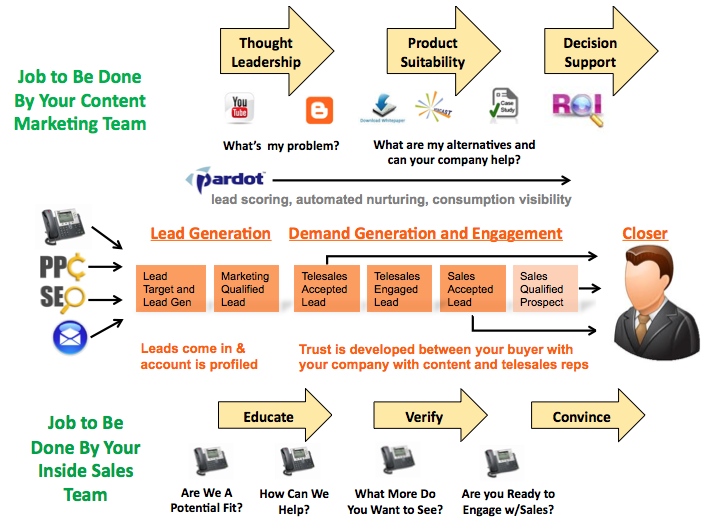
To build an engine requires a telesales team and marketing team aligned with a singular focus of putting more sales qualified leads into the hands of your closers.  Below is how this alignment works.
A Framework for Agreement on the Lead Stages is a Critical Marketing Automation Best Practice

Most clients we work with are generally great at defining what a “Lead” is and what a “Sale Qualified Lead” is.   If a company has an active inside sales team in place already they may have some of the other sales lead definitions in place as well.

As part of our initial consulting work we work with the sales team to distill specific probing and open ended questions that can be used in the early stage sales process to define where the buyer is in their sales process.  This is then used by both marketing and the inside team to support the sales team.

Ultimately the key driver to the organization is going to be how many deals actually close.  What a combined telesales and marketing team can impact is how many “Sales Qualified Leads” get in the hands of the “Closer”.

There is no one right and wrong way to set the criteria below.  What we are sharing is a starting point so your executives and your closers can evaluate the early stage pipe and make better decisions about what actions to take.  For sales specifically it is meant to communicate where the buyer is in their buying cycle, if and when sales should engage and how sales should approach engaging your buyer (where is the buyer in their buying cycle).  The criteria below allows your marketing automation to do its job and allows your inside team to move deals through the pipe more effectively.  When properly executed you will:

  • Save your closers and product specialist’s bandwidth.
  • Allow your sales team to “cherry pick” leads from the pipe earlier if they see an opportunity they would like to pursue.
  • Clearly communicates to your sales team where the buyer is in their buying cycle so they know how to best approach that buyer.

Lead Target – The decision makers and companies you are targeting.  Ideally you are targeting an ideal customer profile.

Marketing Qualified Lead – Any lead that has expressed mild interest or raised their hand and opted into receiving content from your company.  The source of the lead does not matter.

Telesales Accepted Lead – A lead where the company is the right fit (right account profile) and the buyer you are speaking with has the interest in learning more.  May have the ability to influence or may have the ability to get you in front of the influencer or decision maker.

Telesales Engaged Lead – (a sub set of Telesales Accepted Lead).  There is an agreed next step.  Could be in a week, month or could be in a quarter.  In some cases it could be at a specific point in time for next year’s budget cycle.  Typically the buyer has been asked if they are ready to talk to sales and has declined “not yet but stay in touch”.

Sales Accepted Lead – You know the lead has the ability to influence or champion.  Your product can solve a problem the buyer has articulated.  May be willing to schedule an appointment.  May require someone more senior to move forward.

Sales Qualified Lead – Meets one or more of the following criteria.  Decision maker is involved.  Path to budget or live budget is in play.  A champion has expressed interest in moving the deal forward with you.  Specific pain or need has been articulated by the buyer.

We generally find that reaching the initial agreement is simple to reach as part of our initial interview process.  Once the questions and criteria are in place we are able to work with our client to keep lead volume up as we work with our clients to build the engine.  For more marketing automation implementation best practices details check out our next best practice blog – How to Keep Volume Up as You Build Your Engine.


.
 

Marketing Automation Implementation Best Practices B2B Sales Marketing

So now you that you have purchased a marketing automation platform you are ready to implement and it’s not as simple as you were led to believe.   As an outsourced sales and marketing company we have already helped to implement several platforms (as well as implementing our own) and helped companies with several stalled implementations. Here are some best practices in marketing and sales automation because,  as one vendor recently told us,  ‘we can sell them the car but we can’t drive it for them’.  Here are some basic tips and some best practices to help you avoid some headaches and to learn from our mistakes and success. If you have not checked out what these platforms can do here is a quick overview from Pardot  5 Minute Overview of Marketing Automation  and this post will make a whole lot more sense.

Think about your Content in a Different Way – The whole point of a marketing automation platform is to drive more business in a more effective way.  This starts with how you are speaking with your buyer.  If your content is still all about your product – tech sheets, features and benefits etc. its -time to think about being customer centric rather than product centric.”  Your drip campaigns will drive more business if you talk to your customers about their problems and their needs.  You may need to look at the “voice” of your messages and refine your language a bit.  As a starting point look at how may time you talk about “Our’ product, “our” team vs.   “your” needs, “your” business and “your” customers.  Stop being product centric and start being customer centric.  Here is a series of blogs on how to shift your content approach and get sales and marketing on the same page.


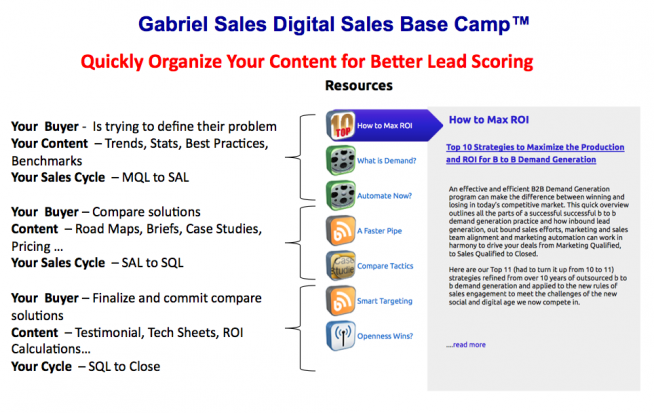
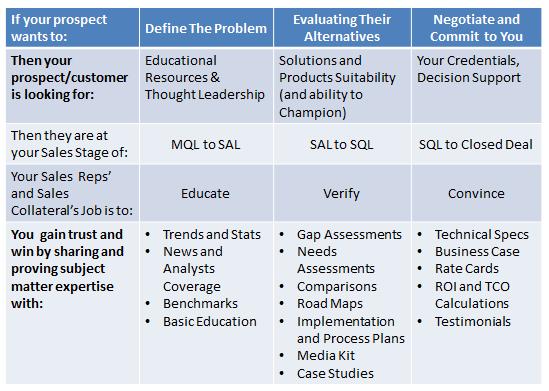
Organize your Content Ahead of Time.  For a marketing automation platform to run effectively it helps to do two things with your content.  First you should isolate all your webcasts,  white papers, blogs, videos on individual website pages.  This allows you to easily understand what your customer specifics needs are which in turn allows you to score your leads more effectively as you track their digital interest.  Secondly, it really helps to also create landing pages that offers your customer content for all three stages of their buying cycle so you can track when your buyers are moving from educating themselves (kicking the tires) to being ready to buy (e.g looking at pricing or testimonials).  Gabriel Sales has created an easy to use sales content management technology – Gabriel Sales Digital Base Camp™ that can help you do this in a matter of weeks. Below is an example of one of those lead scoring features.

Involve Sales and Invest the Time Integrating with your CRM – What we have found is that even a basic integration can take an IT professional too much time.  Most of the marketing automation platforms we have seen have huge volume of really cool features and bells and whistles so you can tend to over design before you know how you want to use them. Ultimately this is about empowering your sales team and recognizing your IT teams expertise is not sales.  Probably one of the biggest bottle necks we have seen is that IT folks get proprietary and a project that they thought would take weeks can take a developer three months or more . The challenges are not with the system’s API or stability; they were with our client’s requirements, process definitions and prioritization. Like most development work that starts “easy” it quickly gets complex when they don’t understand the underlying business processes. Unfortunately as the time line  expands it ends up being sales and marketing that are on the hook for results and not the developers. Salesforce.com has been the easiest integration for all the platforms we have seen.


Keep your Initial Drip Campaigns Simple.  This is probably one of the biggest lessons we learned.  When we first started we came up with a very complex IF/ then workflow so if they opened this piece of content on a topic area we would send them another piece of content on topic area B and then if they didn’t open that we would send them content Z.  It was too much and just writing about it confuses me. What we found is about 80% of the value you are going to get from your initial drip campaigns is going to come from simply implementing them.  It takes time to learn a new software and the biggest value the software provided initially is simply keeping your brand and solution in front of your buyers over time so your reps don’t have to.  A simple five to seven touch campaign without any IF/then work flows was enough to get more deals flowing at less cost.  Don’t frustrate yourself.  You will quickly learn from your wins. If you are a smaller company, as a best practice, we recommend that you start by talking to your sales reps about their sales process and simply take that sales process map and create your initial drip campaigns for about three target markets.


Tap your vendors (and other vendors) knowledge centers –  This industry is not that old.  Eloqua, Pardot and Marketo (to name a few) all have fantastic knowledge centers that can teach you the basics of lead scoring and nurturing etc. Our vendor Pardot has been a huge help but we have also found both Marketo and Eloqua’s knowledge centers to be valuable as well.  Obviously as an outsourced sales and marketing company we also recommend that you strongly consider working with an organization like ours.  We have the advantage of having worked in the space across multiple enterprises so we have made a great deal of the mistakes already so you don’t need to.

We hope this blog has been helpful.  Marketing Automation is a relatively new concept for most marketing teams and we have found that once you start to gain some momentum you will quickly realize that it’s clearly how business will be done for the next decade. We are just at the beginning of a new paradigm starting with marketing automation and then,  as we are quickly discovering, if your marketing automation implementation is done correctly this will  drift towards sales automation.  Ultimately this will begin to drive more deals fast at less cost.  We are experiencing some fantastic initial success reducing cost of sales percentages for both ourselves and our clients. The learning curve is exponential. So have fun.

If you have not checked out what these platforms can do here is a quick overview from Pardot  5 Minute Overview of Marketing Automation. If you have a stalled with your marketing automation implementation or if you would like to know more about best practices in marketing and sales automation, feel free to contact us for a quick consultative call.