A Twist on Selecting a Marketing Automation Platform

hand pushing on a touch screen interfaceAt Gabriel Sales, we have a slight twist on selecting certain types of software and platforms. We look closely at how the tool can be easily and most effectively used by a sales team and not just the marketing team. When selecting a marketing automation platform to be used by a sales and marketing team, here is some of the criteria we recommend you consider from the sales users’ perspectives:

Is it simple for a sales rep to login and know exactly where to go?

This is a bit of a no-brainer for software design in itself, but our experience with marketing automation software demonstrates that a lot of features may be clear and easy to use for the marketing team while the sales team is vastly overlooked.  Look for software that is easy to use from your sales users by having them attend demos and ask questions pertinent to how they do their jobs.

How easy and versatile is the automated alert system?

It’s imperative that sales reps are notified real-time for certain prospect events and daily/weekly/monthly for others. Having a diverse set of alert options (email, SMS, desktop and mobile apps) will help your team have the fastest response time to your prospects.  Data has shown that responding within an hour of inquiry increases conversation rates by 7x (Source). As an example, having a drip campaign sending automated scheduled emails that will then alert sales users when a prospect has interacted with an asset in the campaign where that interaction shows a buying signal.

How clear are the methods and accessible are the variables that can be segmented upon?

A sales rep wants to use their time efficiently and being able to group prospects into well-defined segments makes their job much easier.  Want to call on everyone who has a score of 100+ that visited the site this week AND went to the pricing page? Should be a straightforward process to get that list.

How does lead scoring work?

Scoring needs to be flexible and comprehensive.  A sales rep wants to be able to see the aggregate score and the specific activities and their respective score. They may not always understand the logic behind specific scoring, but if they are able to see that a video playback was scored at 50, they know that the video itself is a high value activity and a signal to the prospects interest level.

Is prospect activity tracking thorough and easy to understand?

Sales reps want to be able to understand what the prospect is interested in to best modify one-to-one interactions. Having marketing automation software that has a large collection of different activities it can track is imperative for best understanding specific interests in both content and content types. Does Prospect A watch a lot of videos? Send more videos in the follow-up. Is Prospect B interested in the features, create some quick clips on highlights of those features.

What processes can be automated to keep the sales staff productive and not breaking momentum?

Sales reps want to stick with their highest importance activities and not get caught up in dealing with too many steps to record and follow-up with new prospects. Having a systemized process that makes it dead simple to manage alleviates huge headaches and bottlenecks for sales reps doing their best work. An excellent example of this is building a form that the sales rep can complete (that does not set a cookie) that then triggers a series of activities including 1) sending an email, 2) adding to a nurturing campaign and 3) notifying sales executives of next steps.

This is not an exhaustive list of features to consider when selecting a marketing automation platform, but it is a list of the major features we’ve identified as a collaborative sales and marketing team that will optimally support your sales team.

B2B Sales and Marketing Trends in 2014: Co-Creation

B2B Sales and Marketing Trends in 2014In one of our blogs last week, we made the argument that regardless of whatever 2014 turns out to be the year of, content is going to be the fuel that will take us where we want to go. Whether we want to improve our social media presence or invest more in lead nurturing, content is the driving force that will lead us to either success or failure.

In addition to improving content development skills and learning to act like a publisher, B2B companies also need to be aware to two broad trends that I believe will be important in sales and marketing in 2014:

B2B Sales and Marketing Trends in 2014: Co-creation

The first trend is co-creation. ‘Co-creation’ is a relatively big philosophical idea that has recently been applied to many business contexts and situations.

In the B2B world, the concept of ‘co-creation’ can be applied in a few ways; the first is in regards to sales and marketing integration. If your sales and marketing teams are still working separately, it is not likely that you are doing everything you can to create a smooth and easy buying process for your prospects. The situation at many B2B companies is this: marketing creates content that they think is cool, and sales thinks it is worthless, so it doesn’t get used.

By having sales and marketing instead listen to implicit and explicit feedback from your audience, they can work together to co-create content that will be more effective on both sides of the table. For example, have your marketers listen to the objections that your sales reps hear on the phone everyday. Then, have your marketers create content with your sales team that is focused on answering those objections in digital format. With everyone listening to feedback and working together toward a shared goal, efficiency and effectiveness of all of your tactics increase dramatically.

Another way the concept of co-creation can be applied to B2B is in the creation of social proof. 

B2B Sales and Marketing Trends in 2014: Social Proof

In B2B sales and marketing, social proof is essentially digital evidence of your customers’ satisfaction with your company, product or service. This could be in the form of a customer testimonial, a Facebook ‘share’, a LinkedIn ‘recommendation’, etc. Each time your prospects/customers share one of your blog posts on Facebook or gives you a written testimonial to be featured on your website, they are co-creating your marketing content with you.

The power of this type of co-created content should not be underestimated. In a recent survey of B2B marketing professionals on the value of different types of content in convincing prospects of a company’s value proposition, it was found that content sourced from existing customers was not only more effective than internally sourced content, but also more effective than content from 3rd-party analysts. This shows that as we go into 2014, co-creating content with your customers (case studies, testimonials, video testimonials) is going to be an increasingly high-value activity.

To continue reading the second half of this blog on B2B Sales and Marketing Trends in 2014, click here.

Content is the Fuel of the Future (and the Future is Now)

b2b content developmentIt’s time to get something straight.

2013 is about to wrap-up and 2014 is around the corner.

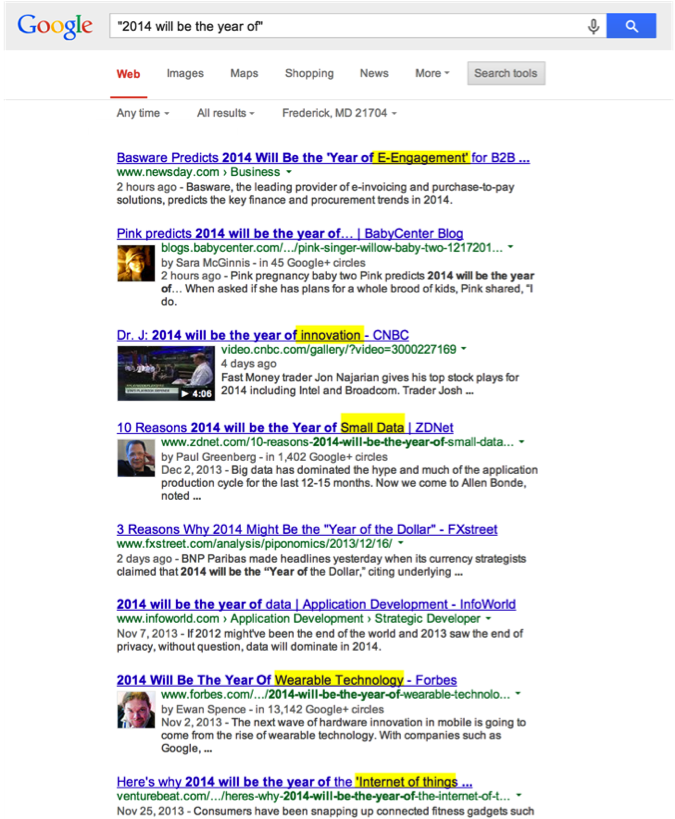
There are hundreds (if not thousands) of articles out there that profess that “2014 will be the year of …{insert technology/strategy}”.

google2014search

On the first page of Google, terms include: e-engagement, innovation, small data, wearable technology, internet of things and other non-business predictions.

Even the editors at CMO.com put out a market research piece asking top marketing leaders what they believe 2014 will be the year of…and you’ll get answers across the spectrum of marketing topics: mobile, video, social, privacy, curation, relationships, branding, etc.

That’s great – 2014 will be the year of everything. 

However, Gabriel Sales is of the belief that there is an underlying element that fuels all of these predictions for 2014 (and what fueled the predictions over the past decade and what will continue to be the fuel many years into the future).

Before I give away the answer, think about this…

How do you e-engage?

What do you feed a system of innovation?

What is small data?

What will people access using wearable technology?

What does the internet of things output?

Content.

Plain and simple, content is the main fuel of all of these ‘2014’ predictions and so many more.

Content is the necessary gas for marketing automation, a previously crafted analogy by Travis Arnold of Kapost, found here.

Content supports all of your marketing efforts – SEO, PPC, email marketing, nurturing, banner ads, remarketing, social and more. Without content, you are not providing any substance or value to your audience. You’re just trying to sell by being a ‘pretty face’ or the ‘smartest person in the room’. That doesn’t work anymore.

The year of 2014 isn’t just about content or content marketing, but about providing such valuable content to your audience that they can’t help wanting to buy from you because you’ve given so much value already for free.

Think of developing your content this way.

You are educating your prospects so much they feel that they have become an expert in your space. In turn, they’ll realize that if your company is providing this kind of value prior to the sale, imagine how much value your company provides to their customers.

This kind of thinking is what many call ‘viral marketing’. The content you deliver publically is so good, people want to share it to help spread that good to others.  And, the service/product you deliver to your customers is so much improved that you’ll create company evangelists on both sides of the dollar sign.

For more on creating valuable and relevant content for your 2014 B2B sales/marketing efforts, read our recent blog series titled, “5 Reasons Your Content Isn’t Converting.”

This is what we do at Gabriel Sales – create and share content that supports all of your marketing and sales efforts – attracting leads, educating prospects and helping you close deals.

Feel free to contact us with any questions.

How an Outsourced Sales Team Can Help Your Marketing Team

outsourced sales teamThere comes a time for every B2B business owner, where they must decide how to approach their sales and marketing. There are many different routes you can take: hiring part-time or full-time staff, purchasing consulting services, hiring an outsourced sales team, or some combination of these.

The best option for your company is going to depend on your resources, your specific situation and your goals. If your goal is to dramatically increase revenue through your sales efforts, an outsourced sales team might be your best option. By leveraging a B2B outsourced sales team, you gain access to sales talent that you generally could not afford to hire internally. Additionally, the experience and expertise that comes with an outsourced sales team will help support and optimize your marketing efforts for greater effectiveness and efficiency.

Here are 5 ways an outsourced sales team can help your marketing team:

1. Content development

There have been a few articles recently that talk about the need for B2B companies to act like publishers in terms of their marketing content. For many companies, coming up with fresh content on a regular basis (that provides real value for prospects) is an extremely time consuming task.

At Gabriel Sales, one of the ways our sales outsourcing services support marketing teams is by providing detailed feedback from prospects on the value or effectiveness of different pieces of marketing content. Based on our analysis of phone calls with prospects and marketing analytics data, we provide recommendations for content that your prospects will find engaging and valuable (we can also produce the content for you if you have the need).

2. Augment your under staffed sales team

In recent years, budget limitations and other factors have left many B2B sales teams understaffed. In addition, cold calling just isn’t as effective as it used to be—making it much more expensive to succeed with this tactic. By going with an outsourcing option, you can gain access to an entire sales team for approximately the cost of one internal rep.

Despite how incredible an individual may be in terms of talent and skill, that person can never match the combined training, experience and established relationships that an outsourced sales team can provide. So, instead of spending money internally to hire someone new, it may be more cost-effective to outsource a whole team.

3. Leverage your investment in CRM and MA software

For many B2B companies, technologies like marketing automation and customer relationship management (CRM) software may still be relatively new and confusing. For an outsourced sales team like we have at Gabriel Sales, navigating these technologies is now second-nature. By leveraging an outsourced team, you can therefore bypass months or even years trying to figure it out on your own.

Additionally, one of the top two reasons for dissatisfaction with marketing automation is poor integration with sales. By leveraging an outsourced sales team with over 10,000 hours of marketing automation experience, you gain access to best practices and tips for better sales and marketing alignment. In other words, you let the experts show you how to succeed and what to avoid without having to go through all the headaches of learning on your own.

4. Provide qualitative and quantitative feedback on all tactics.

Every outsourced sales team needs to provide evidence of the value of their work. At Gabriel Sales, we provide our clients twelve different types of reporting on our efforts—from data on conversion ratios to verbatim transcripts of cold calls. We also have weekly meetings with each of our clients to discuss our successes and areas for improvement.

This much transparency and visibility allows your marketing team to easily understand how best to support sales with content and determine what campaigns would be most effective. With the detailed reporting of an outsourced sales team, determining how and where to optimize is greatly simplified.

5. Convert quality inbound leads to qualified prospects

Even when inbound leads come in with a high level of perceived interest, they still need to be qualified. By using an outsourced sales team, you can follow up on inbound leads and nurture them until they are sales qualified for a much lower price than handling it internally.

With a dedicated and experienced outsourced sales team at your service, your marketing team gains the data, technological skills and overall expertise they need to do their jobs as efficiently and effectively as possible.

You can learn more about the value of a B2B outsourced sales team here. To learn about the outsourced sales solutions we offer, visit our services page. Feel free to contact us with any questions.

Marketing Automation Software Wishlist 2014

marketing automation software wishlistHaving integrated and managed multiple marketing automation software solutions, the following features were not part of any of them.

1) Generate a prospect list report with last email correspondence topic and date. 

Why?

I want to know when people were last contacted to make sure everyone is getting nurtured appropriately, and no one has fallen out of drip program cycles unnecessarily.

Feature Note: The ability to select prospects by last correspondence date and select a next action, e.g. send an email, would be extremely useful.

2) Profile and score prospects via social channels that are not opted into my database, yet. 

Why?

If I can connect with someone directly outside of my marketing automation database, I should be able to get a gauge whether he/she is a potential customer for my business without needing him/her to be cookied on my particular site.

Feature Note: A database within the marketing automation software of all social connections/fans of multiple social pages and company representatives would be a revolutionary addition.

3) A recommended call-to-action engine based on matching the following: 1) a registered database of my content (that my marketing automation software understands the contents of) 2) content consumption patterns by my prospects. 

Why?

When viewing a prospect, I’d like my marketing automation software to prompt me for some recommended actions/next-steps to take for that particular prospect, e.g. finding an interest pattern and prompting me to send a piece of related content they he/she has not yet consumed.

Feature Note: Having a one-click “Execute this Action” button would be supreme for this feature.

4) ‘Emails sent’ check and suppress/delay automation.  

Why?

The ability to suppress or delay emails would be helpful in not overbearing prospects with too many emails.

Feature Note: The ability to override the delay/suppress should be available in case a critical announcement needs to be sent.

For more on marketing automation, you can find more educational blog articles here. Please feel free to contact us with any questions.

\n